
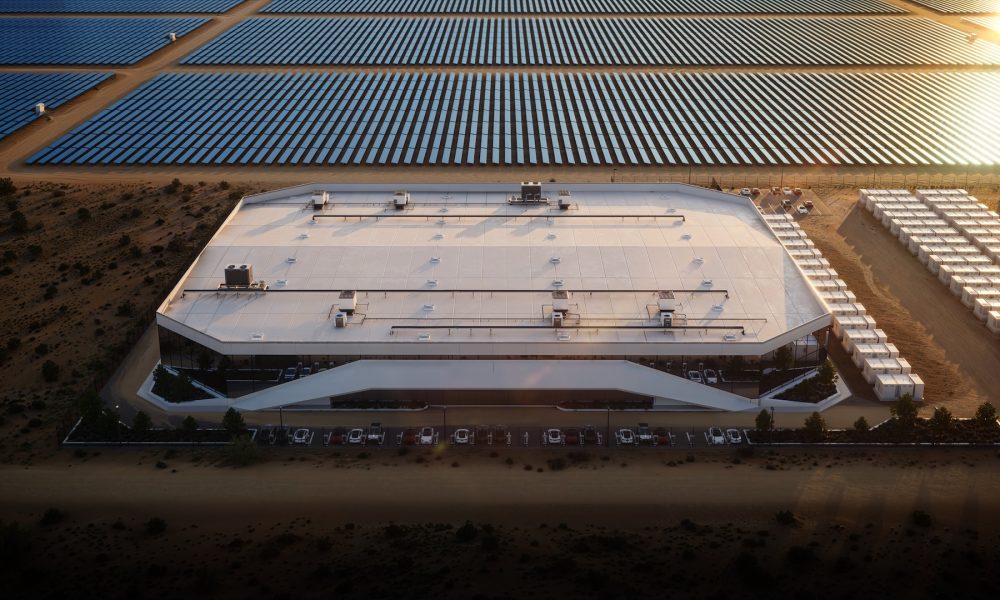


Tesla rates its newest product at 7.4 MW of continuous output at 34.5 kV AC. It has no wheels, no seats, and no Autopilot. It goes to work in 2027.
The product is Powercore, a solid-state medium voltage transformer that also does the jobs of an inverter and a circuit breaker. Tesla’s Megapack account announced it on X on Tuesday with three claims: “reliable, safe and secure,” “Made in America,” and “Operating 2027.”
Elon Musk added one line of his own: “Advanced solid state transformers at scale from Tesla.”
The numbers, shared by Sawyer Merritt, are specific. Peak efficiency is 98.86 percent, and the DC range runs from 800 to 2,000 volts.
The built-in solid-state breaker clears faults in about 100 microseconds. Grid-forming support covers 10 MVA of peak power.
Tesla has not announced pricing, a factory location, or a first customer.
This is the piece Tesla promised and then went quiet on. In September 2025, Tesla introduced Megapack 3 and Megablock and said it would build its own transformers, then offered almost nothing else.
Megablock bundles four Megapack 3 units with a transformer and switchgear into one medium voltage block. Powercore looks like the transformer that was missing from that box.
The engineering pitch targets a part of the grid that has barely changed in a century. A typical battery or solar site today runs low voltage inverters to turn DC into AC, then sends that power through a large oil-filled transformer to reach grid voltage. Powercore handles both steps with power electronics, which means less hardware, a smaller footprint, and no flammable oil.
Tesla energy executive Max de Zegher put it bluntly in a post Musk shared. “Transformers have barely changed since the 1890s: copper coils in a tank of oil,” he wrote, noting that batteries, solar, and compute all run on DC. Powercore, he said, delivers “one conversion and about half the losses.”
The timing argument is just as direct. Lead times for conventional transformers have stretched into years as AI data centers and renewable projects pile into utility interconnection queues. A company that can ship its own transformer with its own batteries skips a line everyone else is stuck in.
That is the real story here. Selling batteries is a hardware business, but selling batteries that plug into the grid without waiting two years for a transformer is a scheduling advantage, and developers pay for schedule.
Tesla’s energy business is already running hot. It deployed 13.7 GWh of storage in the third quarter, its second best quarter on record, and says Megapack supply for 2027 is nearly sold out.
The car side of the house tells a different story this month.
Tesla has signaled it will wind down Cybertruck output at Gigafactory Texas around the middle of next year. Unplugged Performance, a Hawthorne tuner that has modified Teslas since 2013, is now publicly pitching to take over the line at no cost or risk to Tesla. It also wants to add a three-row CyberSUV on top of it.
The offer is generous on paper. Tesla would keep the intellectual property, a quality veto, a license fee on every vehicle, and a free equity stake. But Tesla has been clear that its manufacturing space and cell capacity are reserved for Cybercab.
So the pickup Tesla once sold as its boldest product is being shopped around by an aftermarket shop. Meanwhile, a gray box of power electronics gets a launch post from Musk himself.
Powercore still has to prove itself in the field, and Tesla has given no date beyond the year. Customers, pricing, and a production site remain blank.
The 2027 Megapack order book, by Tesla’s account, is already close to full.

Share this Story