
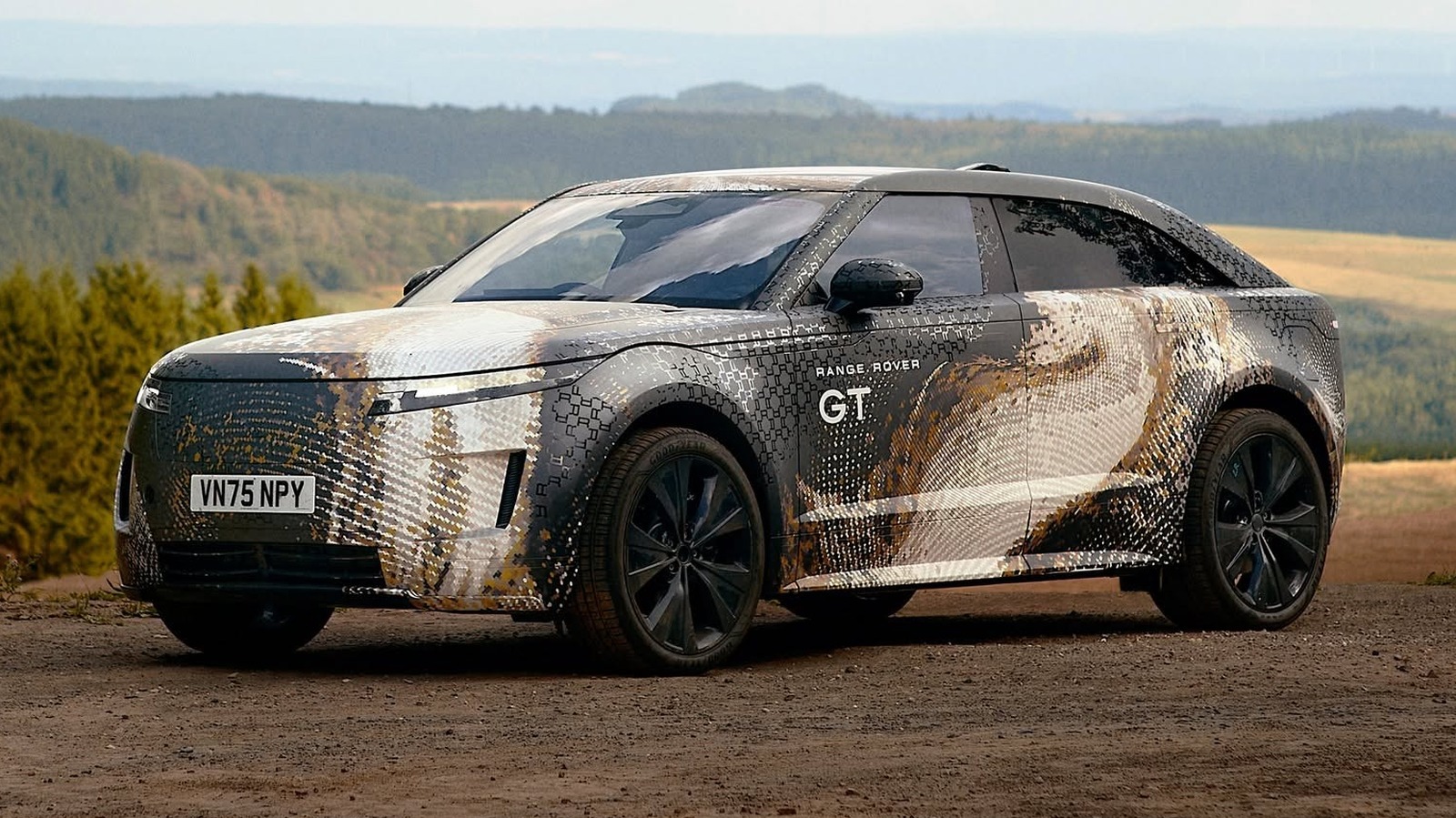


Jaguar Land Rover keeps calling its upcoming Range Rover GT a “car.” Not an SUV. Not a crossover. A car. A grand tourer, specifically. The British automaker is clearly trying to rewrite expectations for what a Range Rover can be, even as the vehicle itself looks an awful lot like a squashed Velar wearing athletic shoes.
In a newly released development video, Range Rover showed camouflaged prototypes being driven from the UK through Belgium and onto the Nürburgring. That’s the kind of shakedown run you’d associate with a BMW 8 Series or a Bentley Continental, not something wearing a green oval badge. Engineers emphasized long-distance refinement, wind noise reduction, and the lowest center of gravity in Range Rover history.
Those are sedan talking points, not SUV ones.
But the body tells a different story. Beneath the camo wrap, the GT carries flared wheel arches, familiar Range Rover headlight signatures, and a roofline that tapers like a fastback. It sits in the same visual territory as the Kia EV6, Hyundai Ioniq 5, and Polestar 4, vehicles that exist in the ambiguous gap between traditional sedans and crossovers.
Electric platforms enable this kind of design flexibility. Flat battery packs mean low floors and no transmission tunnels, letting designers play with proportions that would have been impossible five years ago.
Range Rover even insists the GT will be “immensely capable off-road” and “class-leading amongst its peers” on unpaved surfaces. A brief clip shows it scattering gravel. The claim is hard to evaluate without specs, and the relatively low ride height will inevitably limit what it can do compared to a Range Rover Sport or a full-size Range Rover.
Calling it class-leading depends entirely on how you define the class.
Underneath, the GT rides on JLR’s new Electric Modular Architecture, the same platform underpinning the Jaguar Type 01. It will likely share that car’s 850-volt electrical architecture and possibly its 118 kWh NMC battery pack, which would support DC fast charging at up to 350 kW. A dual-motor all-wheel-drive powertrain is the expected configuration, skipping the Jaguar’s pricier tri-motor layout.
The interior borrows heavily from the Type 01 as well, with a dramatic two-spoke steering wheel, floating center console, and a large central screen. This is a clear departure from the traditional Range Rover cabin, which has historically traded on leather-lined British luxury and physical controls. Whether loyal Range Rover buyers, people who appreciate walnut veneer and a mechanical gear selector, will embrace a minimalist, screen-forward cockpit remains an open question.
The EV version arrives first. A hybrid follows later, though JLR has not confirmed whether it will use a powertrain borrowed from elsewhere in the lineup or something bespoke. That second variant may end up being the volume seller, given how many Range Rover customers still prefer the security blanket of a combustion engine.
What JLR is really attempting here is a category expansion. The Range Rover name has always meant something specific: upright, commanding, planted on a throne above the road. The GT inverts that premise.
It wants to be fast, low, aerodynamic, and still carry the badge that says you’ve arrived. Whether the market agrees that a Range Rover can be a grand tourer, or whether this is simply a luxury crossover dressed up with aspirational language, will depend on the final product. First deliveries are expected in 2026, and pricing has not been announced.


Share this Story