
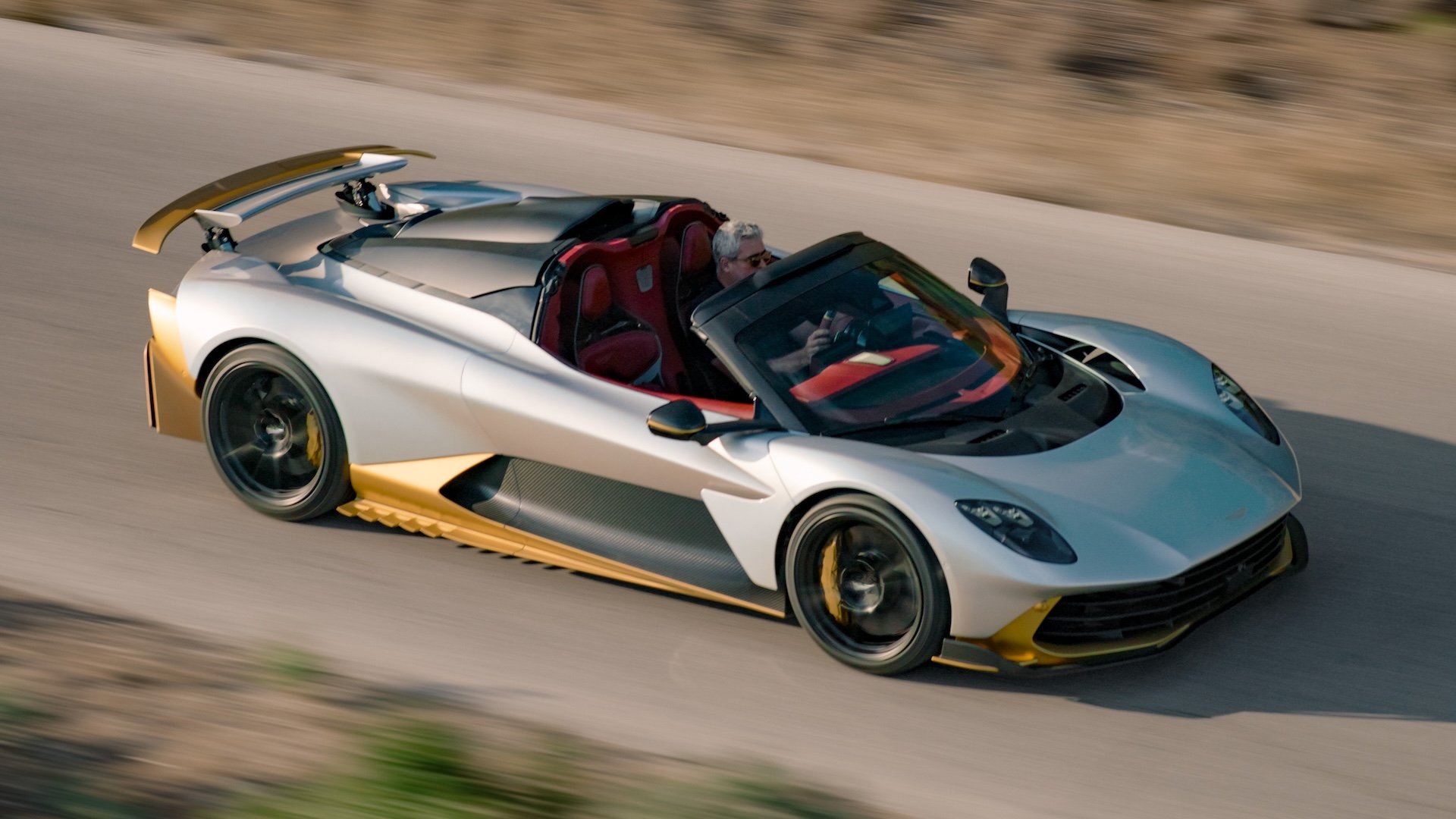


The new Aston Martin Valhalla Spider is faster with nothing above your head than with its roof in place. That is not a typo.
Aston Martin revealed the open-top version of its 1,064-hp hybrid supercar ahead of this weekend’s Concours at Wynn Las Vegas, and buried in the spec sheet is a number that deserves a double take. Top speed with the removable soft top on: 124 mph. Top speed with the soft top off: 217 mph. That is a 93-mph gap determined entirely by whether a piece of cloth is attached to the car.
A sensor built into the Spider detects whether the roof is secured, and the car’s electronics enforce the 124-mph cap when it is. Remove the top, and the full fury of a flat-plane 4.0-liter twin-turbo V8 and three electric motors is unleashed. Aston says revised aerodynamics make the roofless configuration not just viable at triple-digit speeds but genuinely faster than the coupe, which itself tops out at 217 mph.
The powertrain is shared with the hardtop Valhalla. That means a plug-in-hybrid setup pairing the twin-turbo V8 with a 6.1-kWh battery pack, producing a combined 1,064 horsepower and 811 lb-ft of torque. Zero to 60 takes 2.5 seconds. Pure-electric range is a token 8.7 miles, enough for the kind of errand that involves pulling out of a private garage and into a valet line.
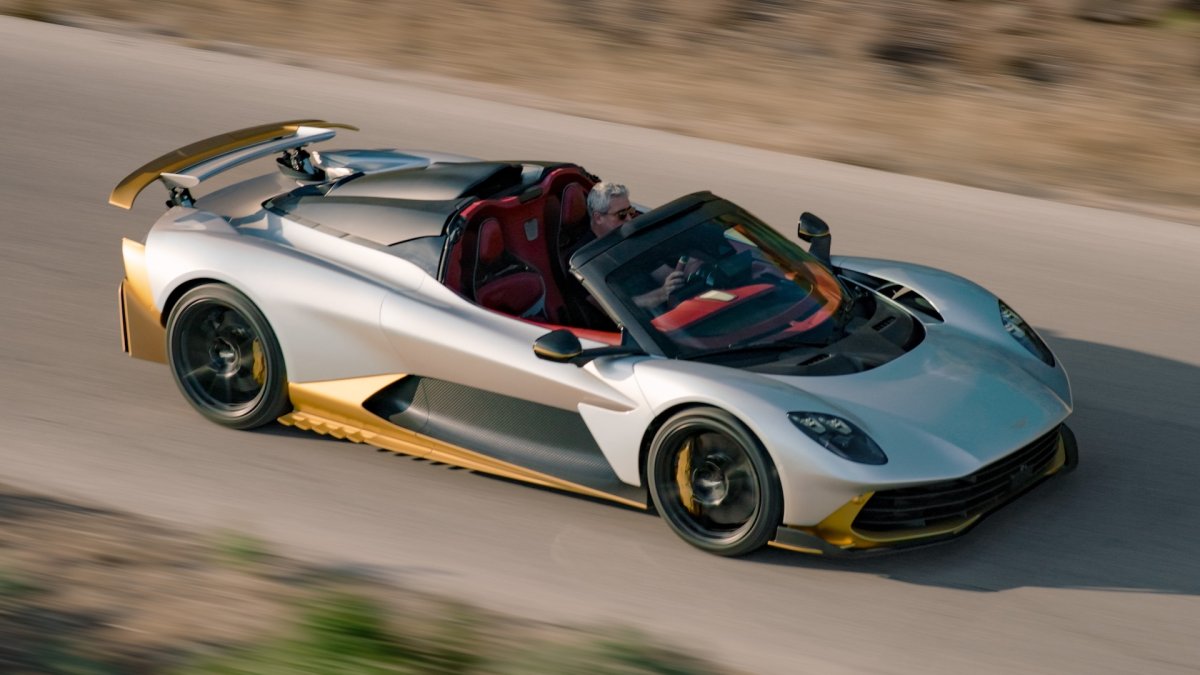
Aston Martin pitched the Spider as a grand touring machine, not just a track weapon. The car gets touring seats as standard rather than the aggressive carbon-fiber buckets found in the coupe, though those are available at no extra cost. A three-part wind deflector stows in the sill cubbies when not in use, designed to keep the cockpit livable at speed.
The soft top itself rolls up and fits inside the car, so owners are not forced to gamble on the weather forecast before leaving home. A carbon-fiber hardtop is also offered but cannot be stowed in the vehicle. Whether it raises the speed limiter beyond 124 mph remains unclear, and Aston has not commented on that detail.
Ten levels of adjustable traction control and torque vectoring carry over from the coupe, giving drivers the ability to dial in exactly how much of the car’s output they want to manage themselves. That kind of configurability matters in a car with this much power and this little roof.
Pricing for the Spider has not been announced. The coupe starts at $1,051,700, and open-air variants in this segment typically carry a premium. At that level, the sticker is almost beside the point. The allocation list is what counts, and Aston Martin is clearly positioning the Valhalla Spider as the rarer, more desirable sibling.
What lingers is that speed restriction. Supercar buyers do not typically accept electronic leashes, and telling an owner their million-dollar convertible is capped at 124 mph with the top up feels like a conversation Aston Martin will have to keep having. The engineering logic may be sound. The aerodynamics may demand it.
But try explaining to someone who just wrote a seven-figure check that they need to pull over, remove the roof, and stow it before the car will let them use all 1,064 horses. Aston says the Spider drives just as well as the coupe. The spec sheet says it drives better, as long as you are willing to feel the wind.

Share this Story