
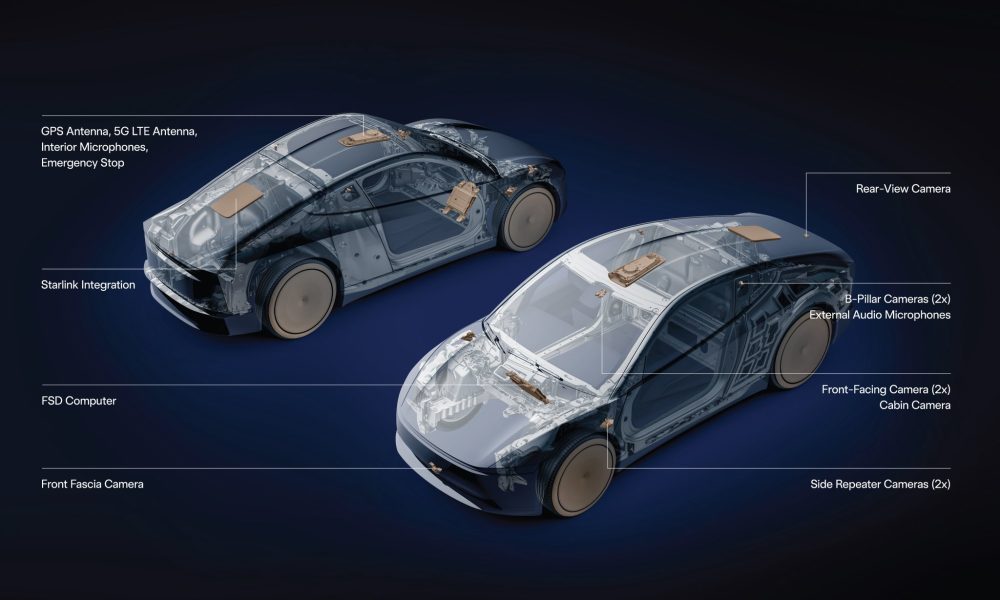


The Cybercab’s battery pack has empty space inside it, and Tesla put it there on purpose.
Robert Sumpf, Tesla’s director of mechanical design engineering for battery modules and packs, revealed during a Munro Live factory tour that the gaps beside and beneath the Cybercab’s cell modules were deliberately reserved for a future switch to lithium iron phosphate chemistry. “We protected this pack to go to an even lower energy dense chemistry as we scale and need to bring LFP into the platform,” Sumpf said.
Today the Cybercab runs Tesla’s own 4680 nickel cells in an 88S6P configuration. LFP cells pack less energy per unit of volume, so a direct swap would shrink range. The extra cavity lets Tesla stuff in more LFP cells to compensate.
What it gets back: cells that cost less, run cooler, and survive far more charge cycles. LFP overtook nickel as the most-used EV battery chemistry worldwide last year.
Not all the empty space was strategic. Lars Moravy, Tesla’s VP of vehicle engineering, admitted part of it exists simply because “we didn’t need as many batteries as we thought we did.” Tesla told Sandy Munro in early 2025 it was targeting a pack under 50 kWh with close to 300 miles of range.
The pack itself is a quiet rebellion against Tesla’s own recent history. Instead of potting hundreds of cells into one massive structural block, as in some Model Y and Cybertruck builds, the Cybercab uses four individually sealed modules in a steel enclosure. A bad module gets swapped. The rest stays.
Sumpf was not diplomatic about the old approach, handing the Model Y structural battery “a grade D” because it was brutal to build and nearly impossible to fix. He estimated a fully structural design gains about 10 percent more cell volume but said “the issue is the service cost.”
That calculus changes when your car never really parks. Chief engineer Eric Earley said replacing an entire pack before half a million miles “is a killer on cost,” so remanufacturing and serviceability were baked into the design from day one. Wireless battery management boards replace the wiring harness. New contactors are fast enough to eliminate the pyro fuse entirely. Sumpf graded the finished Cybercab pack an A minus.
The broader production picture makes the battery story more urgent. Moravy told Munro Live that the Giga Texas line now builds robotaxis faster than Tesla can deploy them. “We don’t run every day because the line can run so fast,” he said.
Texas DMV records from last week list 544 Cybercabs authorized for the fleet, outnumbering the 507 Model Ys on the same roster for the first time.
Tesla deleted the paint shop entirely for this vehicle. Exterior panels get their color inside the mold. Only side modules receive an anti-corrosion e-coat.
The unboxed assembly process splits the car into front, rear, side, and center modules built in parallel, then married on a final line of just 25 automated stations. Floor space per vehicle dropped roughly 50 percent compared to a Model Y line.
Every Cybercab built since volume production began in April has gone into Tesla’s own fleet. Service launches in Austin and, next month, Dallas. Tesla says it wants to deliver Cybercabs to outside customers by the end of 2026, though Elon Musk has indicated the vast majority will remain Tesla-owned, running as a transport service.
Sumpf gave no date for an LFP version, named no cell supplier, and offered no range estimates for the switch. The space is there, waiting. The production line is already outrunning the deployment team.
If Tesla can drop cell costs further with LFP while the factory keeps accelerating, the economics of a robotaxi fleet start looking very different from anything the taxi industry has ever had to compete against.
Munro Live asked when it could get a Cybercab to tear down. Tesla’s answer: “Not yet.”

Share this Story