
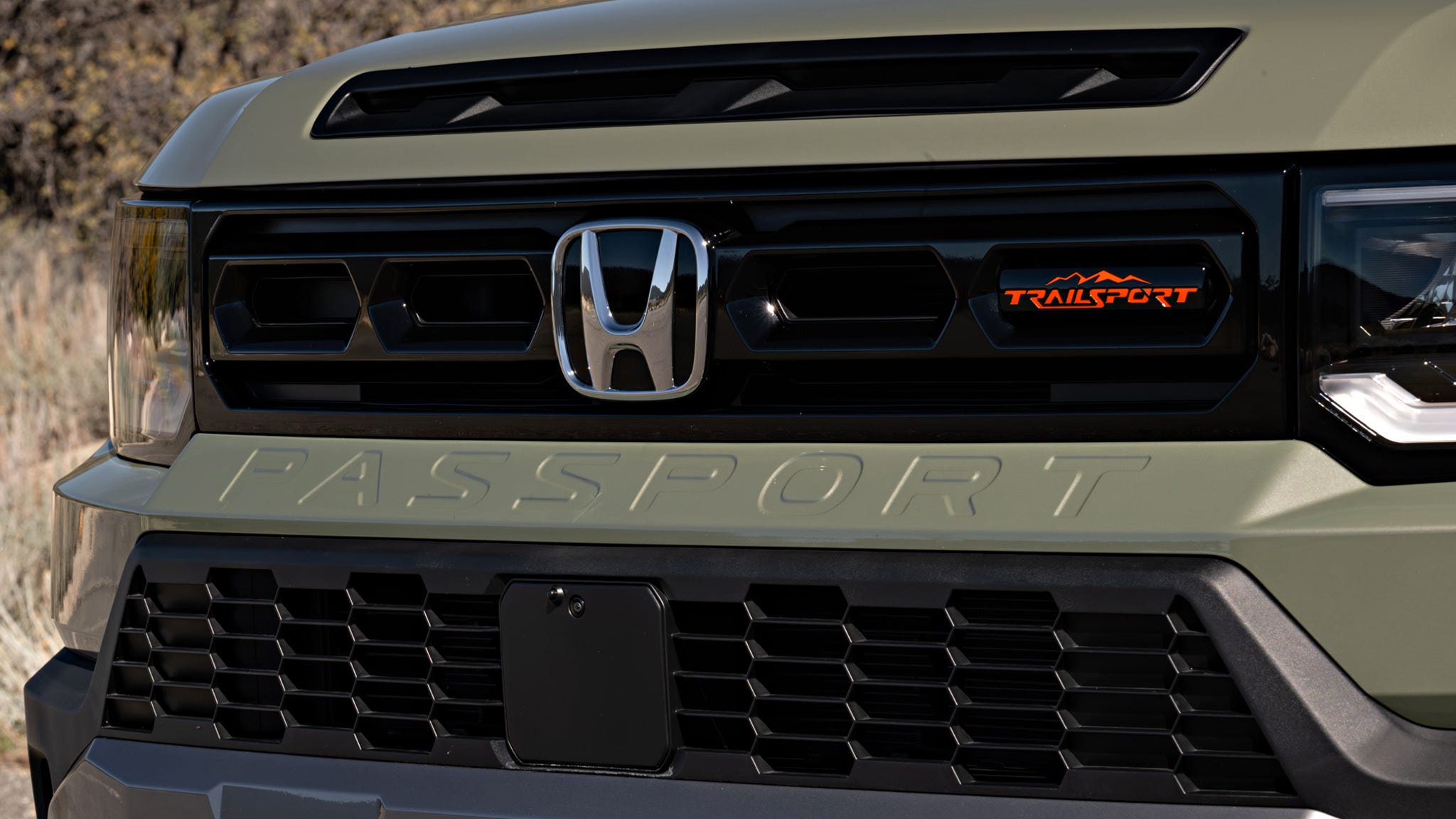


The CR-V Hybrid TrailSport has been a fraud. Knobby-looking tires and earthy paint don’t make a vehicle off-road capable, and Honda knows it. The company’s TrailSport team is now admitting what enthusiasts have said for years: early TrailSport models were dress-up jobs.
The 2027 Passport TrailSport is the first real proof that Honda is done pretending. Revised suspension and chassis components bump ground clearance by 1.38 inches, bringing the total to 9.85 inches. More critically, the TrailSport trim now separates itself from the base RTL, which previously shared its clearance and approach, departure, and breakover angles.
That’s a meaningful mechanical revision just one year after launch.
Honda says customer feedback forced the quick update. Buyers who actually took their Passport TrailSports into the dirt found the gap between image and ability too wide. On rocky, rutted trails in North Carolina’s Uwharrie Mountains, the revised 2027 model reportedly held its own. For a unibody crossover on independent suspension, that’s a legitimate accomplishment.
The people behind this shift matter as much as the hardware. Honda’s TrailSport team is a small group of engineers and product planners who own and wrench on classic off-road rigs in their personal lives. Several hold certifications from the International Four Wheel Drive Training Association.
Their internal battle is the real story. These engineers are fighting Honda’s corporate structure to prioritize trail hardware and software tuning over cosmetic packages. They’re also selling Japanese executives, who operate in a culture where off-roading is far less embedded, on the idea that real capability can move the needle in the American market. The 2027 Passport suggests they’re gaining ground in that corporate fight.
The next target is the CR-V. Honda’s next-generation CR-V TrailSport, expected for 2028, will reportedly abandon its current cosmetics-only approach entirely. That’s a direct repudiation of the current model, which does almost nothing beyond looking the part.
Honda’s platform strategy makes the expansion logical. The company has long shared components across segments, and its next-generation architectures will continue that practice. Suspension solutions developed for the Passport TrailSport can migrate to smaller and larger vehicles without starting from scratch.
The 2028 Ridgeline is the other obvious beneficiary. Already confirmed for production, Honda’s mid-size truck is expected to get a TrailSport variant. Extensive parts sharing with the Passport makes it a natural recipient of the upgraded off-road hardware.
This trajectory puts Honda in direct competition with Toyota’s TRD Pro lineup and Subaru’s Wilderness series. Both built credibility by pairing rugged aesthetics with actual mechanical upgrades from the start. Honda is arriving late to that party, but the Passport’s quick year-over-year improvement suggests the company is trying to compress the timeline.
The question now is how far Honda lets its TrailSport engineers push. A lifted, properly equipped CR-V with genuine trail chops would be a first for the nameplate. A Ridgeline that can hang with a Tacoma TRD Pro on loose terrain would rewrite that truck’s reputation entirely.
Honda’s off-road team has the expertise and the internal momentum. What they need next is a product cycle that doesn’t water down their work before it reaches the showroom floor.
Share this Story