
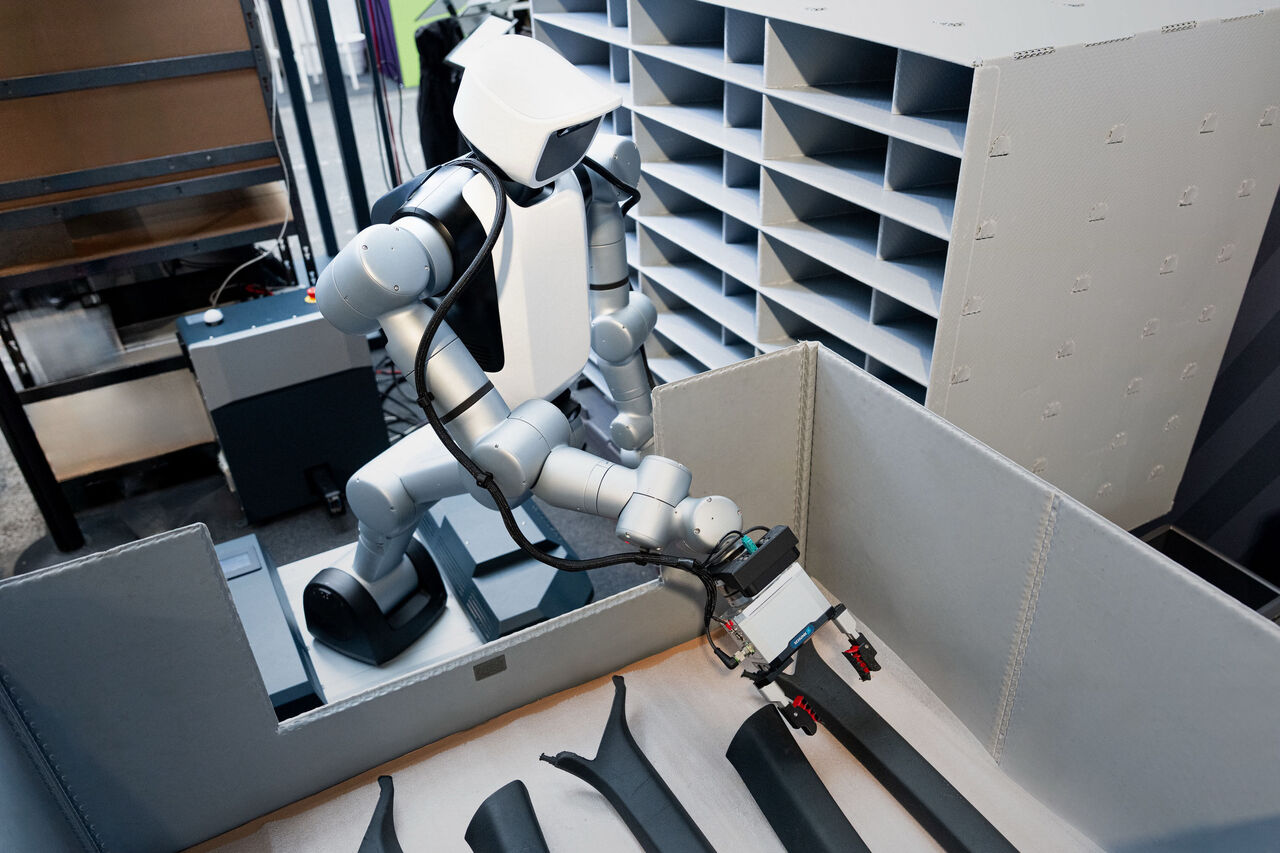


One million parts picks per day. That is the scale of the sequencing operation at Audi’s Ingolstadt plant, where the right component must reach the right workstation in the right order, every single time. Now the automaker wants machines shaped like people to do the picking.
Audi, Munich-based Agile Robots, Dassault Systèmes, and NVIDIA announced a proof-of-concept project at NVIDIA GTC Berlin to deploy mobile humanoid robots in Audi’s logistics chain. The robots are already working inside Audi’s Production Lab, pulling parts from containers and placing them in assembly sequence for premium vehicles.
The partnership reads like a who’s who of the physical AI hype cycle. Agile Robots supplies the hardware, dual-armed humanoids mounted on mobile bases that operate at human height and fit into existing factory layouts without ripping anything out. Dassault Systèmes builds the virtual twin of the logistics environment using its DELMIA software, letting engineers simulate feasibility, timing, ergonomics, and safety before a single robot rolls onto the actual floor.
NVIDIA’s Omniverse libraries underpin the simulation physics. Gerd Walker, Audi’s board member for production and logistics, called parts sequencing “one of the toughest automation challenges in automotive logistics.” He is not wrong.
The problem has resisted conventional robotics for decades because it involves semi-rigid parts, high variant counts, and components dumped unsorted into bins. Traditional pick-and-place arms choke on that kind of chaos.
Agile Robots claims its humanoids can handle it. Dual-arm manipulation lets them wrestle large or flexible parts, while AI-driven perception identifies and grasps components even when they are jumbled together in mixed containers or presented at odd angles. The company, founded in 2018 by researchers from the German Aerospace Center, says it has more than 20,000 robotic solutions deployed globally and over 650 patents filed.
Its subsidiary portfolio now includes Franka Robotics and idealworks, giving it reach across mobile platforms and collaborative arms. The virtual twin aspect deserves scrutiny. Dassault Systèmes says its AI-powered companion, LEO, will eventually compress commissioning timelines from months to days.
That is a bold claim. Factory simulation has a long history of promising speed and delivering complexity. But the logic is sound: validate the robot’s mission digitally before it physically enters a live production environment running at Audi volumes.
Audi frames this under its “thinking factory” vision, where AI and robotics work alongside employees rather than replacing them. The official line is that automating repetitive sequencing frees workers for “higher-value activities.” Every automaker uses that language.
The math underneath it is simpler: labor costs rise, demographic curves in Germany tighten, and a million daily picks is a lot of human hands. This is still a proof of concept, not a production deployment. The gap between a controlled lab demonstration and reliable operation across multiple shifts at full line speed is enormous.
Humanoid robotics companies have been long on demos and short on sustained industrial output. Agile Robots has more deployed units than most competitors, but sequencing at Audi’s scale is a different animal entirely.
NVIDIA’s Deepu Talla noted the project tackles variable, complex work “with minimal changes to existing operations.” That last phrase matters more than any technical specification. Automakers will not redesign factories around robots; the robots have to fit the factory.
Whether Audi’s humanoids graduate from the lab to the line remains an open question. The project is underway, the partners are committed, and the first real-world data is being collected inside Ingolstadt right now.
Share this Story