
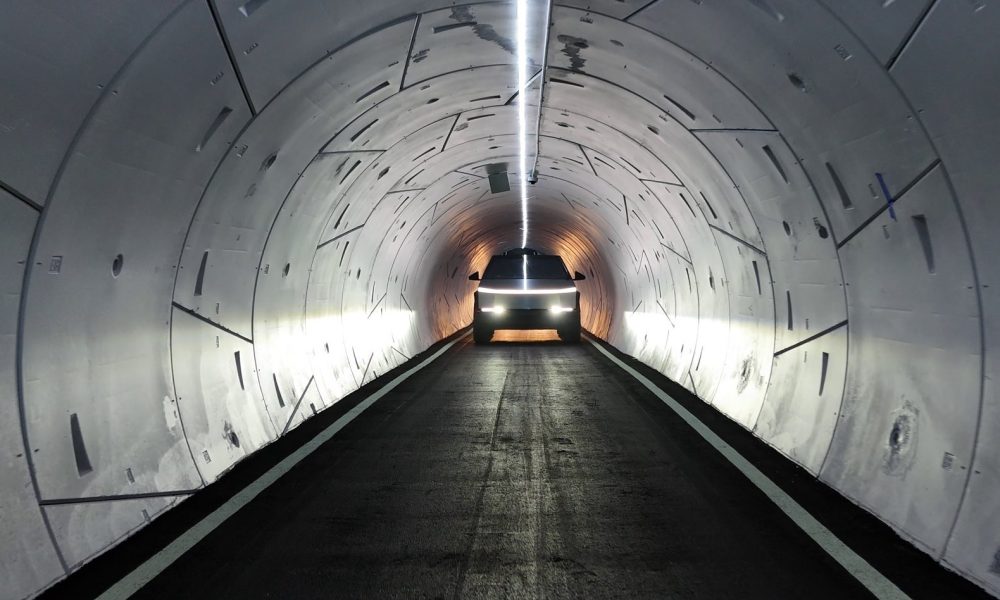


The Boring Company posted a single photo on X this weekend: a red 20-foot shipping container sitting on a low white chassis powered by Tesla Model 3 batteries and drive units. “Fits like a glove,” the caption read. No customer names, no launch date, no route, no timeline.
That restraint is familiar territory for a company that once promised a 29-minute Hyperloop ride from New York to Washington, D.C.
The modified Prufrock Liner Truck is the same platform that already hauls more than 22,000 pounds of precast concrete tunnel segments to the boring machine. It runs on 28 miles of range, maxes out at 12 mph, and is piloted remotely from an operations center in Texas. Swapping the segment bed for a container cradle is not exactly reinventing the wheel.
It is finding a second revenue stream from hardware that already exists underground.
Freight tunnels have been on the company’s menu since at least 2021, when TBC described a tunnel “sized to fit a standard shipping container, barely.” Prufrock 3 later dug a tunnel at Giga Texas that moves finished Cybertrucks off the production line. That remains the closest thing to a functioning freight operation the company has demonstrated publicly.
The timing is no accident. In September, The Boring Company closed a $3 billion Series D at a $23 billion valuation, with money earmarked for a UAE tunneling push and an accelerated Nashville build. In Nashville, two boring machines are mining at the same time, and a third is expected to launch by late October.
Each machine needs liner trucks. A design that works for both concrete segments and containers means more utilization from the same Tesla parts. It is a smart engineering decision dressed up as a product announcement.
But the gap between a photo op and a freight network remains vast. The Vegas Loop, still the only Boring Company system open to the public, moves passengers in Tesla vehicles. Freight is a different animal.
It requires loading infrastructure, scheduling, integration with existing logistics chains, and customers willing to bet on tunnels instead of trucks or rail.
Elon Musk himself offered a reminder this weekend of how wide that gap can stretch. Asked about the fate of the New York-to-D.C. Hyperloop he announced with fanfare in 2017, Musk said simply, “Permits were impossible to get.” The project would have required coordination among two states, the District of Columbia, the Federal Highway Administration, the Army Corps of Engineers, the National Park Service, and multiple other agencies.
It quietly disappeared from the company’s website by 2021. No tunnel was dug. No station was built.
The pattern is consistent. Bold concept, dramatic visual, sparse details, and a long silence before the next update. Sometimes that silence ends with a real product, as it did with the Vegas Loop and the Giga Texas tunnel. Sometimes it ends with a deleted webpage.
A $23 billion valuation buys patience. It also buys the expectation of results. Two boring machines are chewing through Nashville rock right now, and a container-ready truck chassis is sitting outside somewhere, photographed in daylight for the first time.
Whether that truck ever carries commercial freight underground is a question the company clearly is not ready to answer. The container fits. Everything else remains open.
Share this Story