
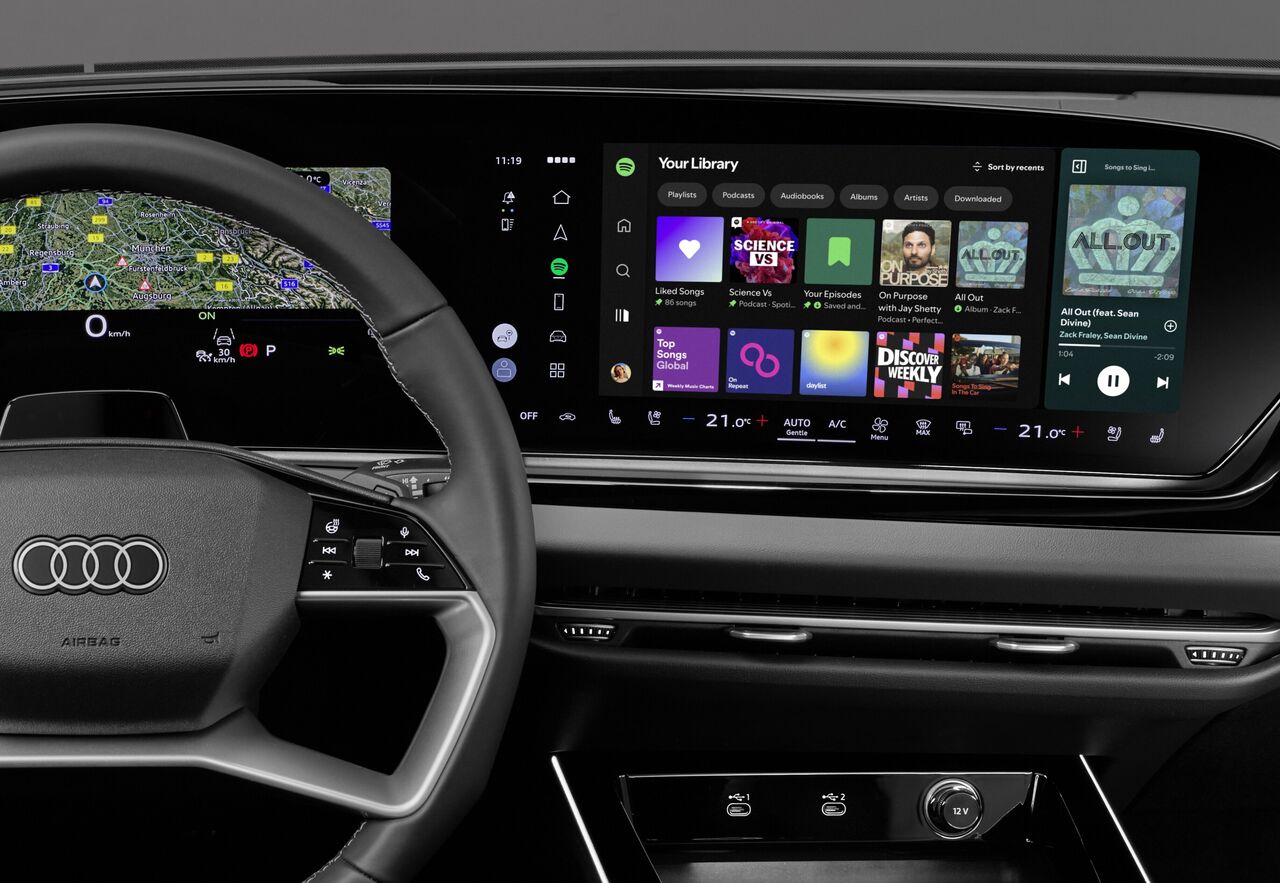


Audi announced on October 21, 2026, that it is the first automaker to run Spotify’s fully native app inside a vehicle, no smartphone required. Music videos, real-time lyrics, Spotify Jam, and Spotify DJ all live directly on the infotainment screen, powered by Android Automotive OS.
That sounds like a press release victory lap, and it partly is. But peel it back and something more consequential is happening. Audi and its VW Group software arm Cariad have turned the car’s center display into an app platform that rivals a tablet.
The native Spotify integration is the proof of concept. The Audi Application Store is the real play.
Previous in-car Spotify versions relied on templates, standardized layouts that looked the same regardless of which automaker’s screen you were staring at. This version ditches that approach entirely. Menus, navigation patterns, and content types mirror what users already know from their phones but are rebuilt for the car’s interface and its particular safety constraints.
Those constraints matter. While the vehicle is moving, music videos and lyrics disappear from the center MMI display. Sign-in and settings are locked out. If the car has a front passenger screen, those features stay available there. When the car is parked, everything opens up.
Spotify Jam lets passengers scan a QR code and add songs to a shared queue, turning the car into a collaborative listening session. Spotify DJ works through voice control even while driving. “Hey Audi” commands remain active as well.
The rollout covers 47 markets across six continents and applies to Audi models built on two platforms: the Premium Platform Electric and Premium Platform Combustion. That means the A6 e-tron, Q6 e-tron, A5, Q5, and A6 from model year 2026 onward. The Q7 and Q9 SUVs will get it at their respective launches.
Downloading the app costs nothing. Using it requires a Spotify account, and pricing depends on the user’s market and subscription tier. Spotify claims more than 777 million users globally, so the addressable audience is enormous.
The deeper tension here is between automakers and tech companies over who owns the in-car experience. For years, Apple CarPlay and Android Auto let drivers bypass the manufacturer’s software entirely. The phone was the brain, and the car was just a screen.
Automakers hated that arrangement because it cut them out of the data loop and the revenue stream. Android Automotive OS changed the equation. It runs on the vehicle’s own hardware, not a phone.
Apps built for it answer to the automaker’s ecosystem, not the smartphone’s. Audi’s native Spotify deal is the clearest signal yet that this shift is picking up speed. The car itself becomes the platform, and the automaker becomes the gatekeeper through its own app store.
GM tried a version of this when it dropped Apple CarPlay from its EVs and pushed its own Google-based system. The backlash was fierce. Audi is playing it differently, keeping CarPlay available while building a native app ecosystem strong enough to make drivers want to use it instead.
Whether Audi can attract enough third-party developers to make the Application Store a genuine destination remains an open question. Spotify is the biggest name in audio streaming, so landing them first is a strong opening move. But one app does not make an ecosystem. The next twelve months of developer announcements will tell us whether this is a strategy or a stunt.


Share this Story