
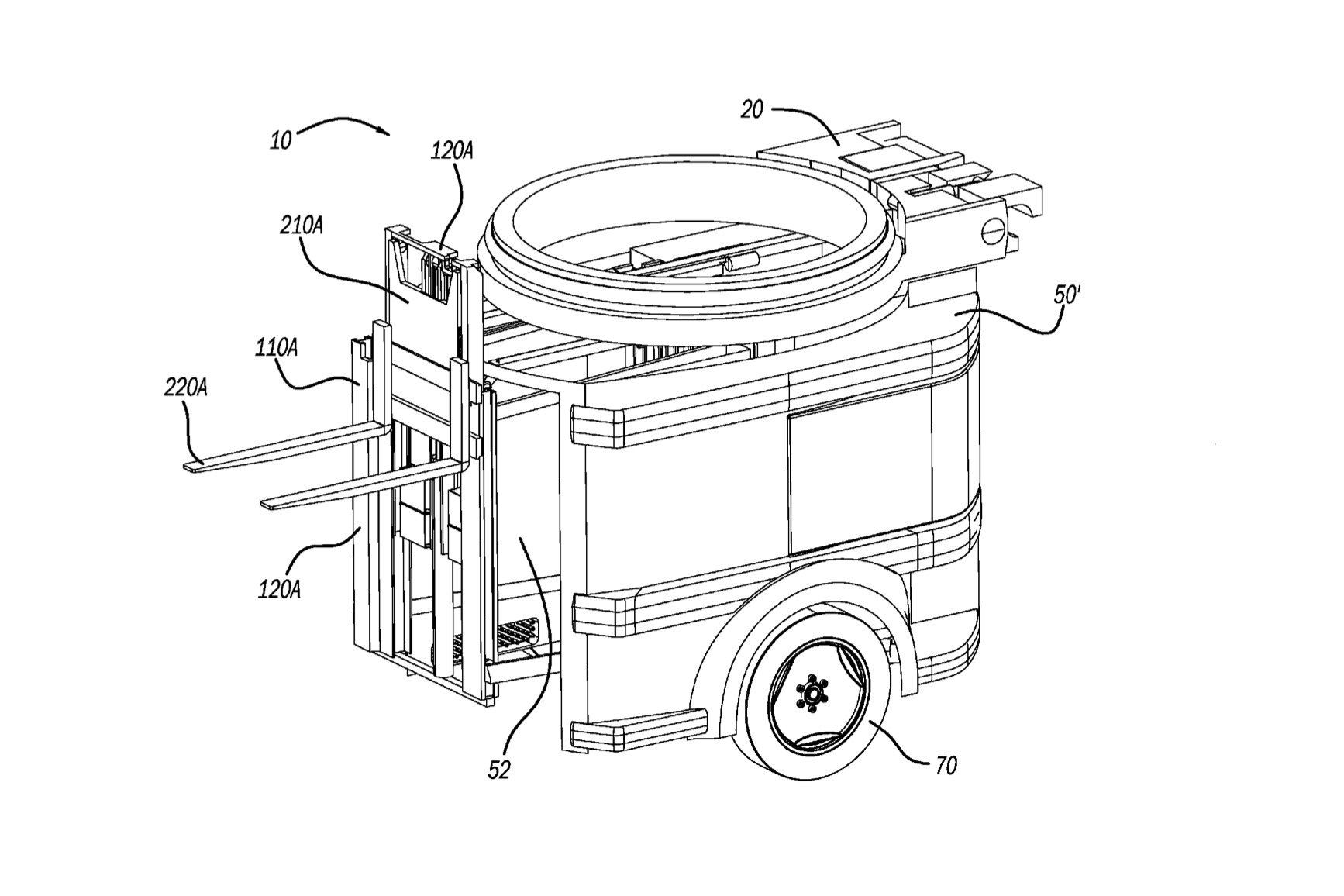


General Motors filed a patent for a driverless forklift, and the design doesn’t even bother with a seat. The application, published by the U.S. Patent and Trademark Office on September 17, 2026, describes a machine built from the ground up to operate without a human aboard.
The drawings show a compact unit with a forklift assembly on one end and a coupling device on the other. No cab. No controls for human hands. GM’s application includes the usual language about autonomous, semi-autonomous, and manual operation, but that reads more like legal coverage than genuine intent. You don’t delete the driver’s seat if you’re planning to keep the driver.
That coupling device is the curious part. A large ring at the top of each unit lets multiple forklifts connect in a chain, like warehouse shopping carts. GM’s filing notes that linked forklifts can move perpendicular to one another, meaning one unit could pivot sideways to grab a pallet while another holds position. The application also describes extending arms for greater reach and specialized gripping gear for pallet handling.
The base design shows just two wheels on a centered axle, a configuration that would demand active balancing hardware similar to what keeps a Segway upright. GM acknowledges that multi-axle variants are possible. That suggests the two-wheel layout is either a starting point or an exercise in minimalism.
The timing here is hard to ignore. GM killed its BrightDrop commercial vehicle brand, which had been positioned as the company’s hub for exactly this kind of technology. When BrightDrop launched in 2021, GM showed off a self-driving cargo pallet concept called the EP1 alongside the electric delivery vans that eventually reached production. The vans survived in diminished form. The EP1 disappeared.
Now a driverless forklift surfaces from the same company, carrying the same DNA. It would be easy to write this off as another patent filing that never sees a factory floor. Automakers patent speculative concepts all the time, and GM’s intellectual property portfolio is full of ideas that went nowhere.
But the warehouse automation market is already moving fast without GM’s help. BMW and Honda already deploy small robotic vehicles at scale in their manufacturing plants. Amazon has been automating its fulfillment centers for a decade.
The economics are straightforward: robots don’t need breaks, don’t file workers’ comp claims, and don’t require the federally mandated certification process that every forklift operator must complete.
Certified forklift operators remain among the most skilled workers in any warehouse. OSHA requires formal training and evaluation before anyone can legally operate a powered industrial truck. That training exists because forklifts are dangerous.
They tip over. They crush people. They drop loads. Replacing a trained operator with sensors and software means the machine has to be better than a careful human in a chaotic environment full of other humans, uneven loads, and tight spaces.
GM hasn’t said whether it plans to actually build this thing or simply wants to own the intellectual property. The patent application is not a product announcement. But the design choices tell a story. When you engineer a forklift without a place for a person to sit, you’ve already made the decision about who you think should be driving it.
Share this Story