
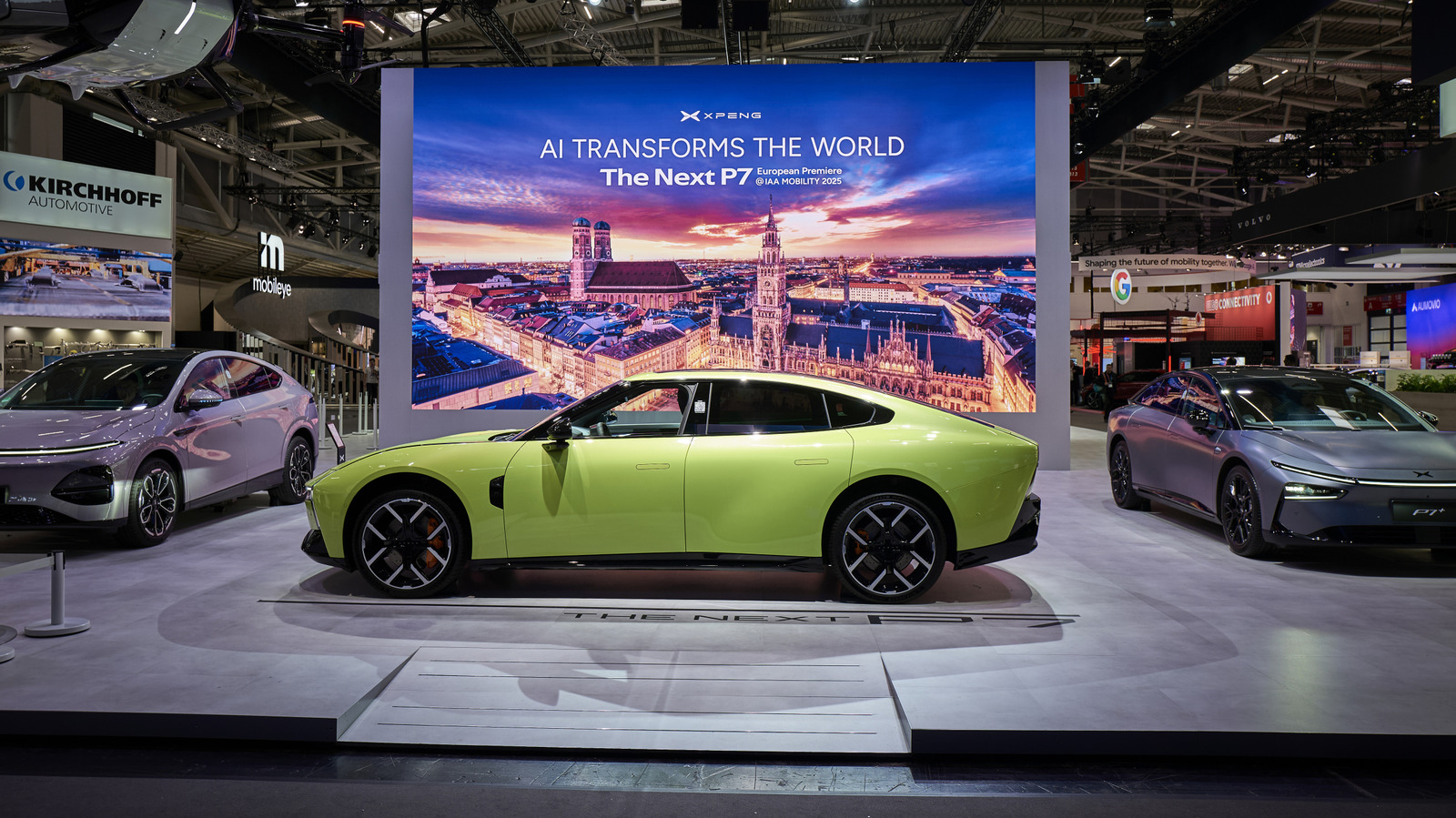


Xpeng’s chairman He Xiaopeng stood at the Paris Motor Show this week and said something that would have sounded delusional three years ago. He wants his company selling 500,000 cars a year in Europe by the end of the decade. That would top Ford’s 2025 European total of 426,459 units.
The math is audacious. Xpeng has moved roughly 60,000 cars across Europe since it first landed in Norway in late 2020. Getting from 60,000 cumulative to 500,000 annual in four years isn’t a growth curve. It’s a hockey stick taped to a rocket.
But Xiaopeng isn’t just talking volume. He’s talking production.
Xpeng already builds three models at Magna Steyr’s factory in Graz, Austria, the same contract manufacturer that has assembled everything from the BMW 5 Series to the Jaguar I-Pace. The G6 crossover, G9 SUV, and P7+ sedan all roll off Magna’s lines. Now the G9L, a flagship range-extender SUV, just passed its production trial at the same plant.
Xiaopeng told Reuters the company will either build a new European factory or take over an existing one, partnering with a local manufacturer. The facility would focus on mid-priced vehicles and comply with emerging “Made in Europe” content rules designed to keep Chinese-subsidized imports from undercutting domestic production.
This is the tension at the center of the Xpeng story. European regulators spent the last two years erecting tariff walls and content mandates to slow Chinese EV makers. Xpeng’s response is to walk right through the front door, set up shop, and build cars that qualify as European.
If 500,000 European sales materialized, Xpeng wouldn’t just leapfrog Ford. It would surpass Opel/Vauxhall at roughly 400,000, blow past Tesla’s 238,656, and land in Kia territory at just over 507,000. For a brand that most European buyers still can’t identify on sight, that target borders on fantasy.
The product pipeline, though, is real enough. The G9L starts at €74,600 in Germany and offers both battery-electric and range-extender powertrains. The EREV version pairs a turbocharged 1.5-liter four-cylinder with an electric motor and 63-kWh battery, producing 577 horsepower combined. Two pure-electric variants will follow with battery packs ranging from 91.9 kWh to 110 kWh.
Those are serious specs at a price point that undercuts comparable European luxury SUVs. Xpeng is also known for its advanced driver-assistance technology, which has been a core selling point in China.
The real question isn’t whether Xpeng can build competitive cars. It clearly can. The question is whether it can build a brand fast enough to move half a million units annually in a market where consumers are tribal about badges and skeptical about Chinese quality.
Ford took a century to build its European identity. Kia spent 30 years clawing from punchline to credible competitor. Xiaopeng is giving himself four years.
Magna Steyr can scale production. European content rules can be met. Tariffs can be navigated. But convincing half a million Europeans per year to choose an Xpeng over a Volkswagen, a BMW, or even a Hyundai requires something no factory can manufacture: trust.
Trust, in this business, has never been something you can import or accelerate on a timeline. Xpeng’s Graz facility is already humming and the G9L is cleared for production. The ambition is declared, and now comes the part where the market gets a vote.

Share this Story