
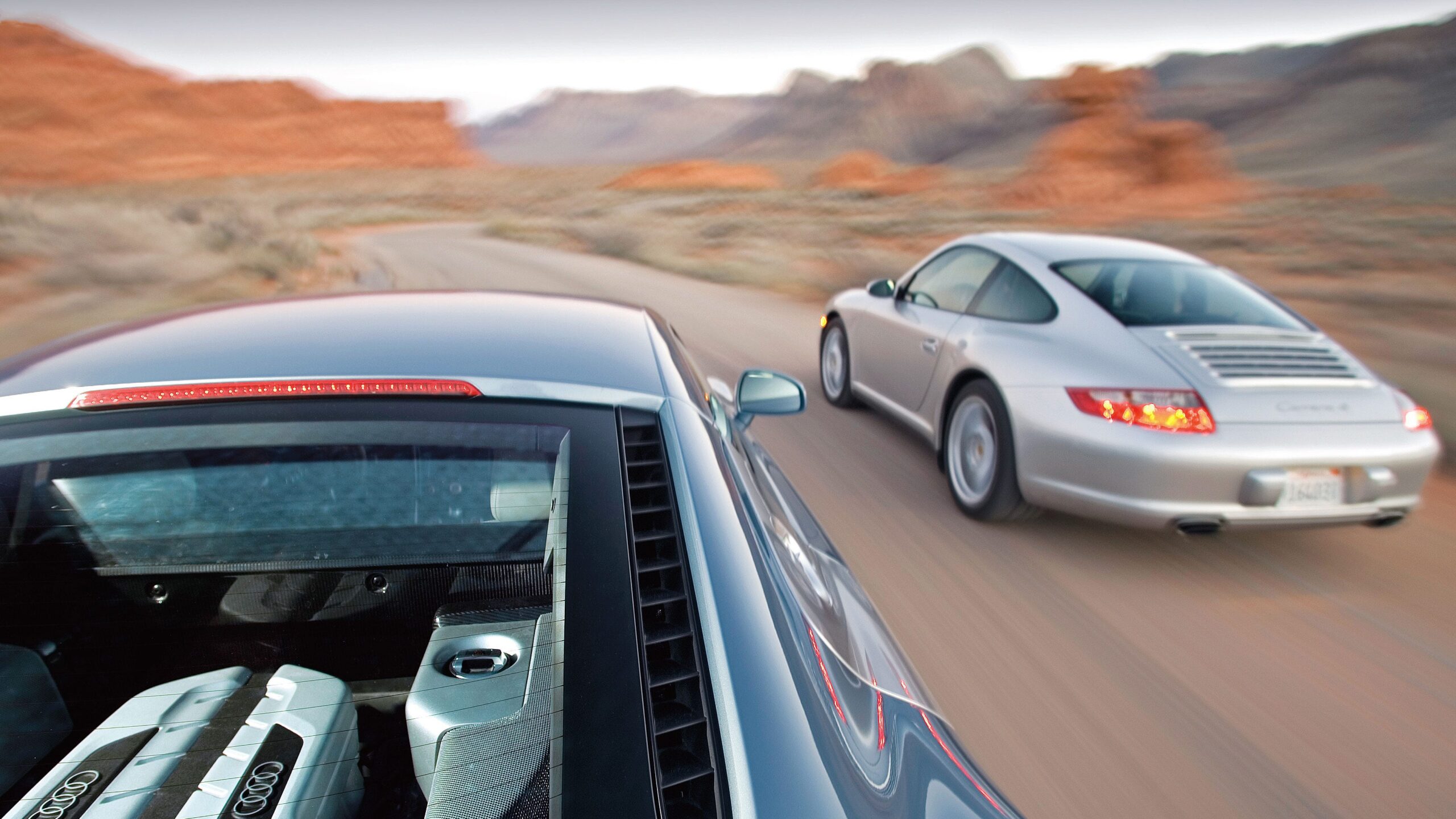


Ferdinand Piëch had a habit of letting his own companies fight each other. The grandson of Ferdinand Porsche, a man who cut his teeth engineering the 906 and 917 race cars, sat on the supervisory board of VW Group while greenlighting the Audi R8. It was a car aimed squarely at the heart of the 911, the very machine his grandfather’s company built its empire around.
The corporate intrigue ran deeper than any boardroom drama Hollywood could cook up. Porsche AG had been aggressively buying VW Group stock, making it the single largest shareholder. That meant Porsche boss Wendelin Wiedeking had a board seat at the company that just unleashed the biggest threat to his flagship product in decades.
MotorTrend’s original 2007 comparison test laid bare exactly why Porsche had reason to sweat. They lined up a manual Carrera 4 at $82,365 against the R8 equipped with the R tronic transmission and magnetic ride shocks, the setup Audi expected most American buyers to choose.
Before either car moved, the R8 had already won half the fight. Frank Lamberty’s aggressive exterior made the 911 look frumpy. Inside, Jens Sieber’s cabin made Porsche’s austere cockpit feel like it belonged to a previous decade.
Then came the numbers. The R8 hit 60 mph in 4.1 seconds and cleared the quarter mile in 12.6. The Carrera 4, down 95 horsepower, needed an extra half second to 60 and six tenths more through the quarter.
The R8 even outran the 355-horse Carrera 4S, though the 480-horse 911 Turbo still demolished it with a 3.2-second sprint and 11.4-second quarter.
Raw speed was only part of the story. Launching a fast time in the all-wheel-drive 911 meant side-stepping the clutch and enduring alarming driveline protests. In the R8, you switched off stability control, squeezed the gas, jumped off the brake, and held on while the exhaust boomed like a stock car.
On track, both cars understeered initially. But the R8 rotated with a smooth, telegraphed transition when you lifted off the throttle. The 911 could match the trick, but the margin for error was razor thin.
Audi’s engineers admitted they designed it that way. “It starts to rotate earlier than a 911,” one said, “but it’s much more controllable.”
The Nürburgring told a similar story. Audi claimed a 7:55 lap, only 13 seconds behind the time Walter Röhrl posted in the lighter, harder, 415-horse GT3.
On public roads, the R8 rode better, ran quieter, and felt more refined. It stopped just as hard as the Porsche. The magnetic ride shocks offered two modes with minimal ride quality difference between them, though sport mode sharpened turn-in and reduced body roll.
The 911 kept two cards the Audi couldn’t match. Its steering talked to you, transmitting every surface change and loading shift through your palms. The R8’s helm was accurate but mute, a videogame wheel disconnected from the road.
And the 911’s manual shifter moved with an oily precision that made the R8’s notchy, deliberate linkage feel agricultural.
Those two advantages were real and they mattered to drivers who valued feel over flash. But MotorTrend’s testers saw the writing on the wall. The R8 delivered genuine supercar performance wrapped in everyday usability, drop-dead styling, and a lavishly equipped interior.
You didn’t need to be a hero to drive it fast.
The Carrera 4 placed second. “No longer the obvious choice,” the editors wrote. Functional, durable, raw, and tactile, but somewhat dowdy, and demanding real skill at the limit.
Piëch’s gambit worked exactly as intended. Every generation of 911 that followed had to be better precisely because the R8 existed. Whether Porsche ever thanked him for that is another question entirely.
Share this Story