
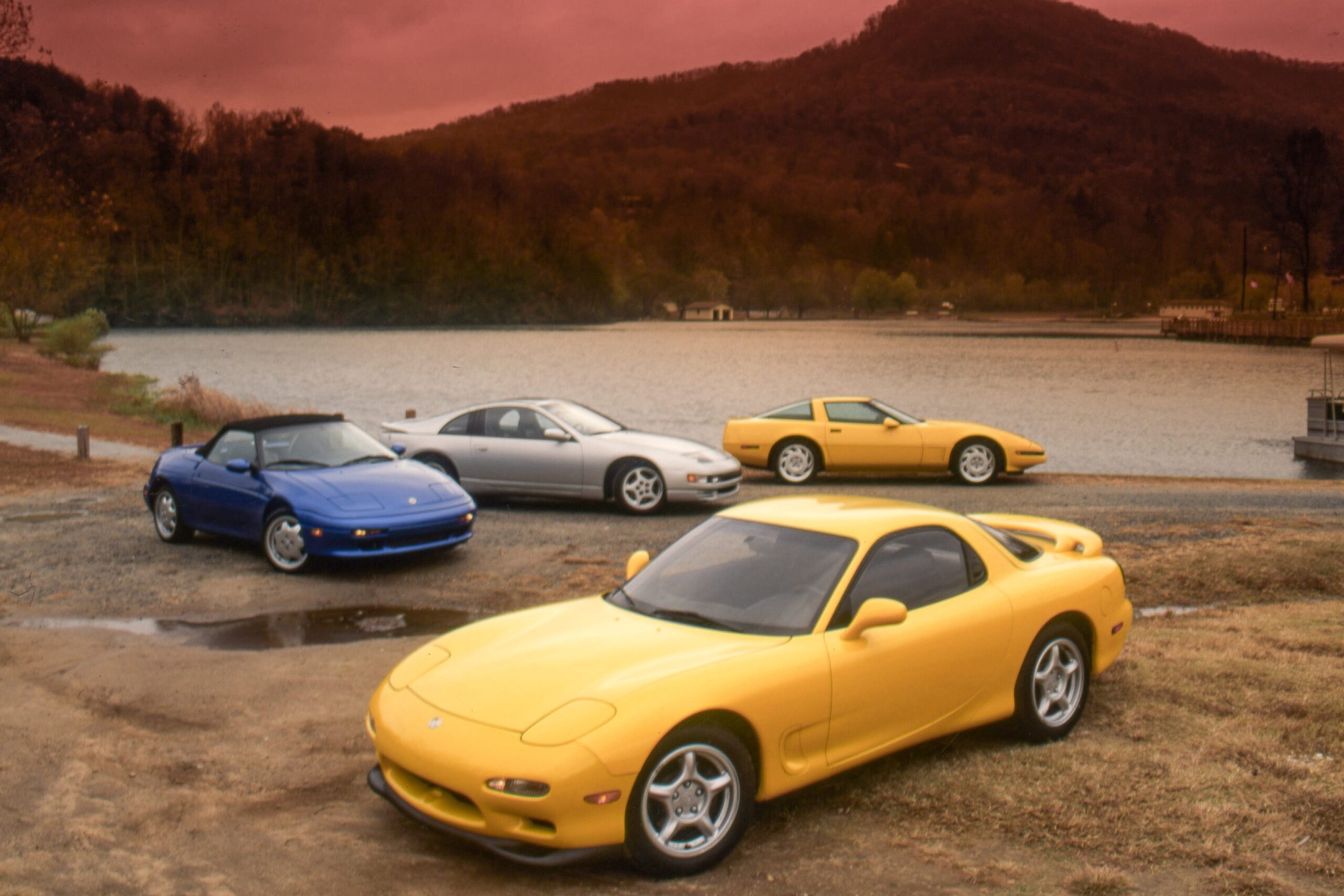


Thirty-three years ago, Mazda walked into a knife fight with a scalpel. While Chevrolet was stuffing 300 horsepower into a 3,400-pound Corvette and Nissan was loading the 300ZX Turbo with every power accessory known to man, Mazda’s engineers shaved a dipstick handle down to a thin wire — all in the name of shedding weight from the third-generation RX-7.
They got the car down to 2,800 pounds. Over 600 pounds lighter than the Corvette. More than 700 lighter than the Nissan. And they nearly won Car and Driver’s 1992 comparison test because of it, losing to the 300ZX Turbo by just two points.
That margin tells you everything about the tension that defined sports cars in the early nineties — and still defines them today. Do you build light and pure, or do you pile on power, grip, and creature comforts until the car becomes a rolling argument against its own existence?
The Corvette made the case for brute force. Its new LT1 V-8 ran the quarter in 13.6 seconds at 104 mph, fastest of the group. It posted the quickest lap around the road course, too, by a tenth of a second over the RX-7.
But nobody on staff ranked it higher than third. The Big Iron approach — massive tires, a six-speed gearbox, contortionist entry and exit — split opinion like no other car in the test.
The Nissan 300ZX Turbo won. Again. It had already claimed two previous Car and Driver comparison victories, and this time it held off Mazda’s lightweight revolution with the kind of polished, complete package that leaves very little to complain about.
It was heavy, yes, tipping 3,500 pounds. It was everything Mazda said a pure sports car shouldn’t be. And it still won.
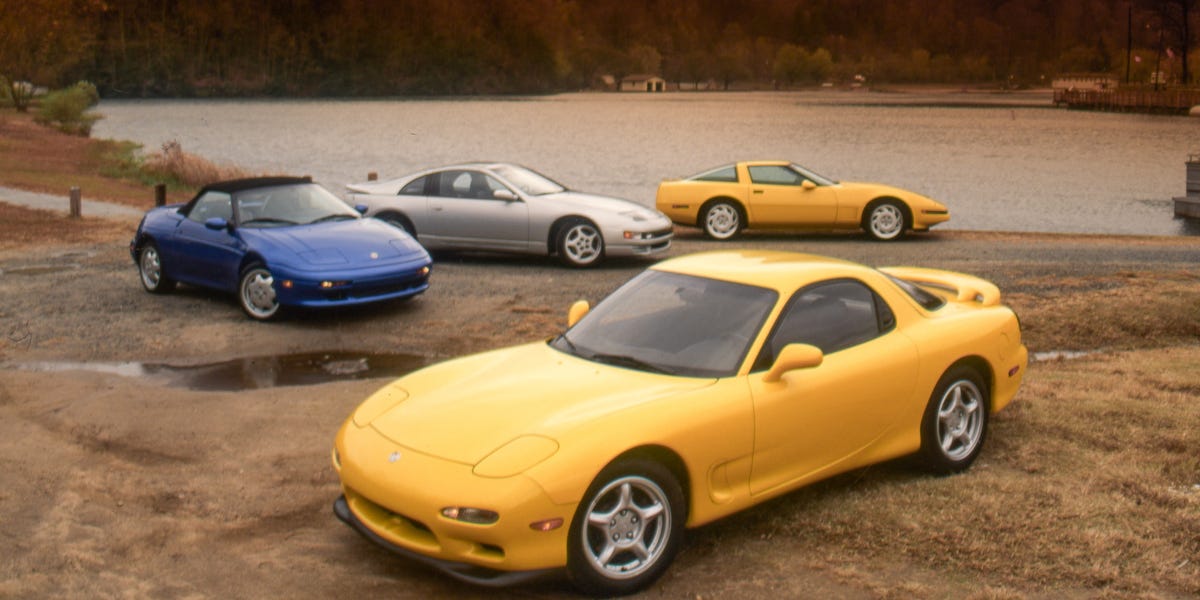
The Lotus Elan finished last, which was both predictable and a little sad. At 2,452 pounds, it was the lightest car there — 350 pounds less than the RX-7 — and it carried the spiritual DNA of every British roadster that ever leaked oil on a country lane. But its front-drive layout, borrowed from an Isuzu Impulse, made it idiosyncratic in ways that bit back hard.
One driver learned this at 100 mph when he lifted off the throttle in a sweeper and the car snapped sideways into a slide that “lasted about a day and a half.
The real story wasn’t who won. It was the question Mazda forced everyone to confront: had sports cars gotten too fat and too complicated for their own good? In 1960, very few sports cars even had side windows. By 1992, power everything was standard.
Air conditioning. Power seats. Power mirrors. The stuff of Buick Electras was now expected in a two-seater.
Mazda’s answer was radical subtraction. Sequential twin turbos on a compact rotary. Torsen limited-slip differential. Vented brakes at all four corners. A tachometer planted dead center in the instrument cluster. Nothing unnecessary. The skin stretched tight “as a bubble pack” around two passengers and a beer-keg-sized engine.
It almost worked. The RX-7 missed the top spot by a whisker, and history has been kinder to it than to the 300ZX. The Nissan aged into a comfortable classic. The Mazda aged into a legend.
The question Mazda raised in 1992 never got answered. Cars kept getting heavier. A base Corvette now weighs 3,600 pounds. The new Nissan Z checks in around 3,500.
The sports car industry heard Mazda’s sermon about purity, nodded politely, and added another 200 pounds of sound deadening.
That thin-wire dipstick handle was a manifesto. The industry treated it as a footnote.




Share this Story