
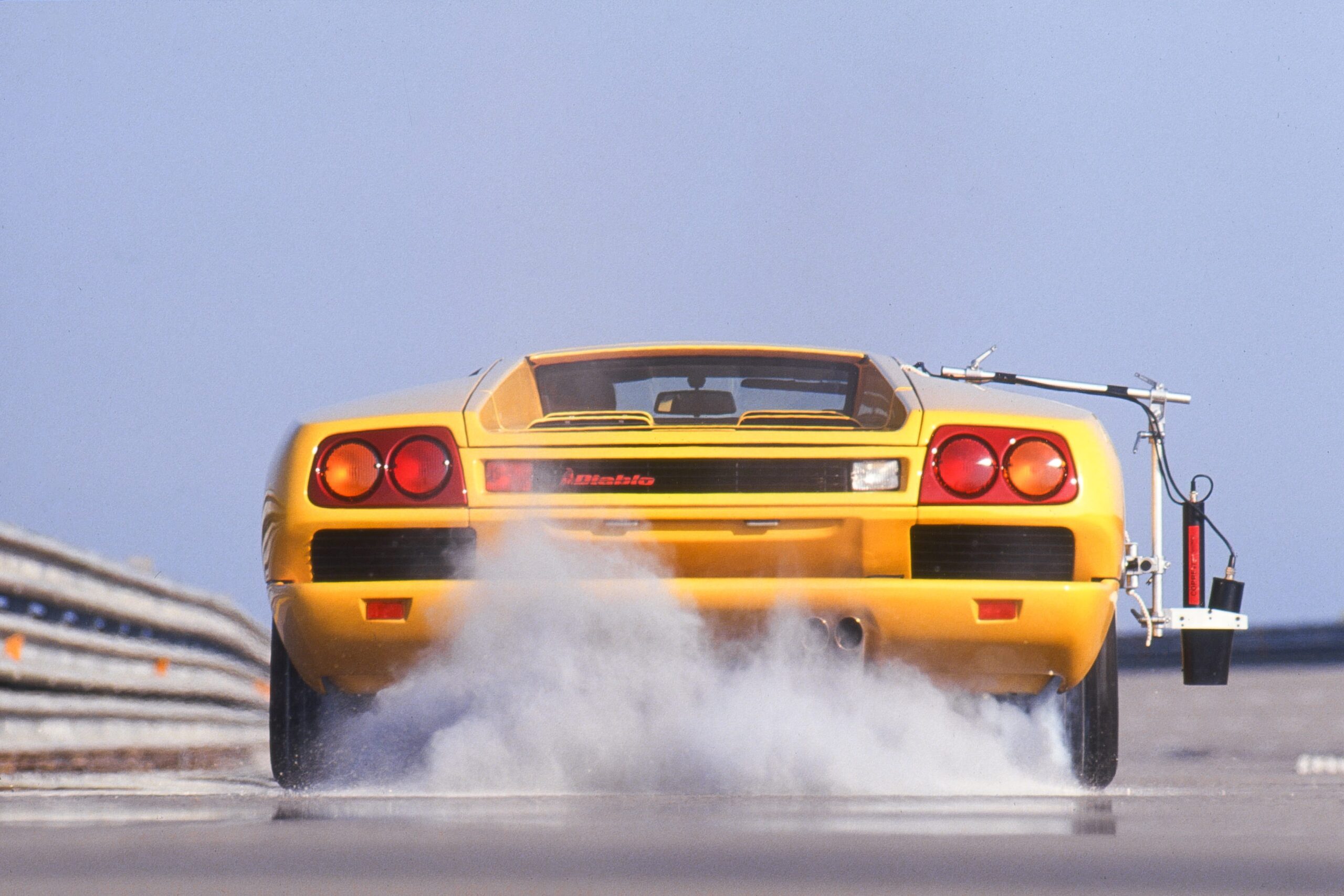


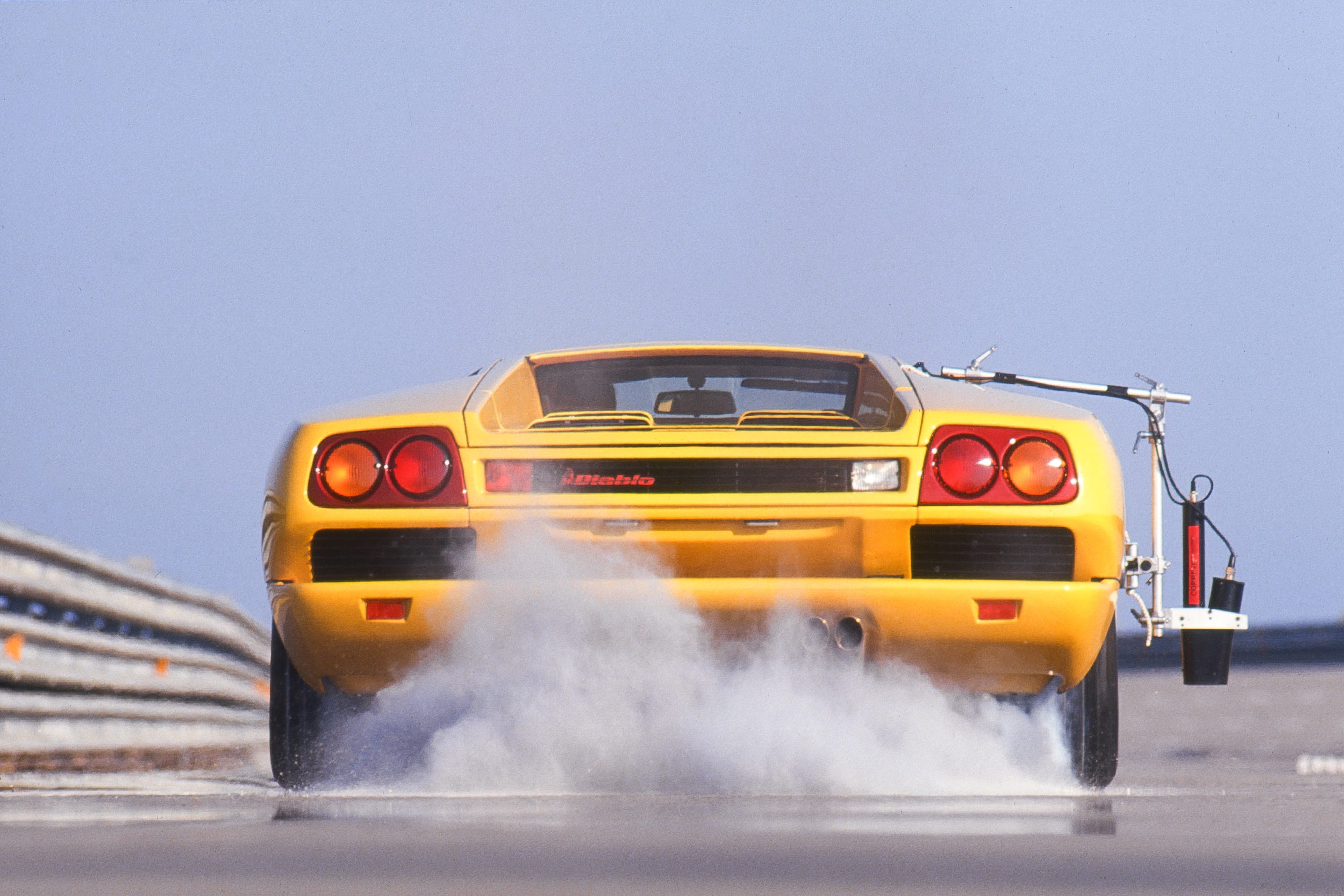
In August 1991, Car and Driver strapped a Lamborghini Diablo to Italy’s Nardo test track and clocked a two-way average of 204 mph. No production car had ever done that. Not the Porsche 959, not the Ferrari F40, not anything with a license plate and a catalytic converter had broken through the 200-mph wall until this 5.7-liter, 485-horsepower V-12 bull from Sant’Agata did it on a banked circle in the heel of Italy’s boot.
The number alone would have been enough to write history. But the way C/D described getting there tells you everything about what supercars used to demand of their drivers.
Above 180 mph, the Diablo started weaving. Not dangerously, not uncontrollably, but enough to whiten your knuckles and make you question your life insurance policy. The testers compared it to a horse reminding you that you’re in charge only because it allows it. They kept their foot in it anyway. The waggling barely increased as the speedometer climbed past 190, then 200, then held at 204.
That mix of terror and trust simply doesn’t exist in modern exotics, where stability control and active aero smooth every ragged edge into digital compliance.
The Diablo was never a technology showcase. Car and Driver said so plainly back then: no multilink suspension wizardry, no variable valve timing, no power-assisted clutch. Just a smooth body with a 0.31 drag coefficient (down from the Countach’s barn-door 0.40), massive Bridgestone rubber, and a big naturally aspirated twelve-cylinder engine. Brute physics, not electronic cleverness.
And yet it delivered. The quarter-mile fell in 12.4 seconds at 123 mph. Sixty arrived in 4.2 seconds, 100 in 8.5. The skidpad registered 0.95 g with steady understeer that turned into tail-happy oversteer on faster sweepers.
Mid-engined Italian supercars did not suffer fools. The Diablo expected you to earn every tenth.
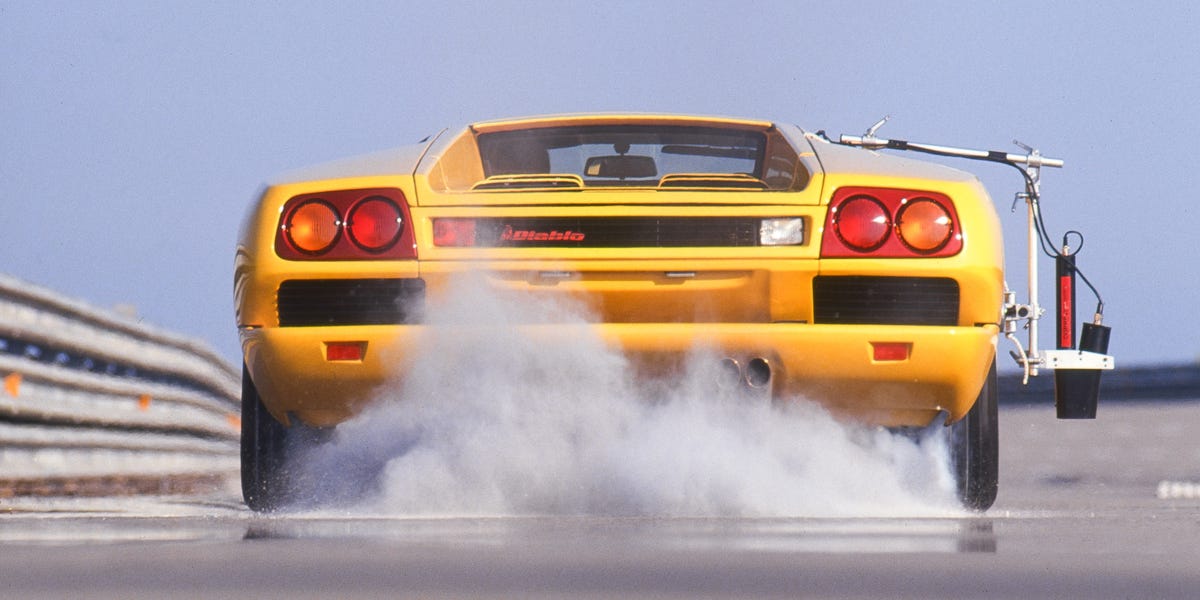
What separated the Diablo from its archrival, the F40, was livability. The Ferrari was essentially a racing car with door handles, its cabin stripped bare, its Plexiglas windows a constant reminder that comfort was someone else’s problem. The Diablo wrapped you in leather, gave you power windows that retracted into those scissor doors, offered automatic climate control, and installed an Alpine stereo you could actually hear at highway speeds.
At $233,610, Lamborghini figured you deserved to be comfortable between moments of sheer panic.
The driving position was surprisingly good. Tilt and telescoping steering, excellent forward visibility, huge exterior mirrors on aero-shaped struts. The only cockpit complaint was an instrument cluster mounted too high, the tach and speedo sitting above the steering wheel rim like an afterthought.
Comfort had its limits. The clutch would punish your left leg in traffic. The steering loaded up exponentially through corners. A few laps on the skidpad qualified as a workout.
Marcello Gandini’s bodywork, refined slightly by Chrysler’s design team during the brief corporate overlap, traded the Countach’s origami aggression for something more fluid. Six air intakes, two hood scoops, three grille openings, all faired smoothly into surfaces that looked fast standing still. The rear bumper doubled as a diffuser.
The Diablo held the title of world’s fastest production car until the McLaren F1 arrived in 1994 and reset everything. But for three years, nothing with a VIN could touch it. In a profession where records are measured in months, three years is a dynasty.
Lamborghini kept building Diablos until 2001, adding all-wheel drive, more power, and incremental refinements. None of them carried quite the same charge as that first run at Nardo, when a test driver watched the Italian landscape blur past at 300 feet per second and chose to enjoy the ride.
Share this Story