
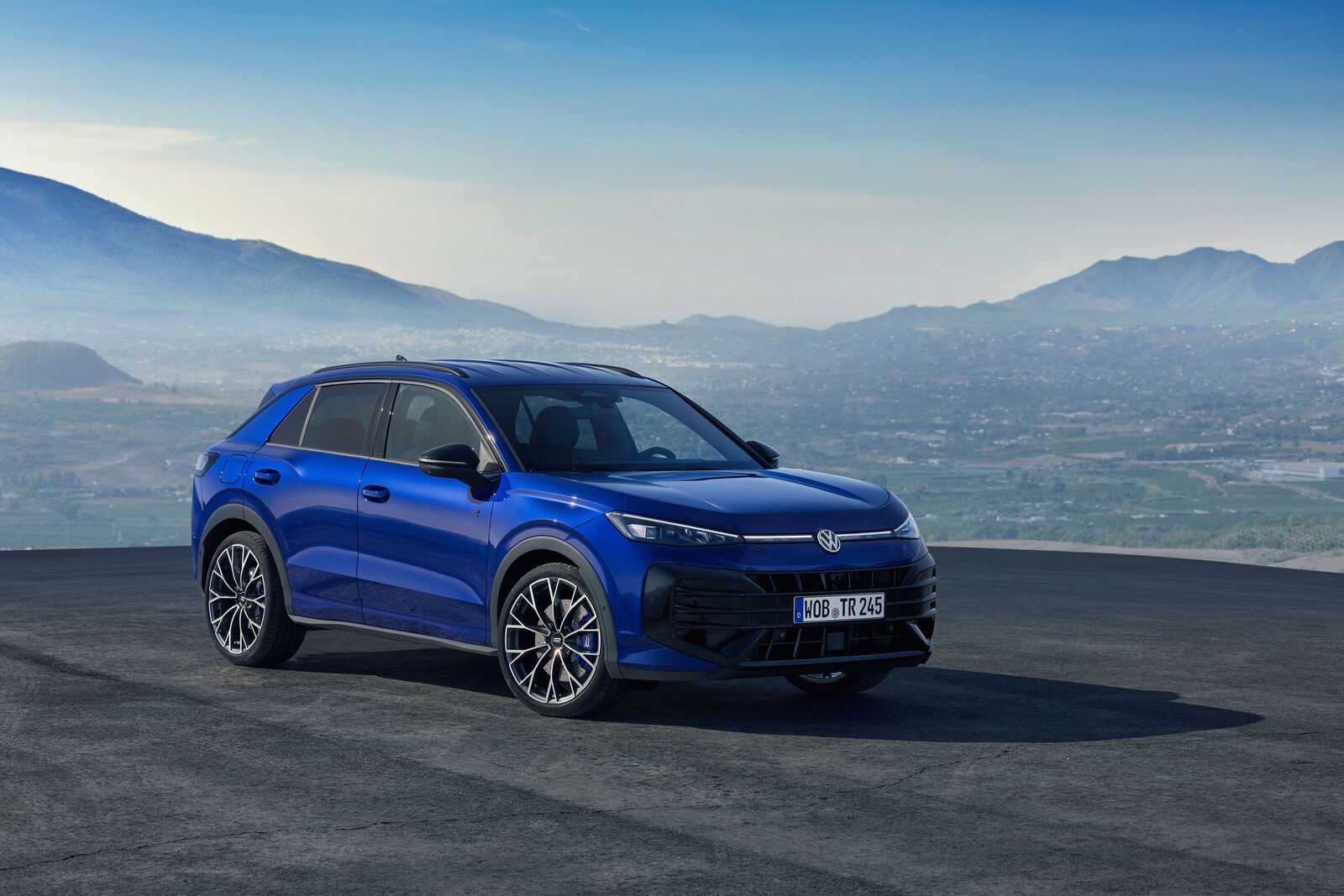


Volkswagen’s newsroom is crowded with electric names: ID. Polo, ID. Cross, ID.3 GTI, ID. Tiguan. Yet the car it put on stage this week burns petrol, makes 333 PS, and wears a CO2 rating of class G.
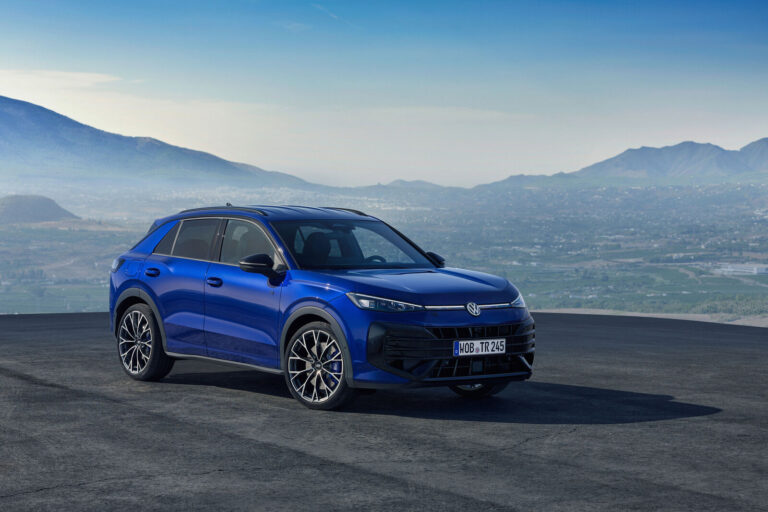
That car is the T-Roc R. It arrives a year after the current T-Roc launched, and Volkswagen calls it the flagship of the range.
Pre-sales open Thursday in Germany, starting at 59,995 euros. That is serious money for a compact crossover. Volkswagen is betting buyers will pay it for a badge that has meant something since the first Golf R.
Under the bonnet sits a new version of the EA888, the evo5, now paired with a 48-volt mild-hybrid system. It makes 245 kW, or 333 PS, with 420 Nm of torque.
This is the first time Volkswagen has put 48-volt hardware in an R model. The company pitches it as a performance tool first and an efficiency measure second.
An electric compressor, powered by the 48-volt system, fills in torque at low revs. Volkswagen promises acceleration with no perceptible break in tractive power, which is a polite way of saying it has dealt with turbo lag.
The same system recovers energy under braking and lets the engine shut off while coasting. Even so, combined consumption lands at 7.9 to 8.3 litres per 100 km, with CO2 emissions of 181 to 190 g/km.
The performance figures are harder to argue with. Zero to 100 km/h takes five seconds with standard launch control, and top speed is limited to 250 km/h.
Volkswagen says it is the most powerful SUV it currently sells in Europe. For a crossover built on the bones of a commuter car, that is quite a claim.
Power goes through a seven-speed DSG to 4MOTION all-wheel drive with R-Performance torque vectoring. The rear torque splitter moves drive between the axles and between the two rear wheels.
New software for the splitter targets µ-split conditions, where one side of the car has grip and the other does not. Volkswagen claims the car stays easy to control when accelerating or braking on mixed surfaces.
The chassis borrows heavily from the Golf R. Adaptive DCC damping and progressive steering are standard, with MacPherson struts up front, a multi-link rear and 18-inch brakes.
One press of the R button on the steering wheel puts the dampers, steering, splitter and all-wheel drive into Race mode. Two more profiles come standard: Drift, for closed circuits, and Special, set up for the Nürburgring Nordschleife.
Yes, an SUV with its own Nordschleife setting. Volkswagen says the powertrain, brakes and chassis got their final tuning on track, the same process used for the Golf R.
The theatre hasn’t been forgotten either. Hold the start button for 1.5 seconds without the brake, then fire it with your foot on the pedal, and idle jumps to 3,000 rpm. The pops and crackles on the overrun are deliberate.
Standard kit includes a four-pipe exhaust, blue brake calipers and 19-inch Zandvoort wheels. Buyers chasing weight savings can add a titanium Akrapovič exhaust and 20-inch forged Warmenau wheels.
Inside, the Digital Cockpit Pro gains a GPS lap timer, an accelerometer and a torque distribution display. Lapiz blue metallic stays exclusive to R models, alongside Canary yellow, Pure white, Wolf grey and Grenadilla black.
Volkswagen’s electric future is spelled out all over its own website. But its most expensive T-Roc, for now, still wants you to listen to the exhaust.
Share this Story