
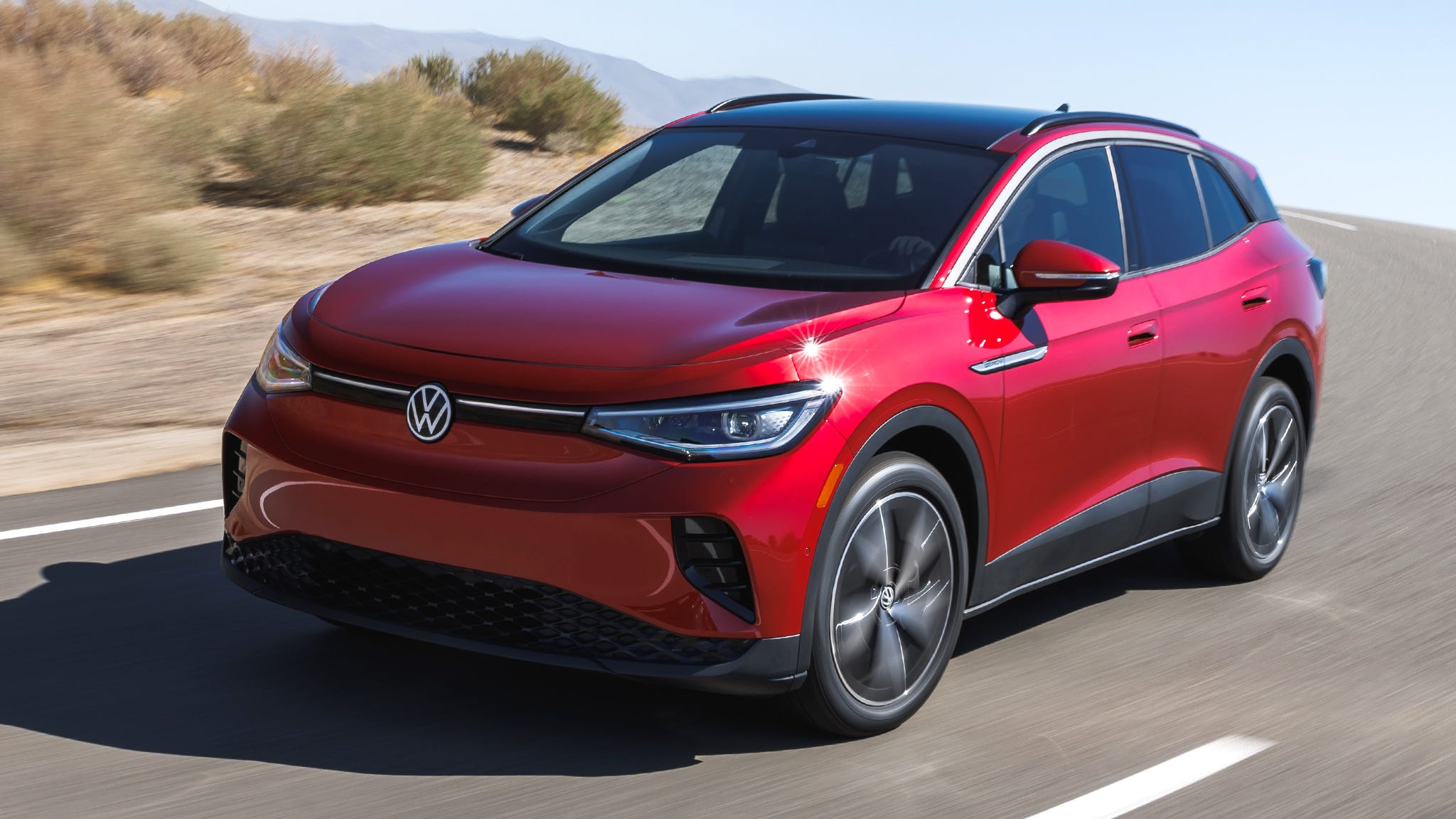


Volkswagen is offering $12,500 off the 2025 ID.4, a discount so steep it nearly screams desperation. The German automaker needs to purge remaining inventory before the ID.Tiguan arrives next year as the successor, and it is pricing the outgoing electric SUV accordingly.
The 2025 ID.4 Limited starts at $41,420. Apply that $12,500 discount and you’re looking at a mid-size electric SUV for under $29,000 before any federal tax credits enter the picture. VW says availability of the 2025 model is “very limited,” which is corporate-speak for “we’re down to the last units on dealer lots.”
For the 2026 ID.4, which is easier to find, VW is still dangling $6,000 off the purchase price. Less dramatic, but not nothing.
The ID.4 was supposed to be Volkswagen’s electric beachhead in America. It launched with big ambitions but never quite found its footing against faster-improving rivals. MotorTrend placed it dead last in a seven-vehicle comparison test of electric SUVs.
That’s the kind of result that doesn’t inspire repeat customers. It does, however, explain why VW is now willing to hemorrhage margin to move metal.
Context matters here. The $12,500 discount on the ID.4 is among the largest EV incentives currently available from any automaker. The only bigger number comes from Audi, which is lopping $20,000 off the 2026 E-Tron GT. Kia offers $5,000 off both the EV6 and EV9, putting VW’s deal in rarefied air.
This is the math that defines the current EV market. Automakers that bet early and big on electric vehicles are now stuck managing the transition between first-generation products that didn’t sell fast enough and second-generation replacements that promise to be better in every way. The ID.Tiguan, built on an updated platform and carrying a name American buyers actually recognize from VW’s bestselling combustion SUV, is designed to fix what the ID.4 got wrong.
But you can’t launch a successor with lots full of its predecessor. So VW is taking the hit.
For buyers willing to live with a vehicle that critics ranked at the bottom of its class, the value proposition is undeniable. The ID.4 is still a comfortable, practical electric SUV with decent range. Its problems were always relative, not absolute.
It felt slow to charge compared to Hyundai. Its software lagged behind Tesla. Its interior didn’t match what Kia was offering for similar money. At $29,000, those complaints carry a lot less weight.
The deeper question is what this fire sale signals about VW’s broader EV strategy in the U.S. The company has struggled to gain traction against Korean rivals and Tesla. The Scout brand is coming with its own electric SUVs.
The ID.Buzz is carving out a niche but not moving volume. The ID.Tiguan needs to land with real momentum, or VW risks becoming an afterthought in the American EV market just as competition intensifies.
Clearing the ID.4 at these prices is a necessary step, and an expensive one. VW dealers sitting on 2025 models are essentially watching the company pay them to make a problem disappear. Whether the ID.Tiguan turns out to be worth the sacrifice is a question nobody can answer yet.
Share this Story