
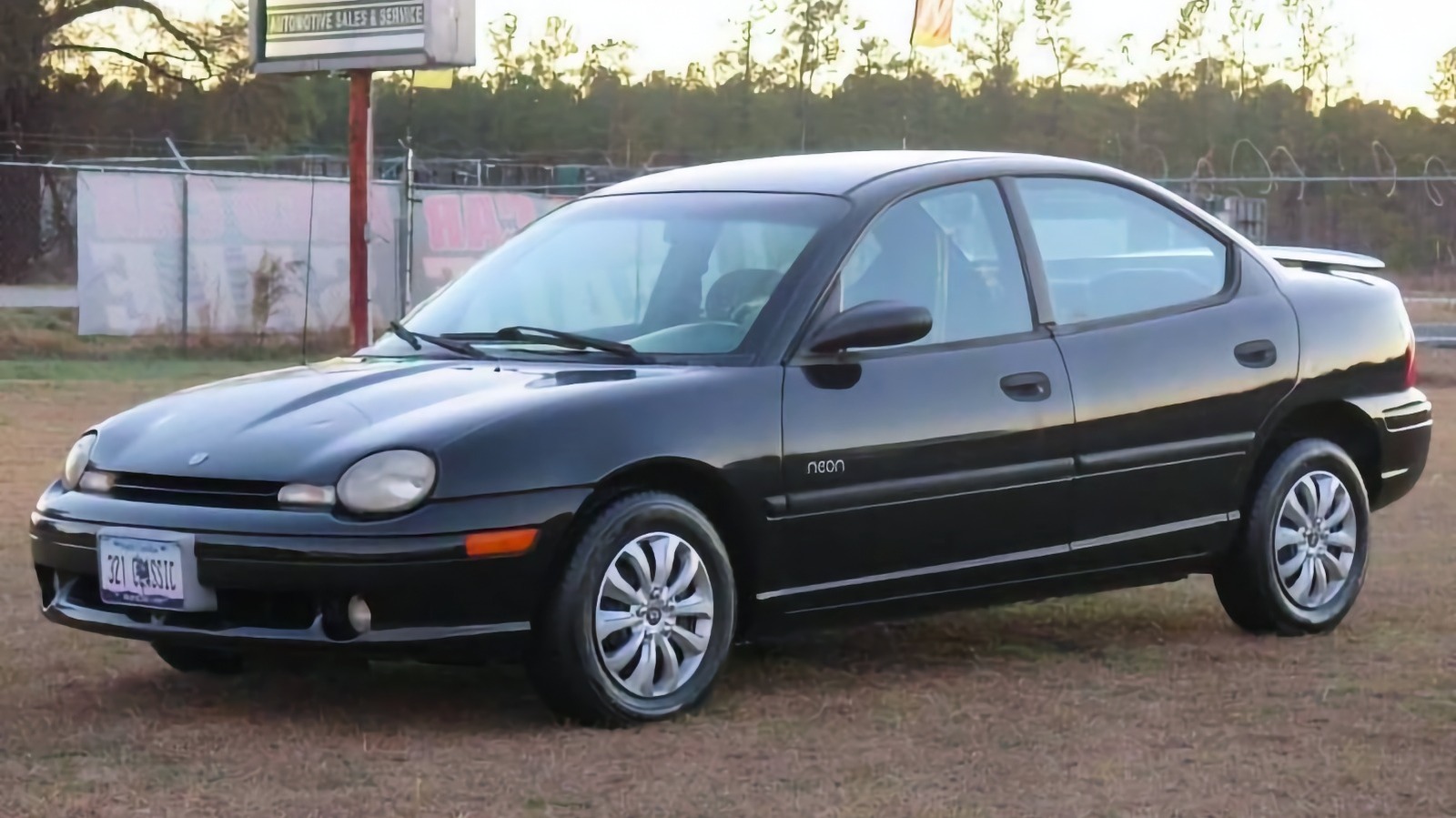


A 1998 Dodge Neon Highline with 59,073 miles just surfaced on Craigslist in Florence, South Carolina, wearing its original black paint and asking $3,999. It’s a car that shouldn’t still exist, and yet here it is — cleaner than most examples that rolled off the Belvidere, Illinois assembly line 27 years ago.
The Neon was Chrysler’s moonshot at a problem Detroit had been losing for two decades: building a small car Americans would actually buy instead of a Civic or Corolla. Bob Lutz, the same man who greenlit the Viper and the Prowler, championed the project. The pitch was simple — domestic production, competitive pricing, and an engine that could actually hustle.
It worked, at least initially. The Neon landed for 1995 with round headlamps that gave it the face of a cartoon character and a DOHC 2.0-liter four that made 150 horsepower. That was real power for a sub-$15,000 car in the mid-nineties. SCCA autocross and showroom stock racers took notice immediately.
This particular car packs that DOHC engine, which is the one you want. But then Chrysler kneecapped it with a three-speed automatic. Three speeds. In 1998. Toyota was shipping four-speed autos in Corollas. Chrysler’s bean counters apparently decided a fourth gear was a luxury the Neon buyer hadn’t earned.
The interior tells the same story. Manual windows, manual locks, manual seat adjustments. Hard plastic everywhere, covered in thin carpet that was probably threadbare by 40,000 miles on lesser-kept examples. The climate control is a single knob that turns one direction for fan speed and the other for A/C — genuinely clever engineering born from a genuinely stingy budget.
But there’s character in this austerity. The seat upholstery features a geometric pattern that no modern manufacturer would dare greenlight, and the full gauge cluster includes a tachometer, which is more than some current base-model compacts offer. The AM/FM cassette deck is a time capsule. Dual airbags round out the safety equipment, which was the whole list in 1998.
The photos show a car that’s survived nearly three decades with only a hood ding to show for it. Clean title. No stories from the dealer about maintenance history, which is either laziness or a deliberate omission — take your pick.
At $3,999, this Neon sits in a strange no-man’s-land. It’s too old to be reliable daily transportation for most people, too common to be collectible, and too slow to be a weekend toy. The three-speed automatic eliminates any pretense of sporting intent. A five-speed manual Neon at this price would be a completely different conversation — those cars were genuinely fun to drive, and the SCCA crowd proved it.
What makes this listing interesting isn’t the car itself but what it represents. The Neon was the last time an American automaker built a small car with any real enthusiasm. Saturn tried the same trick at GM, wrapping economy in a feel-good ownership experience. Both experiments ended the same way — discontinued, their factories repurposed or shuttered.
The Neon nameplate died after 2005. Chrysler never really replaced it. The Caliber and Dart followed, each worse than the last, before Stellantis abandoned small cars entirely. Today, the cheapest new car in America costs north of $20,000, and most of them have the personality of a spreadsheet.
Four grand for a 59,000-mile Neon with the good engine and the wrong transmission. It’s not a steal. It’s not a rip-off. It’s a relic from an era when Detroit still believed it could build a cheap car that made you smile, even if the three-speed gearbox was already wiping that grin off your face on the highway.

Share this Story