
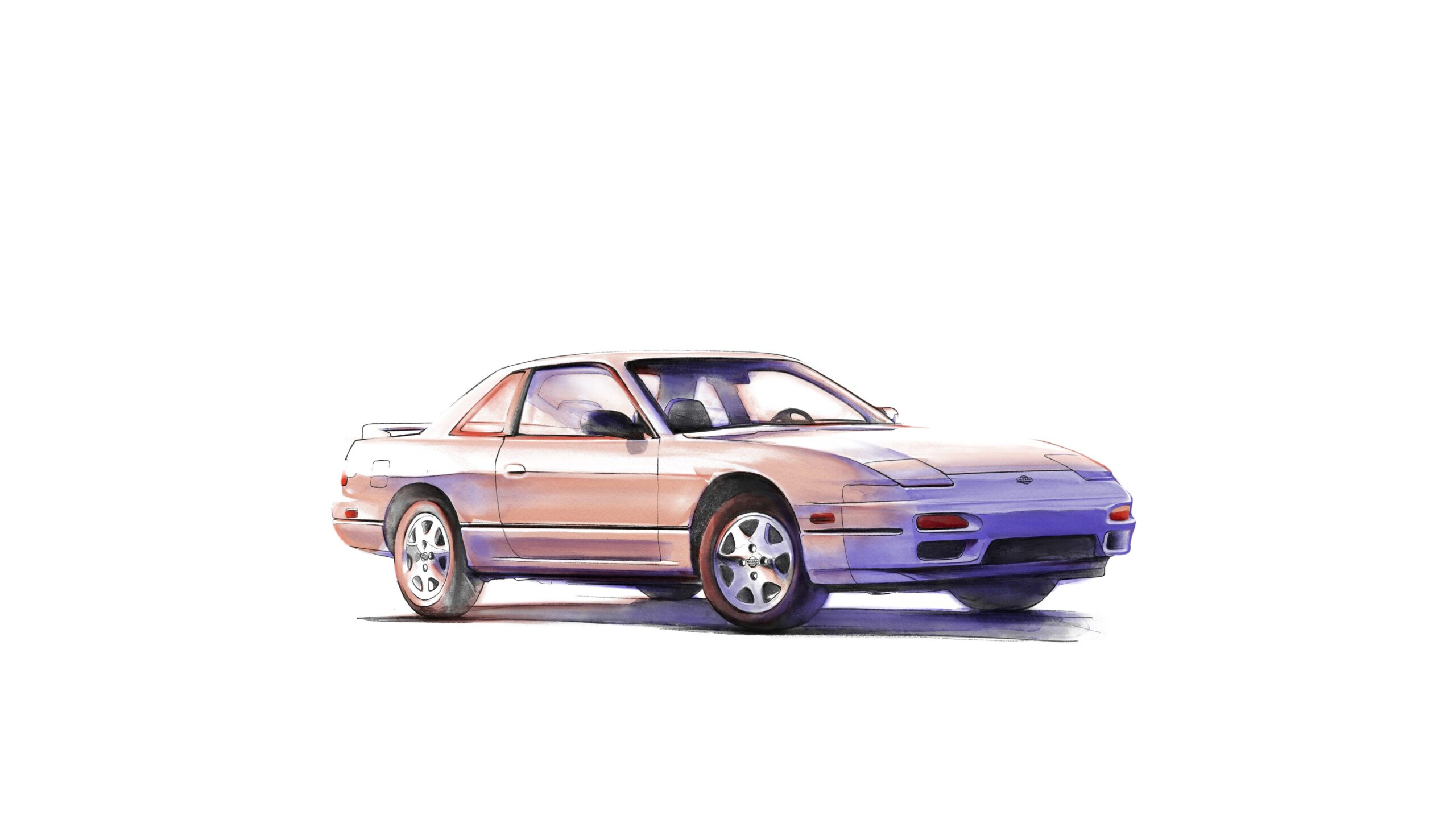


John Phillips has been writing about cars since 1974, so when he dedicates a column to a 155-horsepower Nissan coupe from the early nineties, you pay attention. His latest installment of “The Best Odds” in Car and Driver’s May/June 2026 issue lands on the 1991–94 Nissan 240SX, a car that couldn’t crack 60 mph in under 7.9 seconds but still managed to become one of the most consequential sports coupes Japan ever sent our way.
Phillips frames the 240SX’s life in three acts. The 1988 original was cute but gutless, running a single overhead cam with three valves per cylinder. The 1995 refresh tried too hard to mimic the Japan-market Silvia and lost the plot entirely.
But the middle chapter, 1991 to 1994, was the sweet spot — the car that launched a thousand drift builds and still makes enthusiasts go misty three decades later.
The second-generation engine swap brought double overhead cams, four valves per cylinder, and a modest bump to 155 horsepower. Nobody was outrunning police cruisers. But the chassis was the real story — a 53/47 front-to-rear weight split, a multilink rear suspension, optional four-wheel steering, and rear-wheel drive in an era when most affordable coupes were pulling through the front wheels.
In Car and Driver’s 1992 comparison test, the 240SX posted 0.85 g of lateral grip, the highest in the group. It stopped from 70 mph in 164 feet, numbers that belonged to Porsches back then. The car didn’t just tolerate being thrown into corners — it seemed to enjoy it.
The optional $500 handling package was the move: limited-slip differential, stiffer suspension, four-wheel steering, and summer tires. But Nissan, being Nissan, made you first buy air conditioning for $850 and ABS for $995 before you could check that box. Fully loaded, the car tiptoed past $20,000.
Phillips acknowledges the obvious weakness. The 2.4-liter four-cylinder buzzed like an angry hive at its 5600-rpm power peak, and without a balance shaft, the big-bore engine shook the car at low revs like a washing machine with a brick inside. His colleague Art St. Antoine’s quote from the era cuts deep: “Cars are like electric chairs: they work better when they have more power.
The drifting community eventually solved that problem with aftermarket turbos so large they poked through hacked-open hoods. The 240SX became the go-to chassis for Japanese drifters, and when the culture migrated to California, the car’s reputation only grew. Today, clean examples command prices that would have seemed hallucinatory when the car was new.
What Phillips captures better than anyone is the paradox of the 240SX’s legacy. It competed against the Toyota Celica, Honda Prelude, Eagle Talon, Ford Probe, Mitsubishi Eclipse, and VW Corrado — a murderer’s row of affordable sport coupes that the industry has collectively abandoned in favor of crossovers. He asks how good it would be to have updates of that entire group today. The answer, of course, is that no automaker is willing to find out.
The 240SX died in the U.S. in 1998 with a whimper, not a bang. Sales had softened. SUVs were spreading across every dealer lot in America, and Nissan pulled the plug.
Phillips compares the car to a marathon runner who, steps from the finish line, ducks into a bar for a cold beer. Almost, but not quite. That’s the 240SX in six words.
It was never the fastest, never the prettiest, never the most expensive thing on the road. It was just the one that felt the most alive in your hands. And 30 years on, nothing in Nissan’s current lineup comes close to replacing it.



Share this Story