
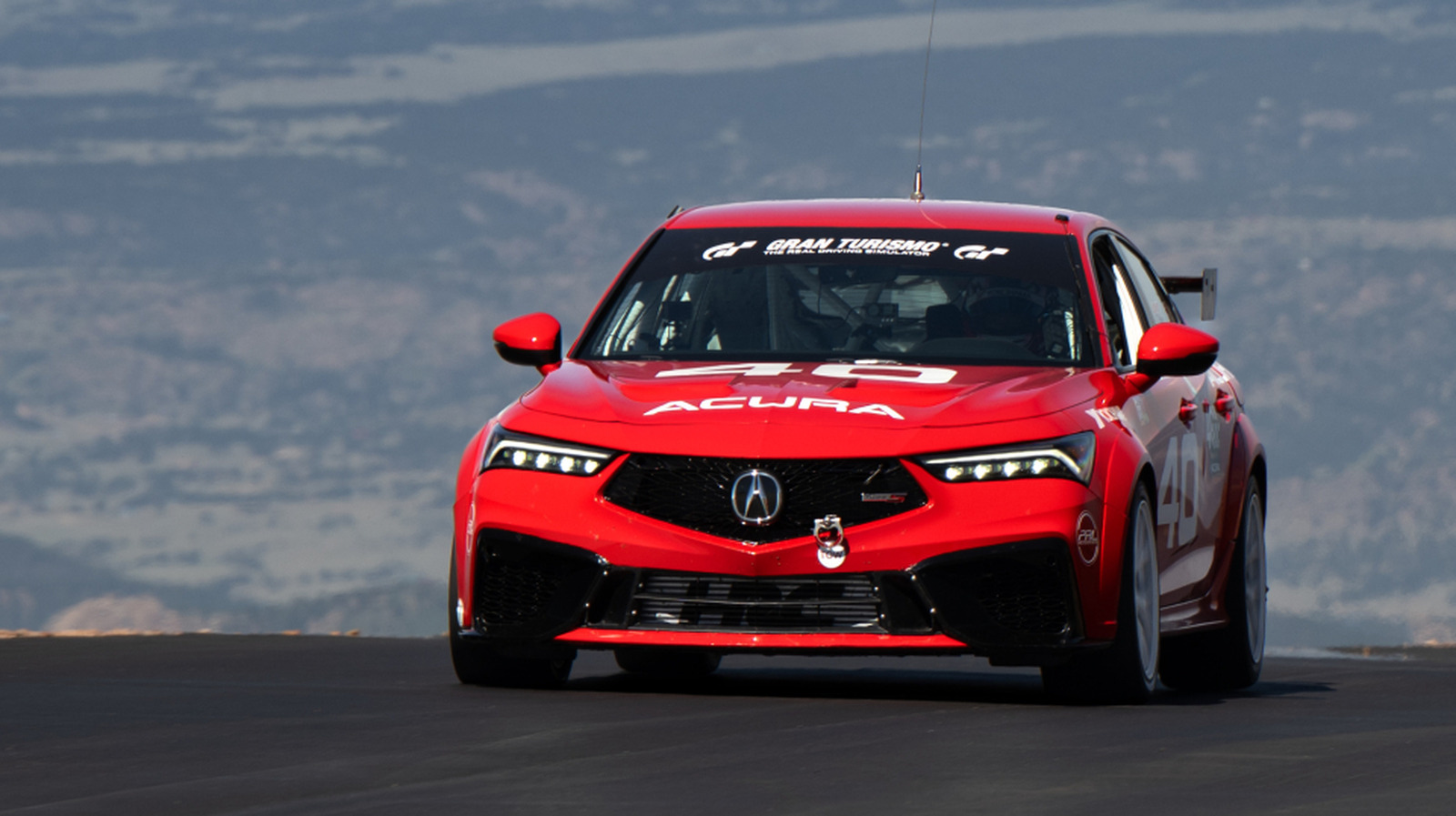


Dai Yoshihara drove the run of his life up Pikes Peak on race day, pushing Acura’s Integra Type S DE5 to a 10:33.174 finish and obliterating an eight-year-old front-wheel-drive record by nearly 15 seconds. He held that record for roughly three cars.
British racer Jim Morris, piloting a fully custom-built Volkswagen Golf with a turbocharged 2.0-liter engine making north of 500 horsepower, crossed the finish line at 10:33.104. Seven hundredths of a second faster. That’s less than a blink. In racing, it’s everything.
The cruelty of the timing isn’t just in the margin. It’s in the context. Acura had done everything right.
Yoshihara, a two-time Formula Drift champion who won Pikes Peak’s Unlimited Class in 2020, had memorized all 156 turns on the 12.42-mile course. He’d logged countless laps in the simulator. He knew where to place the car by guardrails and rocks — rocks being more reliable than trees, he noted, though even rocks move on this mountain.
The previous FWD record of 10:48.094 had belonged to Honda R&D engineer Nick Robinson since 2018, set in an Acura TLX A-Spec. Yoshihara didn’t just beat it. He demolished it. And then, three cars later, it didn’t matter.
The two machines couldn’t have been more different in philosophy. Acura’s Integra started life on the same assembly line as road cars and still carried a VIN, making roughly 360 horsepower. Morris’s Golf wore a production body over a fully custom race chassis and packed a 140-horsepower advantage.
Whether the two cars genuinely occupied the same competitive class is a question Pikes Peak’s broad definitions of “production-based” and “front-wheel-drive” leave deliberately unanswered. That ambiguity is baked into the event. Pikes Peak has always been a place where categories stretch and cars defy easy comparison.
A 1,400-horsepower Ford Mustang Mach-E took King of the Mountain honors this year, competing in the same event as purpose-built specials, modified street cars, and vintage machines. The hill climb rewards speed, full stop. The classification system exists more as a filing cabinet than a level playing field.
None of that softens the blow for Acura. The team had traveled to Colorado Springs with one clear target and hit it cleanly. Yoshihara executed a near-perfect run on a course that punishes the smallest lapse — a patch of dirt, a misplaced rock, a marmot frozen in the road.
He didn’t crash. He didn’t hesitate. He simply got beaten by a car that was, by a measure almost too small to comprehend, marginally quicker.
Later that evening, Yoshihara joined a small group for post-race cigars. The mood was cordial but subdued. Nobody was celebrating. If the driver was gutted, he didn’t let it show, which is its own kind of professionalism.
He’d done his job. The mountain just decided to give someone else the prize.
The Pikes Peak International Hill Climb still feels more like a grassroots gathering than a polished motorsport spectacle. Cars sit under pop-up tents. Drivers like Jeff Zwart, JR Hildebrand, Romain Dumas, Emelia Hartford, and Rob Dahm walk the paddock without entourages.
Everyone wakes up at 4 a.m. Everyone faces the same 12.42 miles alone. The mountain doesn’t adjust for reputation.
Acura will almost certainly be back. The Integra clearly has pace, and seven hundredths of a second is the kind of deficit that haunts an engineering team into finding another fraction somewhere in the data. Yoshihara knows the road, knows the car, and knows exactly how close he came.
Whether the mountain cooperates next time is, as always, entirely up to the mountain.

Share this Story