
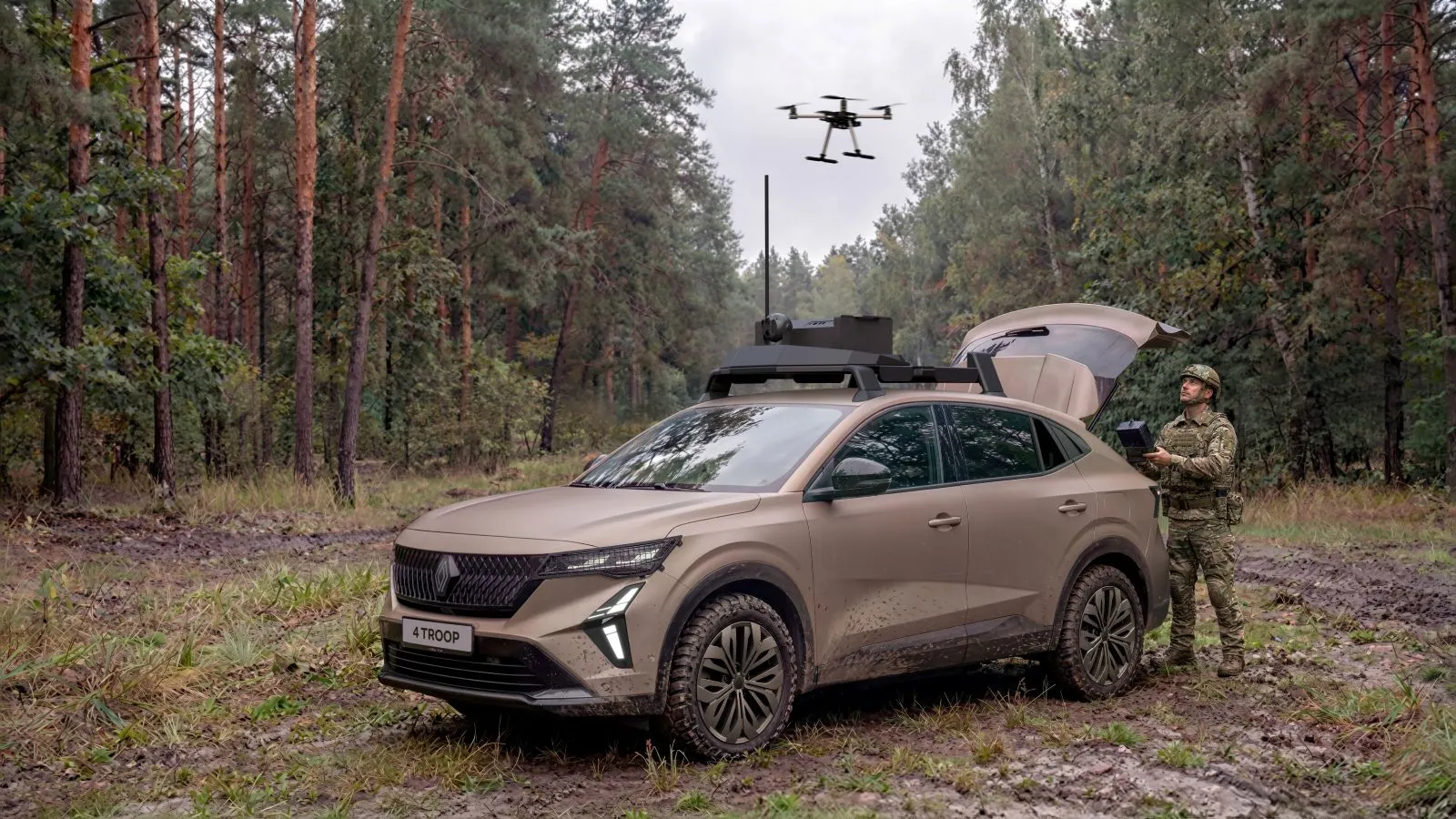


Renault just rolled out a prototype military vehicle. Let that sink in for a moment. The French automaker, best known for Clios and Kangoo vans, showed up at the Eurosatory 2026 defense exhibition with a hybrid-powered tactical platform built alongside aerospace and defense giant Thales Group.
The vehicle is called the 4 Troop, and it’s a militarized adaptation of what Renault calls its Véhicule Civil Multi-Rôles platform. It comes in two flavors — light commercial vehicle and SUV — both with four-wheel drive and a hybrid powertrain designed for near-silent running when the mission demands it.
Thales brings the brains. Its Combat Digital Platform handles secure communications, connectivity, and decision support, turning the vehicle into a rolling command center. Renault brings the body — mass-production expertise, proven civilian architectures, and a supply chain that can scale fast.
The pitch is straightforward: take battle-tested civilian platforms, harden them, wire them up with military-grade electronics, and deliver them at a fraction of the cost and timeline of traditional defense procurement. Reconnaissance, troop coordination, drone deployment, area surveillance — the 4 Troop is meant to do it all without requiring a purpose-built armored vehicle for every mission.
This is not some vanity exercise. Europe’s defense spending is surging under political pressure from both sides of the Atlantic, and the continent’s automakers smell opportunity. The defense sector promises long procurement cycles, fat margins, and government customers who pay their bills.
For Renault, whose core business faces the twin pressures of Chinese EV competition and tightening European emissions rules, a military revenue stream looks less like diversification and more like survival strategy.
Franck Naro, Renault’s engineering VP, framed it in the language of sovereignty. “We are exploring a pragmatic, sovereign approach to operational mobility,” he said, stressing the ability to mobilize production “immediately” using existing industrial capacity. That word — sovereign — carries enormous weight in European defense circles right now. It means built here, controlled here, independent of foreign supply chains.
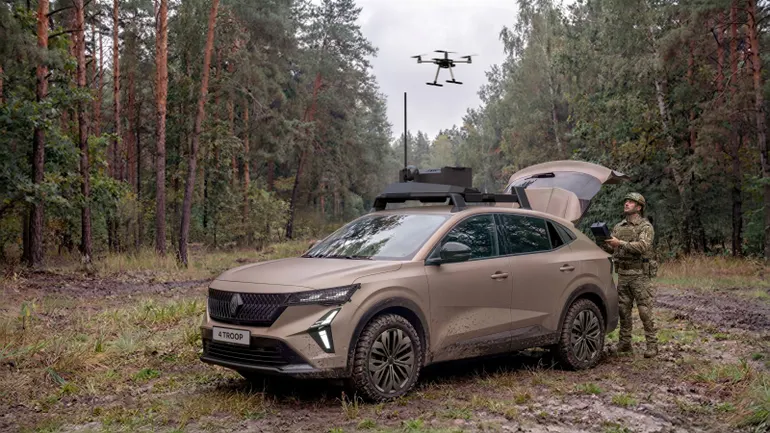
The hybrid powertrain is the quiet star of the package. Silent electric running for covert operations, combustion range for extended missions, and vehicle-to-load capability that lets the 4 Troop power field equipment or even charge other vehicles. It’s dual-use thinking applied to military hardware, and it makes the economics work because the underlying technology already exists in Renault’s commercial portfolio.
Thales EVP Christophe Salomon talked about transforming “tactical data into actionable understanding.” Strip away the defense jargon and he’s describing what every modern military wants: a networked vehicle that sees, thinks, and communicates faster than the enemy.
Details remain deliberately thin — this is a military program, after all. Armor levels, survivability specs, and specific electronic warfare capabilities were conspicuously absent from the joint announcement. What was present was a clear signal that Renault considers itself a defense-industrial player now, not just a carmaker lending its platforms to someone else’s project.
The traditional defense primes — KNDS, Rheinmetall, BAE Systems — should take note. They still own the heavy end of the market, the tanks and infantry fighting vehicles. But the light tactical space, the unglamorous workhorse segment that accounts for thousands of vehicles in any modern military fleet, is suddenly contested territory.
Renault and Thales are betting that a smart civilian platform beats a dumb purpose-built one every time. Given how European defense budgets are expanding and how urgently NATO allies need to field capability, they might be right.

Share this Story