
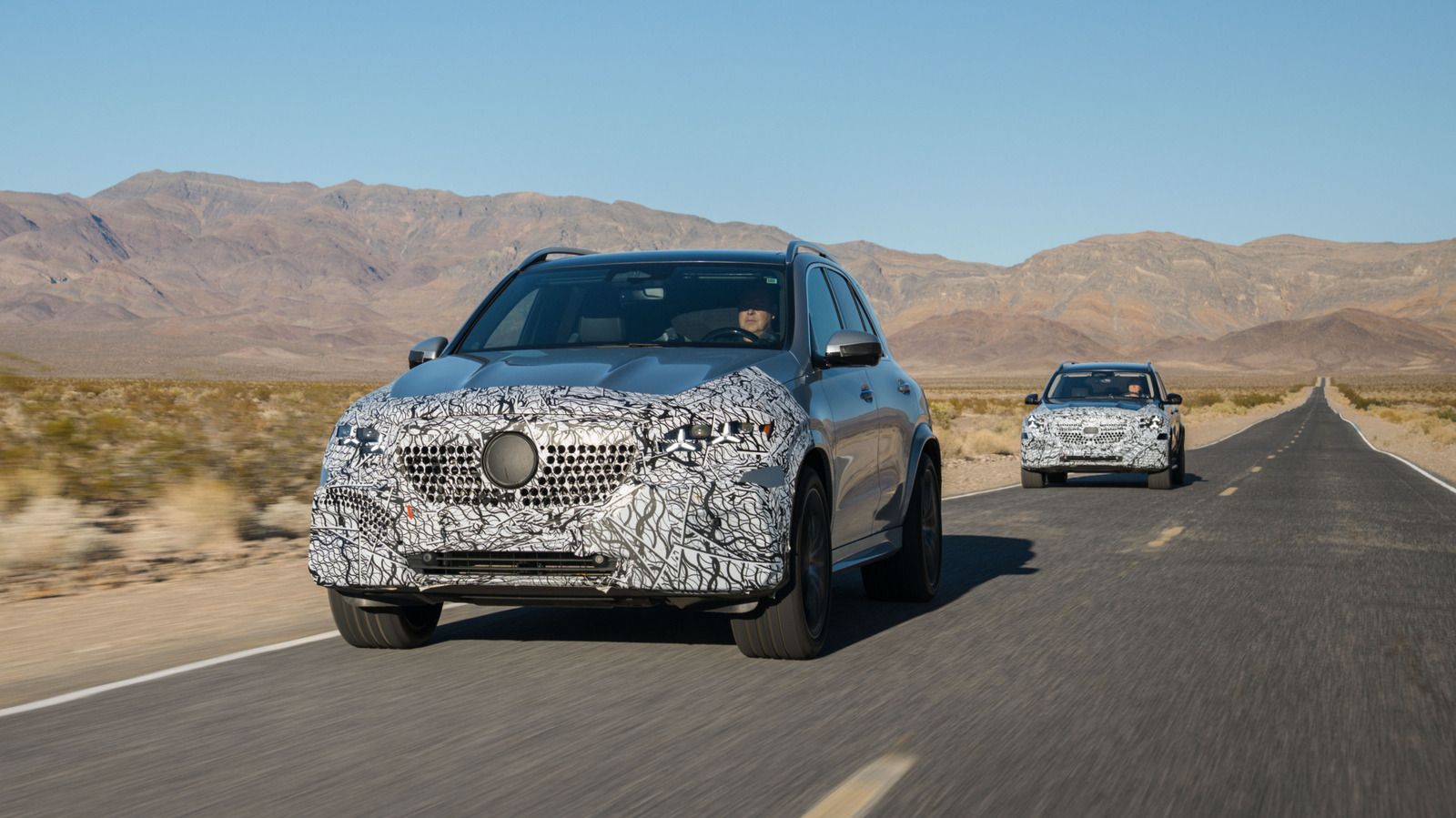


The 2027 Mercedes-Benz GLE and GLS are eight and nine years old, respectively. That’s geriatric by luxury SUV standards. So Mercedes did what you do when you can’t start over — it gave them new faces, better screens, and a V8 with a flat-plane crank.
Jalopnik’s Daniel Golson drove camouflaged prototypes of both facelifted SUVs on a convoy run from Las Vegas deep into the California desert last October, and Mercedes is set to reveal the finished products next week. The details that leaked through the camo tell a familiar story: bigger grilles, star-motif headlights and taillights, and a possible light bar spanning the tailgate.
Inside, both SUVs get the MBUX Superscreen combining three displays under one glass panel, running Mercedes’ latest MB.OS infotainment software. There’s a 3D driver’s display option, more streaming for rear passengers, and more physical controls on the steering wheel. Round air vents replace rectangular ones.
A vibrating massage function joins the spec sheet. None of it is revolutionary. All of it is overdue.
The powertrain story is more interesting. The turbocharged 3.0-liter inline-six with 48-volt mild-hybrid gains roughly 20 horsepower. The plug-in hybrid ditches its turbo-four for that same six-cylinder and promises longer EV range.
Even the base four-cylinder gets the 48-volt treatment. Whether the V8 GLE580 survives is unclear, but the GLS580 prototype was running Mercedes’ updated twin-turbo V8, now with a flat-plane crankshaft and 530 horses — the same unit from the refreshed S-Class.
The real flex was the suspension. Both prototypes wore Mercedes’ E-Active Body Control system, which uses forward-facing cameras to read the road surface and pre-adjust damping in real time. A new Car-to-X feature crowdsources road condition data from other drivers — if someone ahead hit a pothole, your suspension knows before you do.
At roughly $6,500 on current models, it’s expensive. It’s also worth it.
The GLS made the most compelling case, riding on three 23-inch wheels and one 22 after a flat tire the previous day. Golson reported he couldn’t tell anything was wrong. The system’s Curve mode, which actively leans the body into corners rather than fighting roll, turned these heavy SUVs into something that felt almost athletic on twisting canyon roads.
It’s a similar philosophy to Porsche’s Active Ride, and by all accounts, Mercedes’ execution is at least as convincing.
Mercedes says more than 12 million miles go onto these SUVs during their development cycle, with prototype testing spanning 12 countries. That kind of validation program isn’t unique — every major automaker does it. But the sheer geographic range underscores how long these platforms need to last in a global market.
Designs are often frozen three or more years before a car reaches dealers. Which gets at the tension underneath all the camo wrap and desert dust.
The GLE and GLS are fundamentally old vehicles being kept competitive with technology injections and cosmetic surgery. Mercedes isn’t reinventing them. It’s buying time.
The next-generation GLE is expected to share a platform with upcoming electric architectures, but that’s still years away. Until then, these facelifts need to hold the line against a BMW X5 that was redesigned in 2023 and a Cayenne that just went through its own refresh.
The German engineers leading the convoy apparently decided to open up the throttle on empty desert roads, pushing the prototypes past triple-digit speeds on dramatically rolling terrain. Both SUVs stayed stable, quiet, and composed — autobahn breeding showing its hand on American asphalt.
Mercedes will pull the camo off these SUVs within days. When it does, don’t expect surprises. Expect competence, polished to a shine, stretched as far as an aging platform allows.
Sometimes that’s enough. Sometimes it has to be.
Share this Story