
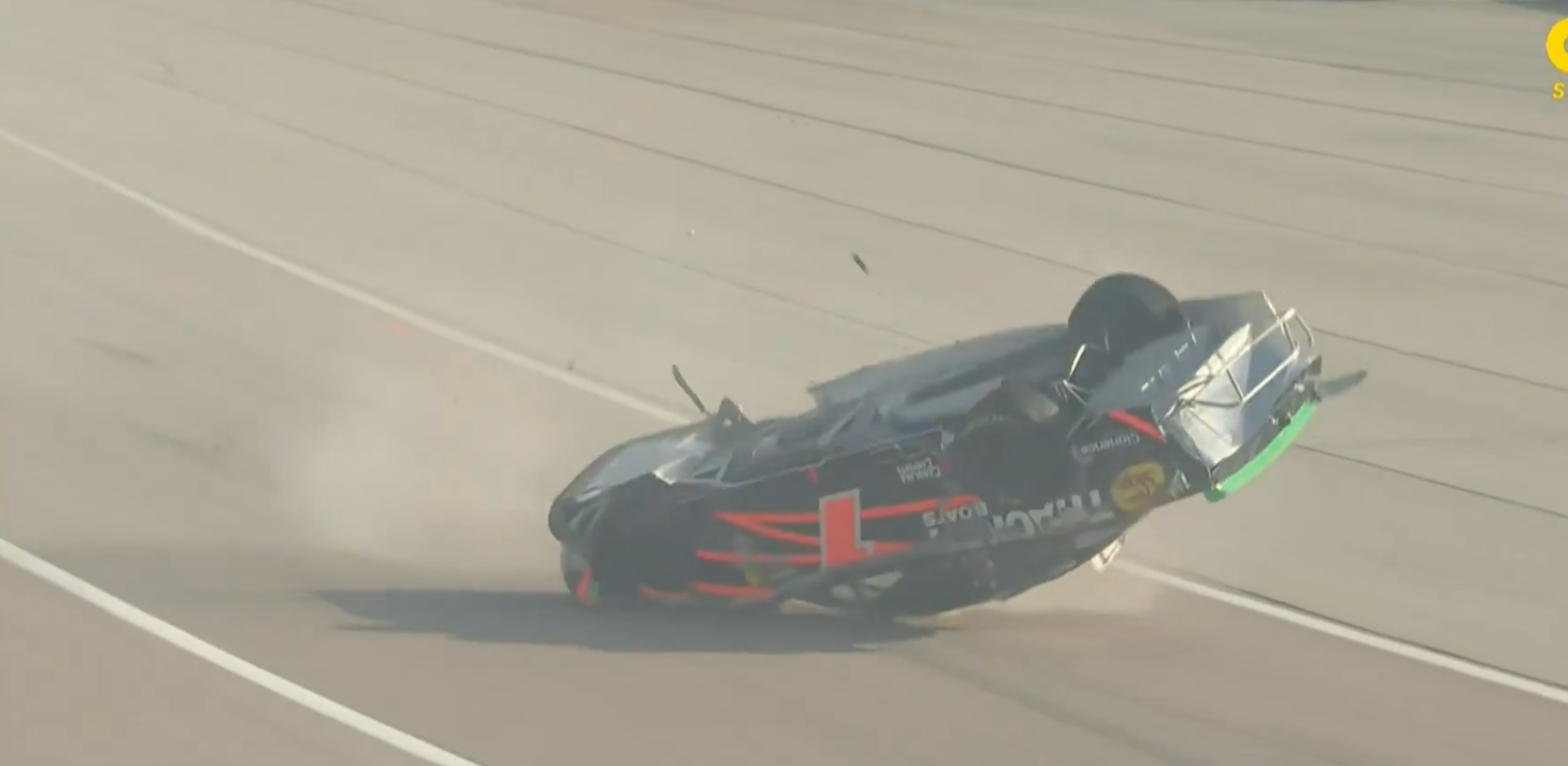


Carson Kvapil was leading the Kansas Lottery 300 on Saturday evening. Two laps later, his No. 1 JR Motorsports car was barrel-rolling down the backstretch like something you’d expect at Talladega, not a 1.5-mile intermediate.
The sequence was fast and ugly. Kvapil had grabbed the lead off the start from the outside of the front row, but William Byron and Corey Day swallowed him up almost immediately. As Byron and Kvapil jockeyed for position with the field closing in behind them, Josh Bilicki spun down onto the apron and the caution flag waved.
But the damage was already in motion.
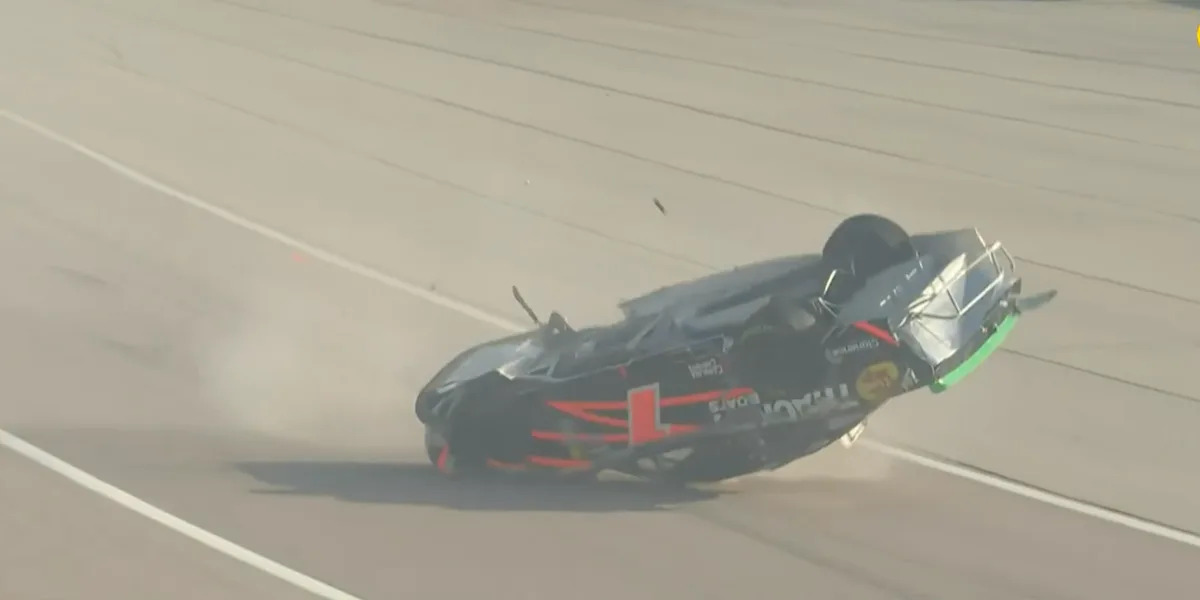
Kvapil got loose, took a hit from Byron, and slammed the outside wall. Then Parker Retzlaff plowed into the back of Kvapil’s car while crashing, catching the underside and launching it into a violent flip. The car tumbled through the air on the backstretch, the kind of wreck that makes television producers cut to commercial and makes crew chiefs go silent on the radio.
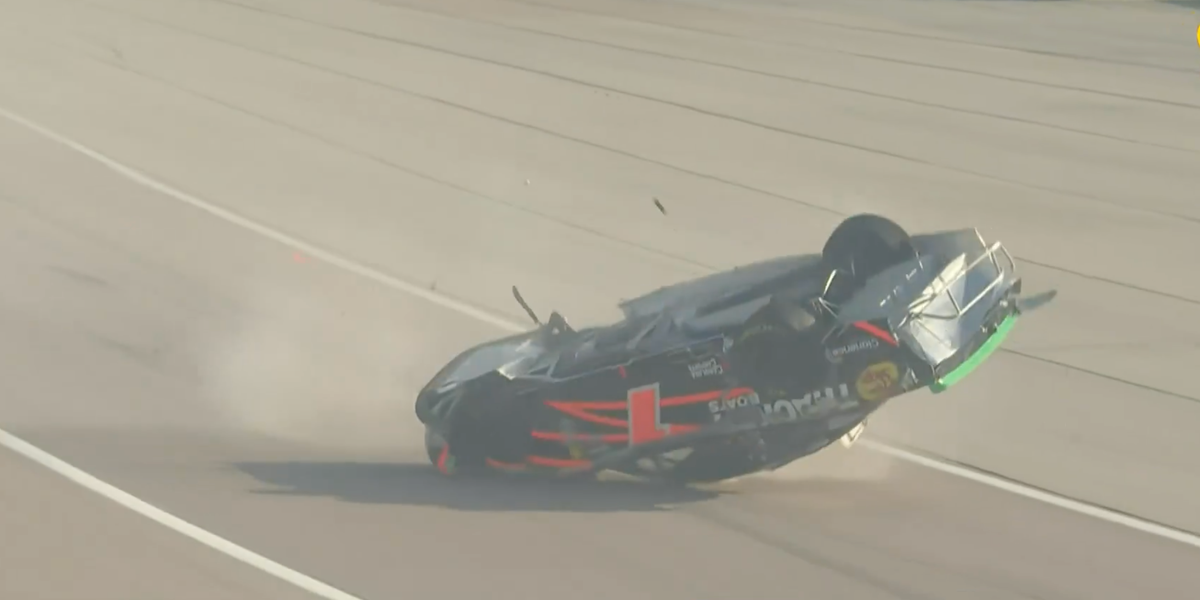
Safety crews righted the car. Kvapil climbed out under his own power, walked to the infield care center, and was seen and released. He was composed enough to talk to The CW Sports afterward, which itself tells you something about the state of modern NASCAR safety equipment.
“I actually didn’t think it was going to flip over like that, but once I started doing that, it didn’t really seem too bad,” Kvapil said, with the kind of nonchalance only a driver running on adrenaline can muster. His frustration was directed elsewhere. “My biggest thing is I just hated for this whole number one Bass Pro Shops team, Rodney and these guys. They brought a really fast race car.”
He had hoped to get through the opening laps, settle in, and race from there. He never got the chance.
Flips on intermediate ovals are genuinely rare in modern NASCAR. The restrictor-plate and superspeedway tracks — Daytona, Talladega, Atlanta, Michigan — account for nearly all the airborne incidents in the Cup and O’Reilly Series. Kansas Speedway, a 1.5-mile tri-oval, doesn’t typically produce that kind of wreck.
What happened Saturday was a chain reaction born from chaos, not pack drafting. A spinning car, a battle for position that went wrong, and a rear-end hit that caught the car at exactly the wrong angle. It’s the kind of crash that reminds everyone how thin the margin is between routine sheet metal damage and a car leaving the ground.
The context around the race made it worse. Friday’s practice and qualifying sessions were cancelled due to storms in the area, meaning the field rolled off for the race without a single competitive lap on the surface. Drivers were sorting out their cars in live traffic at 180 miles per hour. Kvapil acknowledged as much — he was just trying to get through those opening laps.
The race was red-flagged for 12 minutes to clean up the mess and didn’t go back to green until lap 28, following 25 laps under caution. A rough start to a night that began with a driver walking away from a wreck he had no business walking away from.
NASCAR’s safety advances — the composite body, the HANS device, the redesigned cockpit structures — have made moments like this survivable. Kvapil proved that again Saturday. But survivable and acceptable are two different standards, and flips at intermediates should prompt questions about what exactly went aerodynamically wrong when Retzlaff’s car caught the underbody.
Kvapil is fine. The car is scrap. The conversation, once again, is about whether the cars are too willing to fly.
Share this Story