
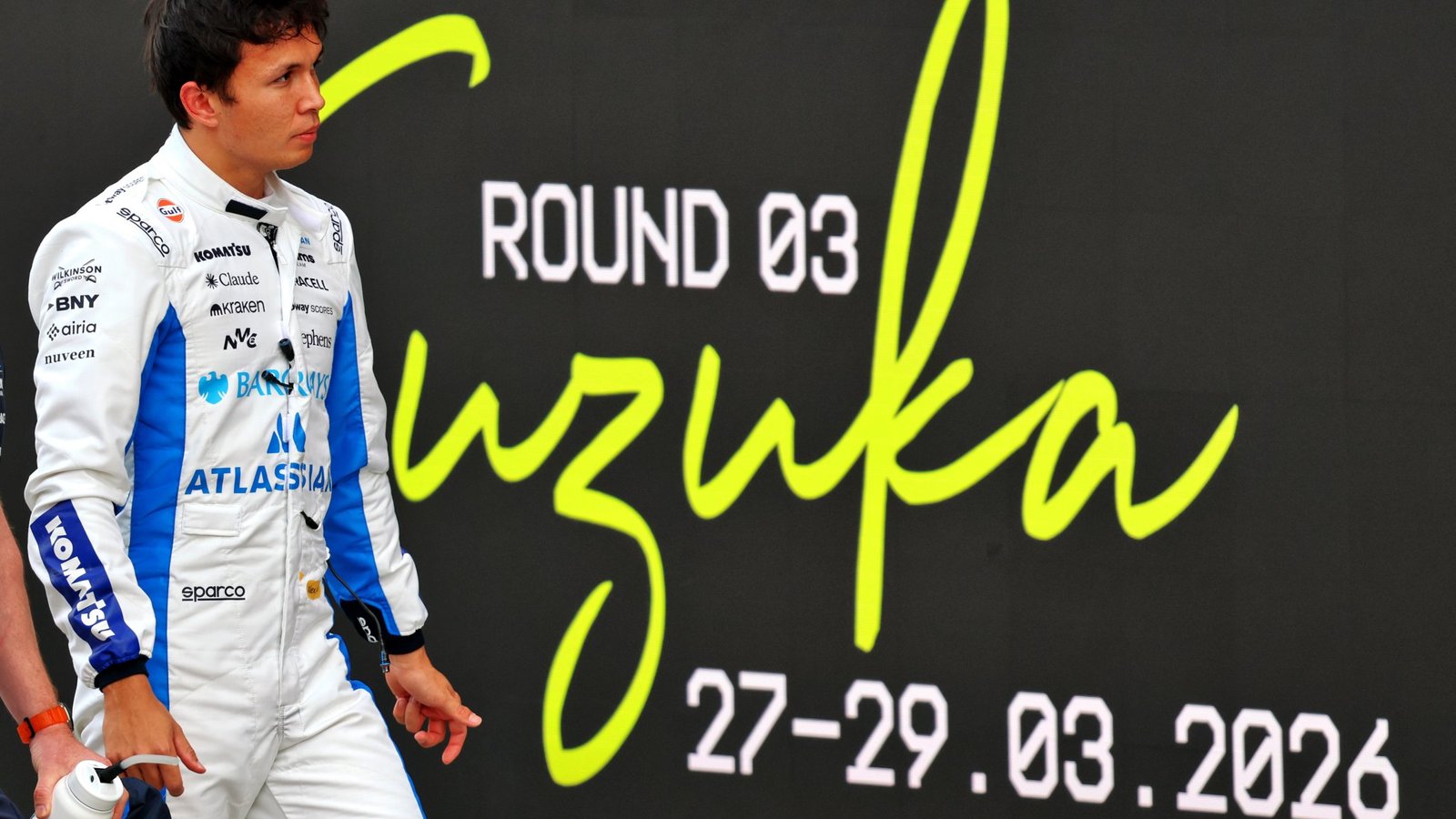


Alex Albon qualified 18th at Suzuka on Saturday, his third consecutive Q1 elimination in as many races. The sarcasm on team radio told you everything about where things stand between driver and team at Williams.
When race engineer James Urwin broke the news — “You probably don’t want to know, but you can probably guess” — Albon fired back without hesitation. “Yes, I complain for three races in a row that there’s something wrong, but I’m sure that it’s my driving style.”
That’s not a driver who’s confused. That’s a driver who’s been raising the same alarm since Melbourne and feels like nobody’s pulled the fire extinguisher off the wall.
The gap between him and teammate Carlos Sainz in Q1 was just 0.161 seconds, a razor-thin margin that separated advancement from elimination. Sainz scraped into Q2. Albon didn’t, for the third time running.
Sainz then posted the slowest time of the remaining 16 drivers in Q2, more than a second off his own Q1 pace. That tells you plenty about where the FW48 actually sits in the pecking order.
Team principal James Vowles came on radio after Sainz’s Q2 exit and called it a “good lap.” Then added: “It’s where the car is.” At least someone’s being honest about the machinery.
Albon, once he’d cooled down for the media pen, pulled back slightly but didn’t retreat. He told Crash.net he wouldn’t detail the issue publicly but confirmed the car feels strong through corners and lacking elsewhere. He described being happy with his driving, happy with the balance, quick through every turn — and still slower at the line.
The implication lands hard when you consider the 2026 regulations. Drivers must lift off through high-speed corners to harvest battery energy for deployment on straights. You can nail every apex and still cross the line slower if your energy management or deployment isn’t right.
Albon all but pointed at this without naming it directly: “You can be quicker in every corner and you can finish the lap slower, because there is a penalty to be applied.”
Williams says it has fixed some issues from Melbourne and China. Albon acknowledges that. But he insists there’s a separate, unresolved problem his team hasn’t yet tracked down.
He was careful to note the team isn’t ignoring him — “it’s not that they don’t believe me” — but three races of the same complaint producing the same result speaks for itself.
This is a team that came into 2026 with legitimate midfield ambitions and has instead found itself scrapping with Cadillac and Aston Martin at the bottom of the grid. Albon finished ahead of only Ollie Bearman and the backmarkers. For a driver who dragged the previous generation of Williams machinery into points through sheer racecraft and tire management, sitting 18th at Suzuka stings.
The overnight gap before Sunday’s race gives Williams a window to dig into the data. But data reviews don’t fix hardware problems. If the issue is rooted in energy deployment — a system-level concern baked into how the 2026 power units work — a Saturday night debrief isn’t going to solve it.
Three races, three Q1 exits, and a driver who sounds like he’s running out of patience faster than his car runs out of battery. Williams has an April break coming. They’re going to need every hour of it.

Share this Story