
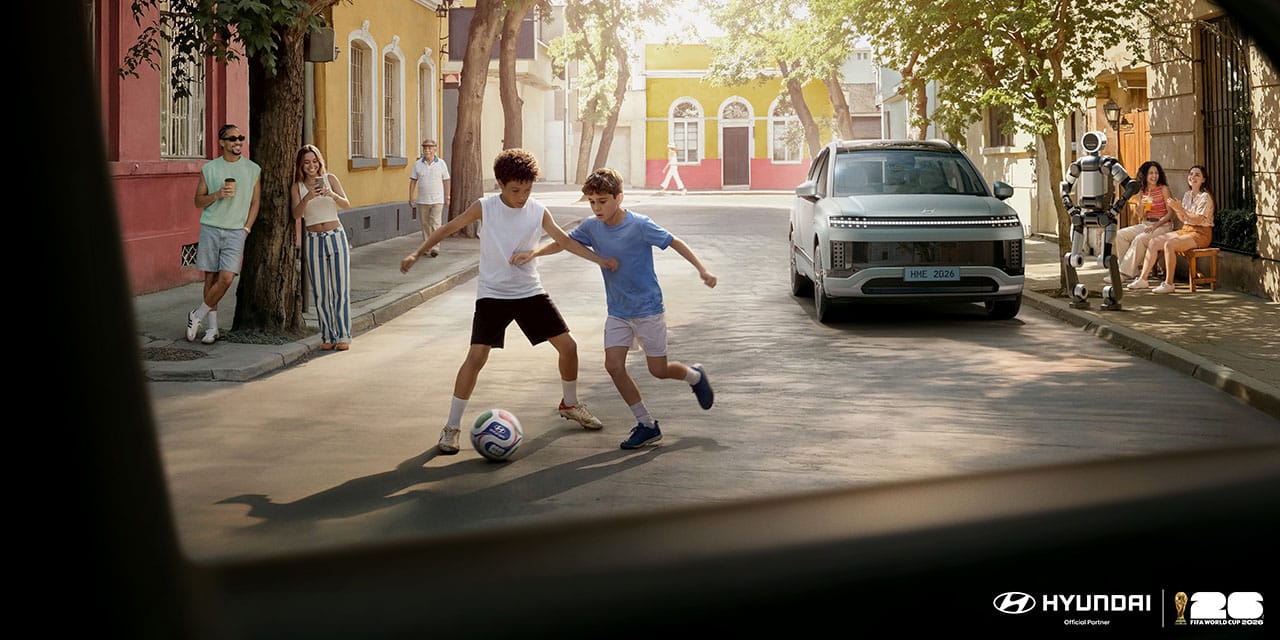


Hyundai Motor is sending humanoid robots to the FIFA World Cup. Not as a gimmick in a halftime show, but embedded into actual tournament operations alongside its vehicle fleet. Atlas and Spot, built by Boston Dynamics—a company Hyundai’s parent group acquired in 2021 for $1.1 billion—will be deployed at designated venues to support match logistics, fan engagement, and safety.
The announcement came at the 2026 New York International Auto Show on April 1, wrapped inside a new global marketing campaign called “Next Starts Now.” CEO José Muñoz called it the company’s “most ambitious collaboration yet” with FIFA, a partnership now in its 27th year. That is a long time to be the automaker ferrying officials and journalists between stadiums.
Hyundai clearly wants more than shuttle duty.
The company simultaneously named Tottenham-turned-LAFC star Son Heung-min as its global brand ambassador. A campaign spot pairs Son with Boston Dynamics’ Atlas, the electric humanoid robot that has been generating viral clips for years but has yet to find a clearly defined commercial role. Putting it next to one of the world’s most recognizable footballers is a visibility play, plain and simple.
Hyundai isn’t shy about what it’s doing here. Chief Marketing Officer Sungwon Jee said the campaign is about “bringing the future directly to fans” rather than waiting for it. That language sounds like boilerplate until you consider how aggressively Hyundai Motor Group has been repositioning itself.
This is a company that now spans EVs, urban air mobility, and a robotics division anchored by Boston Dynamics—an outfit that burned through cash under previous owners Alphabet and SoftBank before Hyundai took the reins.
The World Cup is the stage where Hyundai wants to prove those investments are converging. Atlas and Spot working alongside a fleet of vehicles at stadiums in the United States, Canada, and Mexico gives the company a live, global-audience proof of concept for its robotics-plus-mobility vision. Whether these robots do anything genuinely useful at the tournament or mostly serve as very expensive mascots remains to be seen.
There’s a softer side to the campaign too. Youth football camps in Atlanta, Miami, New Jersey, and Los Angeles will be led by Mia Hamm and Tim Howard, targeting kids ages six to twelve. A children’s drawing contest called “Be There With Hyundai” will put selected artwork on official team buses.
It’s community-level marketing designed to build emotional equity in host cities—smart groundwork for a Korean automaker selling cars in America during a period of intense trade scrutiny.
Meanwhile, Hyundai isn’t standing still on the product front. Just days after the World Cup campaign launch, the company officially debuted its IONIQ lineup brand in China with two new concept cars, signaling a fresh push into the world’s largest EV market after years of declining share there.
The thread connecting all of it—robots at stadiums, Son Heung-min in campaign spots, IONIQ concepts in Shanghai—is a company trying to outrun its own identity as a conventional automaker. Hyundai has spent decades building credibility through value, reliability, and an increasingly sharp design language. Now it wants to be seen as a technology company that happens to make cars.
The World Cup gives Hyundai roughly a month of global attention across 48 teams and 104 matches in three countries. That is an enormous canvas. The question isn’t whether people will notice Atlas walking around a stadium. They will.
The question is whether Hyundai can turn spectacle into substance—whether robots on a pitch translate into anything resembling a business case, or whether this is the most expensive brand exercise in the company’s history.
Twenty-seven years of FIFA sponsorship buys a lot of goodwill. Deploying humanoid robots at the biggest sporting event on earth buys something different: a narrative. Hyundai is betting that narrative is worth more than another fleet of sedans parked outside the stadium.
Share this Story