
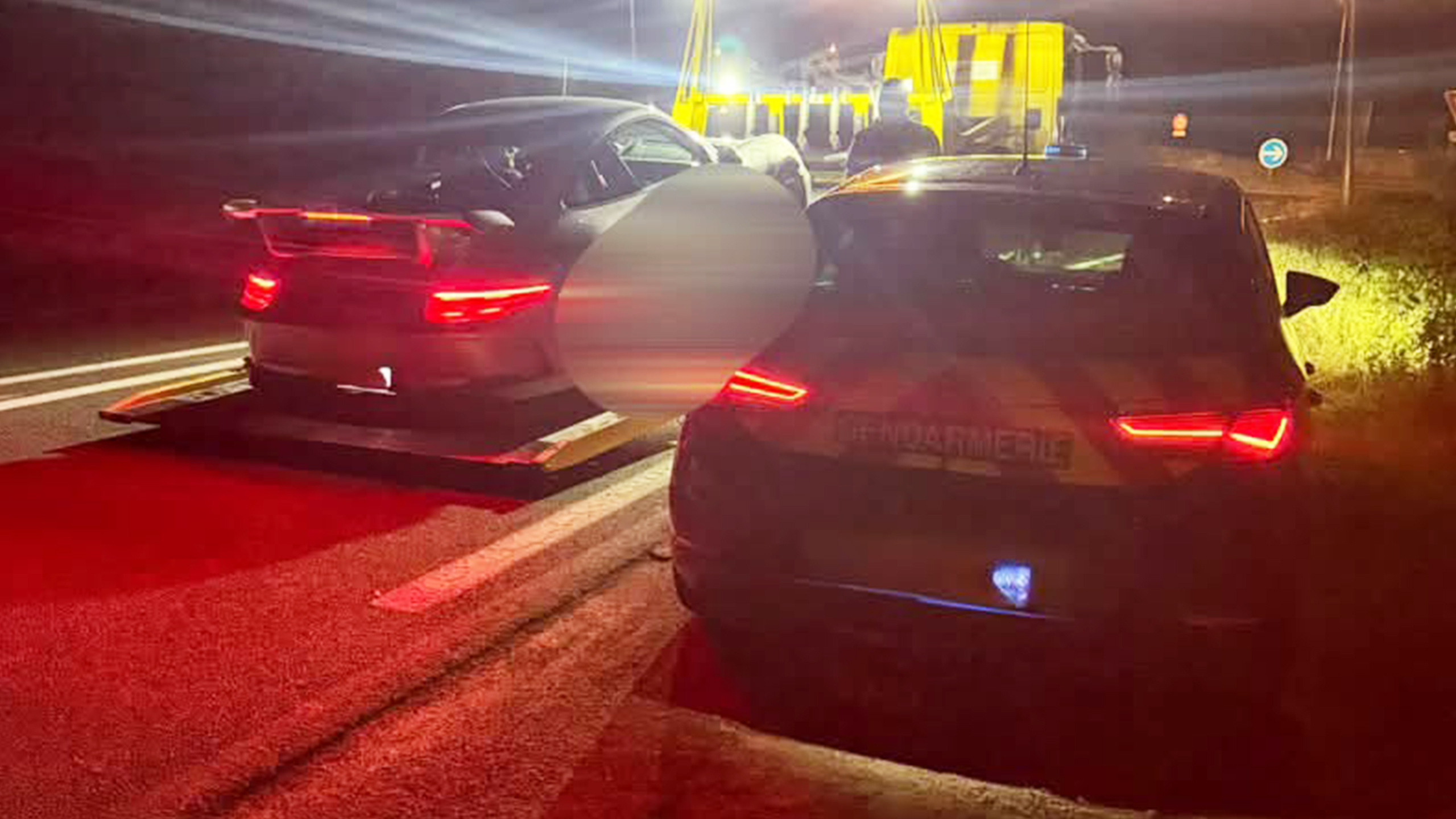


A 48-year-old Swiss executive pushed his Porsche 911 GT3 to 194 mph on a French highway last week, nearly maxing out the car’s 195 mph top speed. French gendarmes in Haute-Savoie clocked him on the A40, a road with an 81 mph speed limit. He was doing more than double it. Closer to triple.
The Gendarmerie de la Haute-Savoie posted a photo of the 991.1-generation GT3 and the radar gun on Facebook, the kind of public shaming European police have gotten fond of. The car was towed on the spot. The man’s French driving privileges were revoked immediately, and he posted a €1,500 bond before walking away.
That bond is pocket change for someone who owns a GT3 and holds a Swiss executive title. The real sting is the car sitting in a French impound yard.
French police applied their standard 5 percent radar tolerance, which brought the official recorded speed down to 186 mph. Even after that generous haircut, it stands as the fastest speed ever detected by law enforcement in France. The previous record belonged to an Audi RS3 caught at 178 mph earlier this year.
The driver is scheduled to appear in a French court in February, where he faces a potential fine of up to €3,750 and as many as three months in prison. Neither figure sounds particularly devastating for a man who was willing to wring every last mph out of a six-figure sports car on a public road.
But here is where the story turns. Local media reports that the radar unit used to clock him is only certified for speeds up to 186 mph. The raw reading was 194 mph, well beyond the device’s approved range. That gap between what the radar measured and what it was built to measure could hand the driver’s lawyers a technical defense that unravels the entire case.
It would be a bitter irony. The fastest speed ever caught on a French road, dismissed because the equipment was never designed to catch someone going that fast. French prosecutors will have to argue the reading is reliable. The defense only has to argue it might not be.
His license suspension applies only in France, so back in Switzerland he is free to drive. Whether he will have anything to drive is another question. Getting a car out of a French impound lot after a criminal speed case is not a quick phone call.
The A40 through Haute-Savoie is a divided highway that cuts through the foothills of the Alps, linking Geneva to points west. It is smooth, well-maintained, and for long stretches relatively straight. In other words, exactly the kind of road where someone with more horsepower than judgment decides to see what the speedometer really says.
A 991.1 GT3 uses a naturally aspirated 3.8-liter flat-six producing 475 horsepower, mated to a PDK dual-clutch transmission. It is a precision instrument built for track work. On public roads, at 194 mph, the margin between a speeding ticket and a catastrophic wreck shrinks to almost nothing.
The court date is four months away. The radar certification question will likely determine whether this becomes a landmark French traffic case or a footnote that disappears on a technicality.



Share this Story