
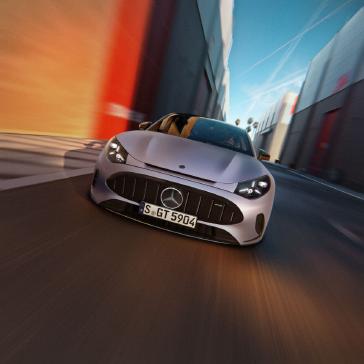


Mercedes-AMG just dropped the entry ticket to its new GT 4-Door Coupe family, and it runs on batteries. The GT 53, unveiled out of Affalterbach, packs 536 hp from two electric motors, hits 60 mph in 3.4 seconds, and claims more than 500 miles of range on the European WLTP cycle. It arrives at U.S. dealers in early 2027.
No combustion engine lives under that long hood. Not even a turbocharged inline-six. The GT 53 uses twin permanently excited synchronous motors, one on each axle, producing 590 lb-ft of torque.
The rear motor handles the heavy lifting with 93 percent battery-to-wheel efficiency. The front motor engages through a disconnect unit only when the car needs extra traction or power, then uncouples itself to save energy.
The battery is where AMG flexes hardest. An 800-volt architecture with 106 kWh of usable capacity, built around 2,660 cylindrical cells cooled individually by electrically non-conductive oil. AMG calls it Formula 1-derived, and the specs back up at least some of that claim.
The pack uses NCMA cathode chemistry pushing over 298 Wh/kg energy density. DC fast charging tops out at 600 kW, enough to add roughly 330 miles of range in ten minutes. The system automatically drops to 400-volt compatibility at older charging stations.
A two-speed transmission on the rear axle pairs an 11:1 first gear for launches and city driving with a 5:1 second gear tuned for highway cruising and high-speed pulls. Shift points vary by driving mode.
Then there is the sound. AMG engineers recorded their 3.0-liter inline-six from the old E 53 Coupe using 16 microphone positions and over 100 measurements. They digitized every characteristic and piped it through the speakers.
In the Sport+ drive mode, the GT 53 simulates gear changes and plays synthesized six-cylinder noise that AMG insists is not mere imitation but acoustic recreation. Steering wheel paddles let you “shift” manually. A dedicated driver display even mimics a traditional tachometer.
Whether that qualifies as authenticity or theater depends on your tolerance for fiction.
The chassis rides on air suspension with adaptive dampers offering three firmness settings. All-wheel drive distributes torque variably between axles thanks to the decoupled motor setup. AMG claims the car sits 1.6 inches lower than its predecessor despite carrying a floor-mounted battery pack.
Active aerodynamics come standard. A rear spoiler adjusts its angle based on speed, acceleration, and driving style, retracting at low speeds and deploying fully during aggressive driving or via a steering wheel button. An optional active rear diffuser extends the bodywork to reduce drag at highway speeds, aimed squarely at protecting range during long hauls.
Inside, a 14-inch central screen angles toward the driver. Individual rear seats replace the usual bench. An optional panoramic glass roof switches between transparent and opaque in segments.
A rotary dial on the console lets drivers tune accelerator pedal sensitivity independent of the selected drive mode, from lazy to aggressive. Six drive programs span the expected spectrum: Comfort, Sport, Sport+, Slippery, Eco, and Individual. Eco mode cuts power output, limits accessories, and switches to rear-drive only.
AMG is selling this as a GT car first, an EV second. The emphasis on range, charging speed, ride comfort, and that synthetic exhaust note all point to a company trying to keep its existing customer base from bolting while the drivetrain underneath changes completely.
Pricing has not been announced. With the GT 63 and GT 55 siblings already revealed, the GT 53 slots in as the volume play for a nameplate that used to require eight cylinders just to qualify.




Share this Story