
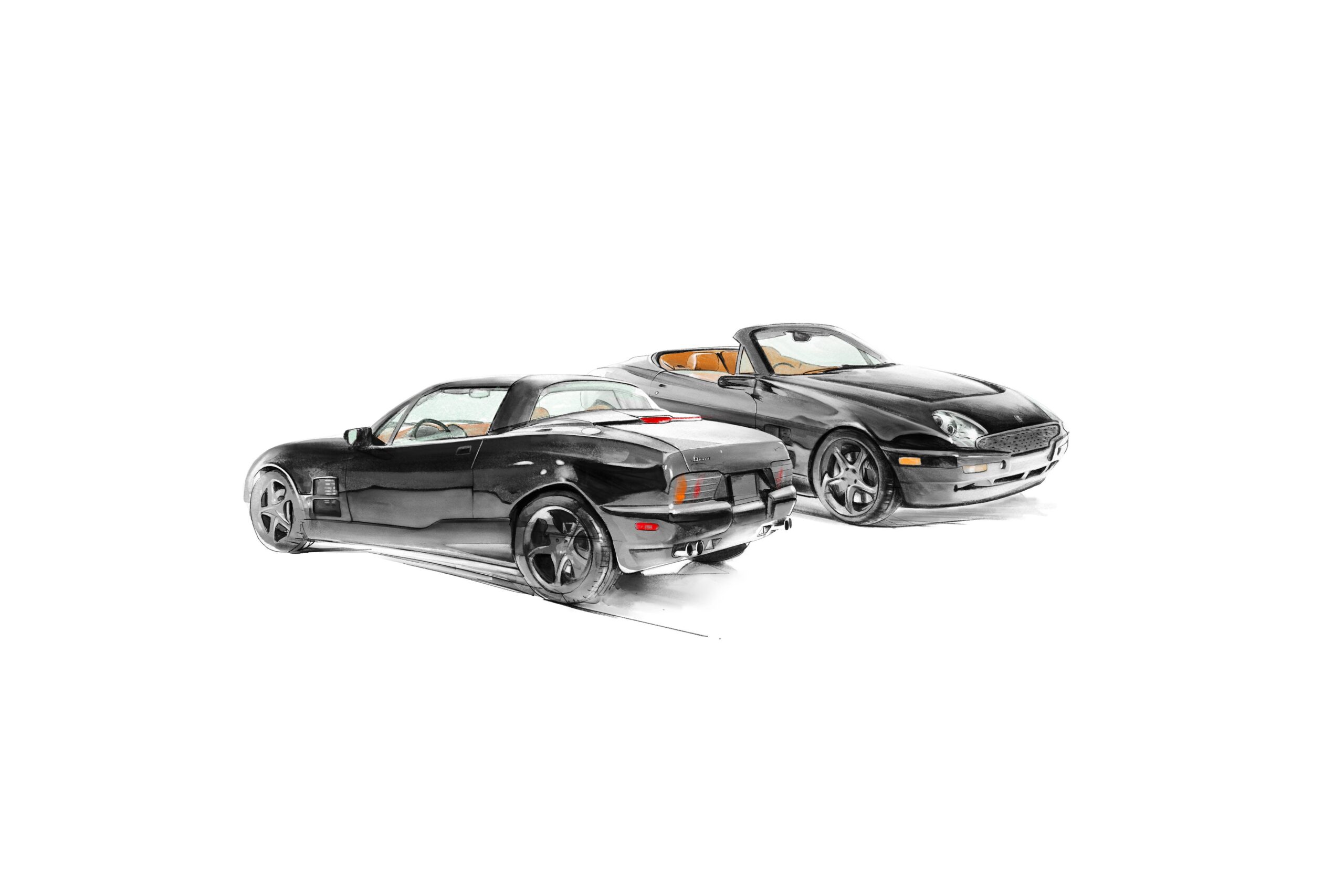


Only 284 Qvale Mangustas ever left the factory in Modena. That number alone should make collectors salivate. Instead, most people who encounter one on the street assume it’s Russian.
The Mangusta story is one of those beautiful automotive train wrecks where ambition, ego, money, and questionable styling converge into something you can’t stop staring at. San Francisco megadealer Kjell Qvale poured nearly $30 million into bringing this car to American driveways, buying his way into a partnership with Alejandro de Tomaso. De Tomaso was the Argentine provocateur who once displayed an ankle-holstered pistol at a dinner table before launching a food fight with jeweler Nicola Bulgari.
That partnership predictably imploded. De Tomaso’s talent for scorched-earth relationships was legendary. The fallout meant the car arrived wearing the Qvale badge instead of De Tomaso’s, and exactly no one outside the two warring camps noticed or cared.
Marcello Gandini drew the lines, and you can see his fingerprints in the canted rear wheel arches. The shape first surfaced as the 1996 Bigua concept and split opinion like a cleaver. The nose had a certain confidence.
The rear end invited questions about unflattering color choices. John Phillips, writing in Car and Driver’s July/August 2026 issue, loved it anyway, lumpy fanny and all.
Under that polarizing skin sat a Ford 4.6-liter double-overhead-cam V-8 from the Mustang Cobra, producing 320 horsepower and mated to a five-speed manual. Bone stock, bulletproof, and cheap to fix. The Mangusta belonged to a proud lineage of low-volume European cars that raided Dearborn’s parts bin, from the Sunbeam Tiger to the Pantera to the AC Cobra.
If you wanted exotic styling with domestic repair bills, this was the formula.
The interior mixed triple-stitched Connolly leather and brushed aluminum with a few too many Mustang parts. The steering column, instrument panel, door handles, and switchgear all came straight from Ford’s catalog. Cost containment has a face, and it looks like a Mustang’s turn signal stalk poking out from behind a chrome bezel.
Car and Driver’s staff mostly dismissed it as a repackaged Mustang with a kit-car complexion, an “Italian TVR” with all the expected squeaks and rattles. The ill-fitting targa top was the chief offender. But the car delivered where it counted: compliant ride, light steering, nearly balanced handling, and 5.5 seconds to 60 mph.
At over $80,000 new, it cost roughly the same as the Panoz Esperante and half as much as mainstream Italian exotica. It was less a sports car than a grand tourer in the Aston Martin mold, just with a name nobody could pronounce and a pedigree that required a footnote.
Today you can find a clean, low-mileage example for around $35,000. Phillips himself nearly pulled the trigger on one at auction before his wife reminded him about a stalled bathroom renovation. The previous owner’s sales pitch was less than inspiring: “Nobody knows what this car is. One guy thought it was Russian. I’ve got enough problems with my own identity.”
That anonymity is both the Mangusta’s curse and its unlikely asset. Fewer than 300 were built and prices sit at a fraction of their original sticker. Every other sub-300-unit Italian car from this era commands six figures or more.
The Qvale Mangusta just sits there, waiting for the world to figure out what it is.
Share this Story