
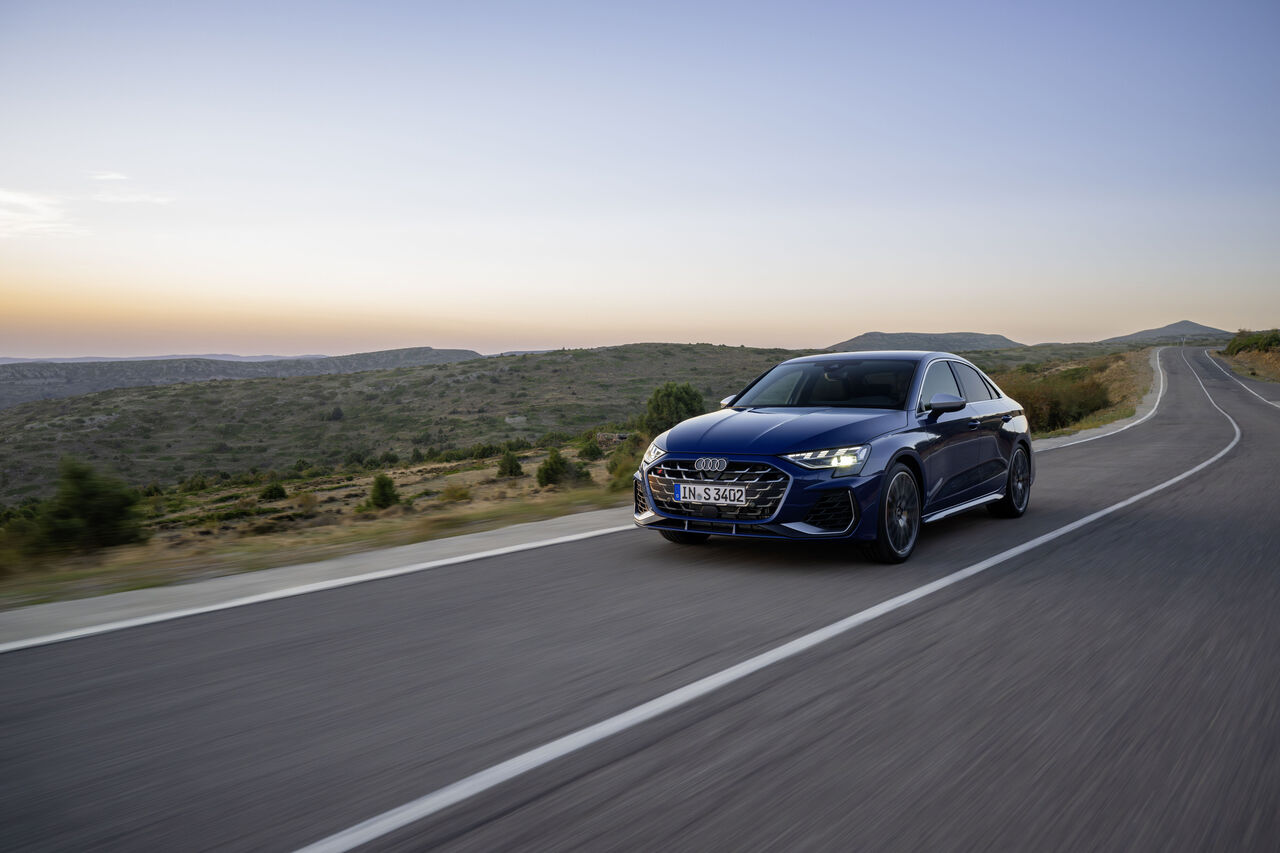


Starting at 31,850 euros, the updated Audi A3 arriving at European dealerships in September 2026 looks roughly the same on the outside. Inside, it’s a different car entirely.
Ingolstadt just revealed a mid-cycle overhaul of its compact bestseller that prioritizes screens, software, and semi-autonomous driving tech over any meaningful mechanical changes. The centerpiece is a new curved panoramic display combining an 11.9-inch virtual cockpit with a 12.8-inch MMI touchscreen. That’s hardware lifted straight from Audi’s larger, more expensive models and dropped into the A3’s dashboard for the first time.
The redesigned cockpit gets a wider decorative inlay stretching from the instrument cluster to the passenger door, four material options including carbon fiber, and a driver-oriented wireless charging tray bumped up to 25 watts. Every steering wheel now gets a physical scroll wheel built into the multifunction buttons. That’s a quiet concession that touch-sensitive controls weren’t the revelation Audi once claimed.
But the real story here isn’t the screen. It’s how aggressively Audi is pushing driver-assistance tech down into its entry-level lineup.
The new adaptive cruise assist plus combines ACC with active lane guidance up to 210 km/h and can now execute lane changes when the driver triggers the turn signal. It brakes automatically at red lights and drives on when they turn green, provided the car hasn’t fully stopped. For the first time in the A3, the system uses swarm data from other vehicles on the same road and online map information to maintain lane positioning even without visible markings.
That online data access comes free for three years. After that, Audi wants you to pay. Welcome to the subscription era of driver aids.
Parking tech gets a similarly aggressive upgrade. Four surround-view cameras generate a pannable, zoomable 3D exterior view. Park assist pro adds remote capability through the myAudi app — pull up, get out, and let the A3 slot itself into a tight space while you watch from your phone. A trained parking feature memorizes up to five specific maneuvers over 50 meters, so that awkward garage entrance only needs to be navigated manually once.
On the powertrain front, Audi changes almost nothing. Gasoline and diesel engines at 116 and 150 PS carry over. The plug-in hybrid still comes in 204 and 272 PS flavors with up to 143 kilometers of electric range and DC fast charging in about 30 minutes.
One notable tweak: the e-hybrid’s towing capacity jumps 300 kilograms to 1,700 kg. That’s a practical addition that suggests Audi knows who’s actually buying these cars.
The S3 soldiers on with its 333 PS turbocharged four-cylinder and quattro all-wheel drive with the torque splitter. The RS 3 keeps its five-cylinder. Both get unique digital daytime running light signatures and specific badges in the Singleframe grille — visual differentiators, not performance ones.
Pricing climbs from 31,850 euros for the base Sportback to 45,350 euros for the e-hybrid, 57,200 euros for the S3, and 68,500 euros for the RS 3. That base price buys a lot more technology than it did a year ago. Whether anyone asked for functions-on-demand audio upgrades and subscription-gated lane keeping in a compact car is a separate question.
Audi is betting that the A3 buyer in 2027 cares less about what’s under the hood and more about what’s on the screen. The powertrain lineup remains untouched while the digital architecture gets a ground-up rethink, so Ingolstadt has made its priorities clear. The compact car isn’t getting faster — it’s getting smarter, and more expensive to keep that way.

Share this Story