
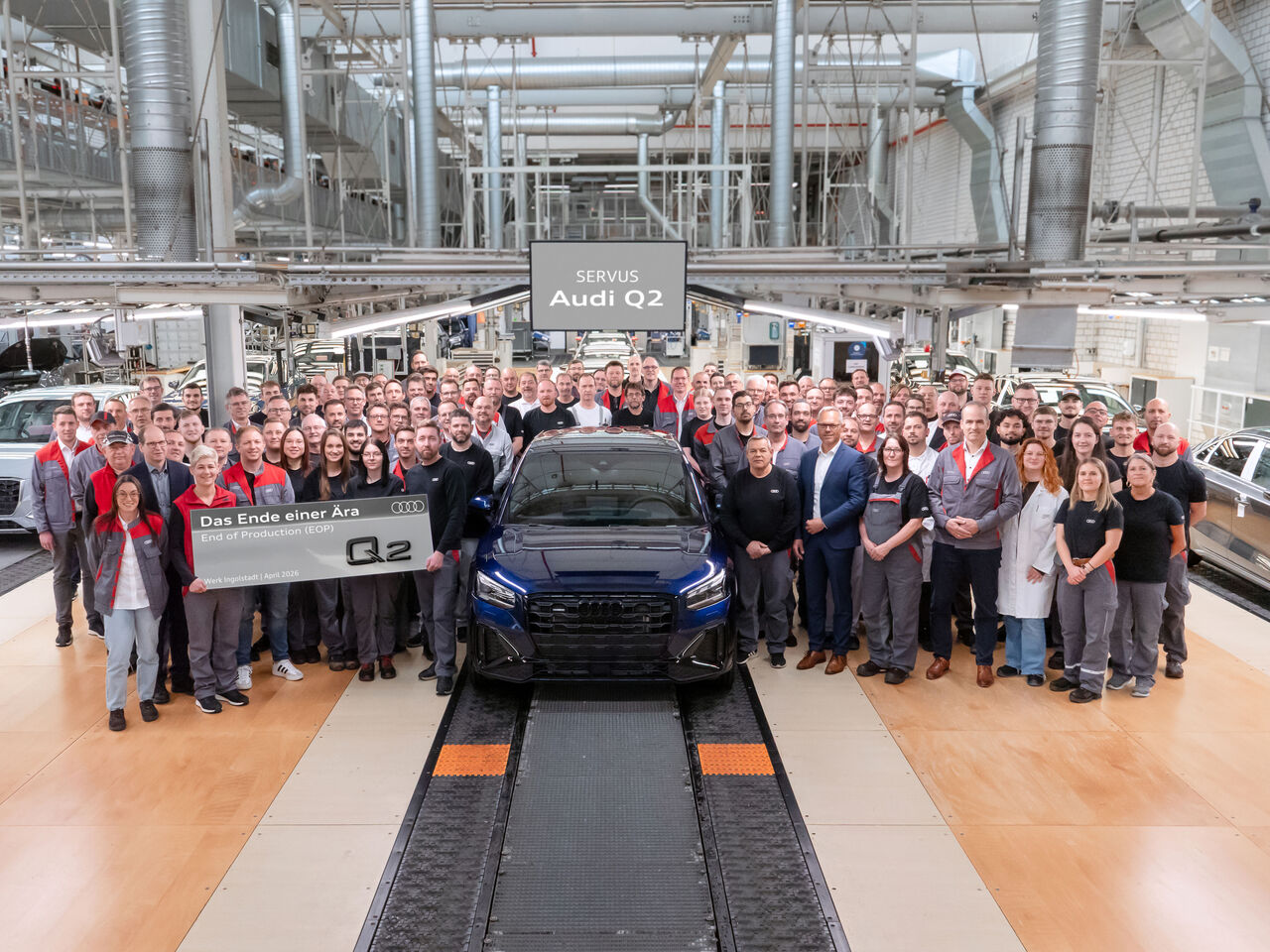


The last Audi Q2 rolls off the Ingolstadt line this month. After 887,231 units delivered since 2016, it’s done. Simultaneously, the A1 ends production in Martorell, Spain, closing out a 15-year, nearly 1.4-million-unit run.
Two of Audi’s most accessible entry points into the brand are gone. What replaces them tells you everything about where the four rings are headed and what compromises they’re making to get there.
Starting mid-2026, Ingolstadt picks up production of the Q3, but not in the conventional sense. Vehicle bodies will be built at Audi Hungaria in Győr, then shipped by rail to Germany for paint and final assembly. It’s a split-production arrangement Audi is calling “integrated production,” a model born from a future-pact agreement signed in March 2025 designed to balance capacity across sites.
In plain language, Ingolstadt needed volume work to keep the lines busy, and Győr had the body shop capacity to share.
Plant manager Siegfried Schmidtner framed it diplomatically: “Working closely with Győr, we are turning a new page.” That page involves shipping unpainted car bodies across borders on freight trains, a logistical feat the supply chain teams apparently stood up in under a year. It’s efficient, but it’s also a clear signal that Audi’s German flagship plant can no longer sustain itself on combustion models alone.
The bigger headline out of Ingolstadt is the Audi A2 e-tron, slated to begin production this fall. It will be the third fully electric model built at the main plant, following the Q6 e-tron in 2023 and A6 e-tron in 2024. The A2 nameplate carries some baggage — the original A2, a lightweight aluminum city car from the early 2000s, was a commercial flop that became a cult hero.
Whether this electric revival fares better depends on pricing and timing, neither of which Audi disclosed.
Neckarsulm is grinding through what Audi calls the largest ramp-up in that plant’s history, rolling out refreshed A5 and A6 families along with the new RS 5. At the adjacent Böllinger Höfe facility, preparations are underway for a fully electric sports car teased by the Concept C show car, due in 2027.
The math here is stark. Audi is sunsetting two high-volume, affordable combustion models without direct replacements in those segments. The A2 e-tron may eventually serve as a spiritual successor, but electric small cars have historically struggled to hit price points that attract the same buyers.
The Q2 and A1 were gateway drugs into the Audi ecosystem in the UK, Germany, and Italy. Losing them creates a gap at the bottom of the lineup that an EV may or may not fill.
Audi’s broader strategy is now visible in full relief: combustion, hybrid, and electric models running on shared lines, with production spread across an international network that trades simplicity for flexibility. Ingolstadt alone will build the A3, Q3, Q6 e-tron, A6 e-tron, and A2 e-tron — five model lines spanning two powertrains. That’s a complex cocktail for any single plant.
The company is also pushing Neckarsulm toward becoming a digitalization and AI hub, leaning on its proximity to the Heilbronn Innovation Park. It’s the kind of forward-looking positioning that reads well in press releases but means nothing until it changes how cars are actually built or sold.
What Audi has done here is place an enormous bet on flexibility — the idea that one plant can juggle combustion and electric vehicles, domestic and imported body shells, legacy nameplates and brand-new architectures, all without tripping over itself. History suggests that kind of complexity is easier to announce than to execute. The Q2 and A1 were simple, profitable, and beloved — their replacements are none of those things yet.
Share this Story