
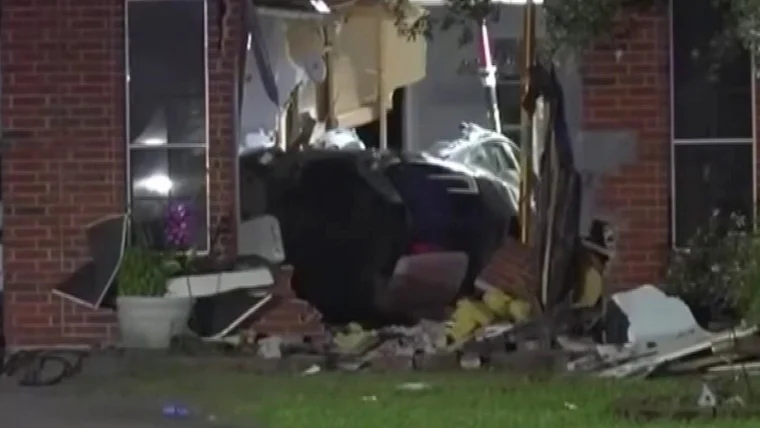


Seventy-three miles per hour on a residential street with a 30 MPH speed limit. The accelerator pressed to 100 percent. Still pressed after the car tore through a brick house and killed a woman sitting inside.
That’s what Tesla says its data shows from the fatal Model 3 crash in Texas that went viral last week, spawning immediate speculation that Full Self-Driving or Autopilot had malfunctioned. Tesla CEO Elon Musk pushed back Monday, posting on X that “FSD drives slowly through neighborhood streets, and this was a high-speed crash.
Ashok Elluswamy, Tesla’s Head of AI, provided the specifics. The driver “manually overrode self-driving by pressing the accelerator all the way to 100%,” he said, adding that the pedal remained floored even through the moment of impact. The victim, identified by the New York Post as Matha Avila, was inside her home when the Model 3 came through the wall.
NHTSA has opened an investigation. Tesla says it will cooperate fully. But the company isn’t waiting for the agency’s conclusions before making its case publicly, a pattern that has become familiar.
This is almost a carbon copy of a 2021 incident in Harris County, Texas, where early reports blamed a fatal crash on Autopilot. After the NTSB investigated with Tesla’s data, the agency concluded there was “no use of the Autopilot system at any time during this ownership period of the vehicle.” The accelerator in that crash had been applied at up to 98.8 percent, and the top recorded speed was 67 MPH.
The parallels are striking enough that Tesla clearly wants the public to draw the connection. Two Texas crashes, both fatal, both initially pinned on autonomous technology, both showing pedal-to-the-floor driver input in Tesla’s telemetry.
There’s a reason the company moves fast on these stories. Every viral crash blamed on FSD or Autopilot feeds a narrative that dogs Tesla’s autonomous ambitions, from its robotaxi plans to its regulatory negotiations to its stock price. The faster Tesla can reframe the story around driver behavior, the less damage sticks.
But speed cuts both ways. Tesla is presenting its own data before any independent agency has verified it. The company has a direct interest in the outcome.
NHTSA’s investigation hasn’t concluded. Local authorities are still working the scene. The driver’s account, if one exists, hasn’t surfaced publicly.
None of this means Tesla’s data is wrong. Vehicle telemetry from modern EVs is extraordinarily detailed, logging accelerator position, brake inputs, steering angles, and system status at granular intervals. If the logs show 100 percent throttle application sustained through impact, that’s a difficult thing to fabricate or misinterpret.
Still, the sequence matters. Tesla’s public defense arrived hours after the crash made national news. The official investigation will take weeks or months. In the gap between the two, public opinion hardens.
The broader tension is one the industry has failed to resolve. When a car equipped with advanced driver-assistance technology crashes, who or what gets blamed first? The software is always the suspect, even when a human foot is doing something the software never would.
FSD doesn’t do 73 in a neighborhood. A panicked or impaired human driver absolutely can.
That doesn’t absolve the technology of scrutiny. NHTSA should investigate every fatal crash involving ADAS-equipped vehicles, and Tesla should hand over every byte of data. But the reflex to blame the machine before examining the human is becoming its own kind of obstacle, one that distorts public understanding of both the risks and the capabilities of these systems.
Matha Avila is dead. The investigation will determine why. Until it does, the data Tesla has released is the clearest account available, and whether it holds up under federal review is the only question that matters now.

Share this Story