
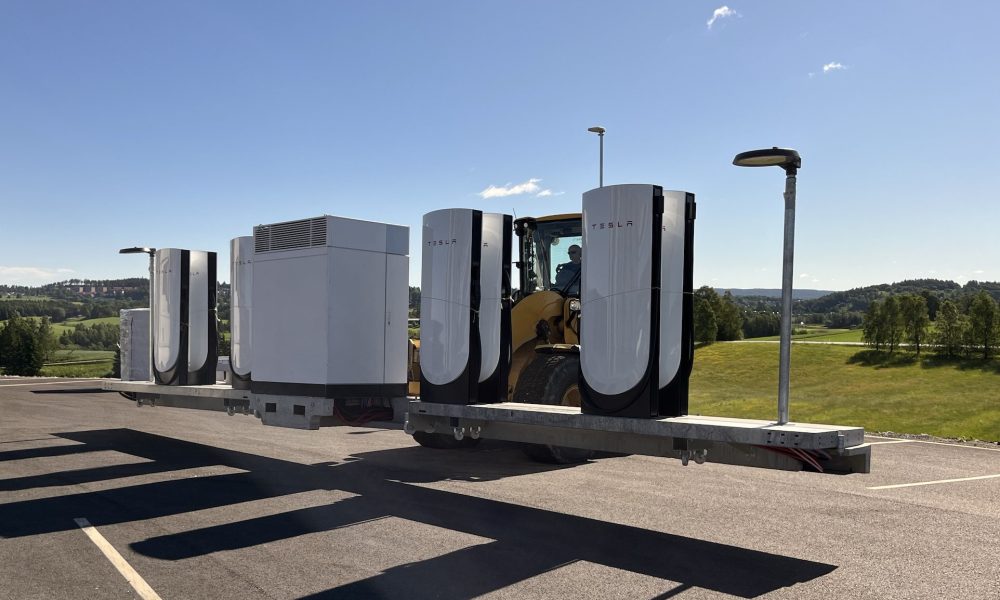


Tesla just unfolded its first modular V4 Supercharger somewhere in Europe, almost certainly Norway, and the move signals that the company’s charging war is no longer about raw kilowatts. It’s about shipping containers and concrete pads.
The Folding Unit, first unveiled in March 2026, is a factory pre-assembled charging station built on an industrial hinge system bolted to a heavy-duty concrete base. It arrives on a truck, unfolds, and connects. No weeks of site work, no separate crews to erect light poles.
Telescopic poles compress for transit and extend on arrival, eliminating one of the quieter bottlenecks that has plagued Supercharger rollouts for years.
The numbers tell the story. Tesla says the design fits 33 percent more stalls per delivery truck, cuts installation time roughly in half, and reduces deployment costs by more than 20 percent compared to traditional builds. Each unit pairs a single V4 power cabinet with eight charging posts capable of delivering up to 500 kW per stall for passenger cars and 1.2 MW for the Semi.
That last figure matters because it means Tesla has doubled the stalls per cabinet at triple the power density of the outgoing V3 hardware. Gigafactory New York rolled its final V3 cabinet in March after seven years and 15,000 units. The V3 era is officially dead.
Norway, as usual, gets first dibs. The country’s EV adoption rate makes it Tesla’s go-to proving ground for new infrastructure, and it has played that role since the original Supercharger stalls arrived years ago. Tesla is targeting a broader European motorway rollout in Q3 2026.
Longer cables on every new station make the posts immediately usable by non-Tesla vehicles, including Ford, GM, Rivian, Hyundai, Stellantis, and others already tapping into the network. That interoperability isn’t charity. Every kilowatt-hour sold to a Rivian R1T or a Hyundai Ioniq 5 is margin Tesla didn’t have to build a car to earn.
The real competitive shift here is logistical. Traditional DC fast-charging installations from Electrify America, Ionity, and others require weeks of civil work, separate electrical contractors, and coordination nightmares that routinely push timelines past six months from permit to first charge. Tesla just compressed that timeline into something closer to days.
Cheaper, faster deployment also changes which sites pencil out financially. Corridors and secondary markets that were previously too expensive to justify — rural stretches of France, southern Spain, the Balkans — suddenly become viable. Coverage gaps that have frustrated EV buyers outside major urban centers could close faster than anyone projected twelve months ago.
This arrives at an interesting moment. Tesla just secured its second FSD approval in Europe in two days, and the Model Y Juniper refresh is dominating in unexpected markets. In South Korea last month, the Model Y outsold every single vehicle, domestic or imported, moving 8,762 units and beating the Kia Sorento by nearly a thousand. No foreign car had ever done that.
The pattern is consistent. Tesla is attacking infrastructure, software approvals, and vehicle sales simultaneously across multiple continents. The folding Supercharger is the piece that ties the physical network to the pace of everything else.
You can’t sell cars where people can’t charge them, and you can’t open charging networks profitably if every site costs a fortune and takes half a year to build.
A hinged steel frame and a telescoping light pole won’t make headlines the way a Cybercab or a humanoid robot will. But in the unglamorous math of network economics, this is the kind of engineering that compounds. Tesla didn’t just build a better charger. It built a better way to ship one.





Share this Story