
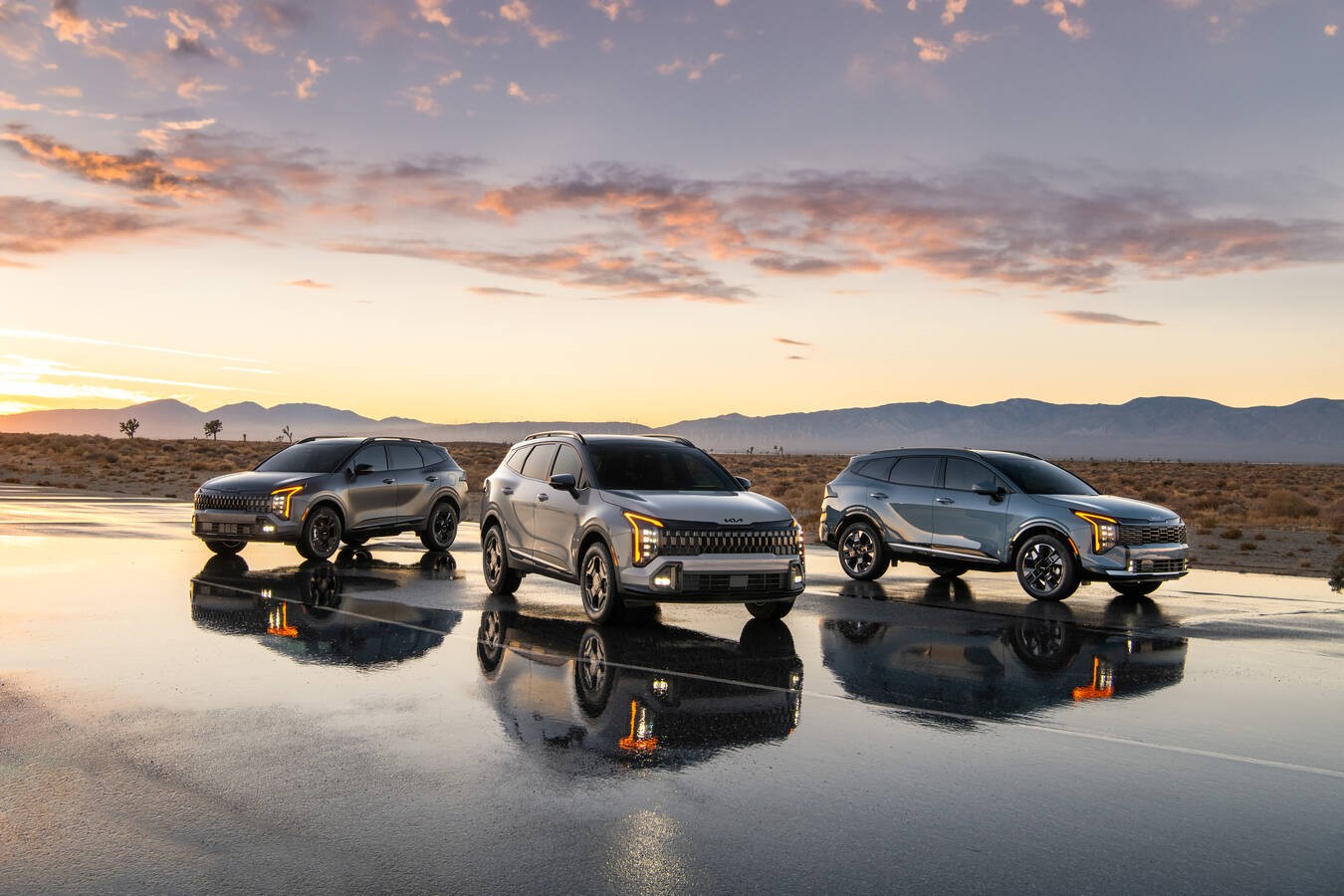


The 2026 Kia Sportage rolled into Louisville on Monday with a refresh that touches nearly every surface and system on Kia’s best-selling nameplate. It’s technically a mid-cycle update, but the sheer volume of changes suggests Kia knows exactly how much pressure this vehicle is under from the RAV4, CR-V, and its own corporate sibling, the Hyundai Tucson. New fascias, new tech architecture, new trims, and more power all made the cut.
Three powertrains remain: a 2.5-liter naturally aspirated four-cylinder making 187 horsepower, a 1.6-liter turbo hybrid now producing 232 horses (up five), and a plug-in hybrid bumped to 268 horsepower (up seven). The gains are modest on paper, but Kia is clearly steering buyers toward electrified trims. Two entirely new hybrid grades, the sporty S and the rugged X-Line, expand the HEV lineup to five trims, making the hybrid less of an alternative and more of the core proposition.
The X-Line Hybrid is particularly telling. It gets active all-wheel drive with terrain modes for snow, mud, and sand, 8.3 inches of ground clearance, raised roof rails, 19-inch black wheels, and aggressive dark trim. Kia wants this truck parked at a trailhead, not just in a Whole Foods lot.
Outside, the Sportage adopts Kia’s LED star map lighting signature with amber daytime running lights, stacked headlamps with optional cube-style projectors, and revised bumpers front and rear. It’s a sharper, more cohesive face than the sometimes-polarizing original fifth-gen design.
Inside is where the real money went. A curved dual 12.3-inch panoramic display runs Kia’s Connected Car Navigation Cockpit, bringing wireless Apple CarPlay and Android Auto plus over-the-air update capability. A new 10-inch head-up display, available only on hybrid and plug-in hybrid trims, projects ADAS information and turn-by-turn navigation onto the windshield. Ultrawide-band Digital Key 2.0 lets owners ditch the fob entirely and share vehicle access via text message from a compatible smartphone.
The driver-assistance suite gets a notable expansion. Highway Driving Assist 2 arrives as an option, offering lane-change assistance triggered by the turn signal and evasive steering support. Standard across the range: automatic emergency braking with pedestrian, cyclist, and junction-turning detection.
Rear legroom holds at a generous 41.3 inches, and hybrid cargo volume checks in at 39.5 cubic feet with the rear seats up, aided by a dual-level cargo floor. Heated rear seats are now available on hybrid and plug-in hybrid models. New interior trim materials aim to reduce fingerprint smudges, a small detail that tells you Kia is listening to actual owners, not just focus groups.
Production logistics reveal Kia’s tariff calculus. The 2026 Sportage Hybrid ships from Gwangju, South Korea, but the 2027 model year Sportage Hybrid will be assembled at Hyundai Motor Group’s Metaplant America in Georgia, expected to come online this summer. Certain ICE Sportage trims already roll off the line at Kia’s West Point, Georgia, plant alongside the Telluride, Sorento, EV6, and EV9. Domestic assembly of the hybrid can’t come soon enough given the current trade environment.
Pricing hasn’t been announced, and Kia’s media drive focused exclusively on the turbo hybrid, with ICE and PHEV press cars arriving later. That sequencing is deliberate. Kia wants the hybrid to lead the conversation.
The Sportage has been Kia’s volume anchor for three decades. This refresh doesn’t reinvent the formula, but it stacks enough new hardware, software, and rugged credibility to keep the compact SUV fight interesting heading into 2026. The real test comes when the Georgia-built hybrid hits dealer lots and Kia can price it without an import premium baked in.


Share this Story