
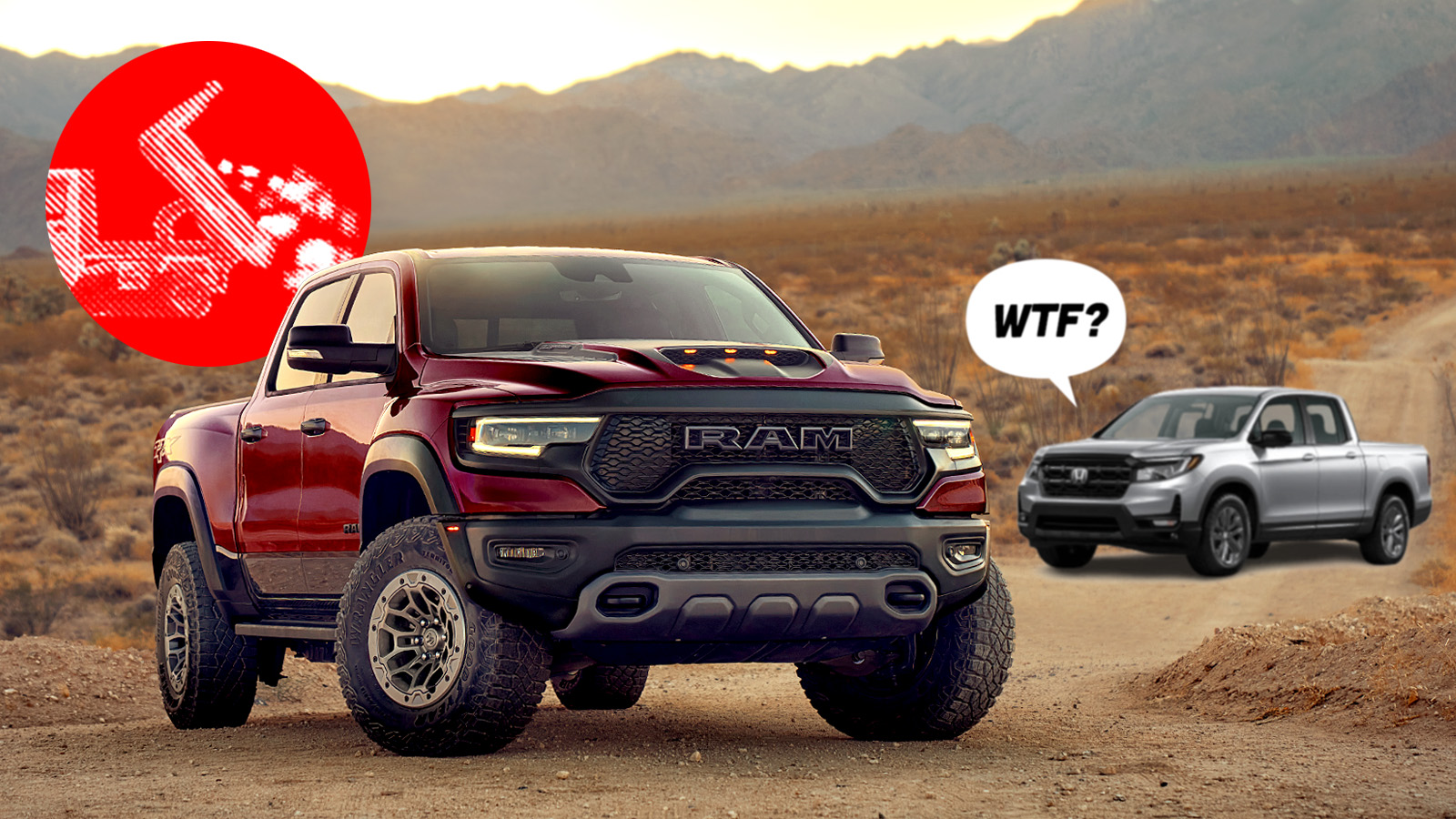


The Honda Ridgeline gets 21 miles per gallon combined. The Ram TRX gets 12. Guess which truck is going away for emissions reasons.
Honda is pulling the Ridgeline off the production line for an 18-month hiatus because its aging V6 can’t meet emissions obligations the company agreed to with the California Air Resources Board. Meanwhile, Ram is busy resurrecting not just the supercharged TRX but also the Hemi V8-powered 1500 and an incoming Hellcat-powered Rumble Bee that will drink premium fuel like it’s going out of style. Which, arguably, it is.
The absurdity isn’t accidental. It’s structural.
Honda is one of six automakers still bound by individual compliance deals struck with CARB over past emissions violations. Those deals run through model year 2026, and unlike the federal fuel economy penalties the Trump Administration has gutted, these state-level agreements remain enforceable. Honda sells a lot of cars in California, and walking away from that market isn’t an option.
Ram parent Stellantis also has a CARB deal, but the math works differently. Many of its new V8 trucks are model year 2027 or later, potentially sidestepping the agreement’s window. And Ram can afford to skip California entirely if it has to. Texas and Florida will happily absorb every supercharged half-ton the company can build.
Honda can’t play that game. California is embedded in its DNA and its balance sheet.
According to Automotive News, the Ridgeline’s hiatus stems from Honda’s pivot away from an aggressive EV strategy. Resources dedicated to electric vehicle development left the Ridgeline in limbo, and supplier constraints made a seamless transition to an updated model impossible. The plan is a heavily refreshed version to bridge the gap until a new, larger hybrid architecture arrives.
In the meantime, Honda will ramp up Pilot and Passport production to fill the void. Both share platform bones with the Ridgeline but have already moved to Honda’s updated DOHC V6 and its own 10-speed automatic. The Ridgeline was still running the older SOHC V6 mated to a ZF 9-speed that nobody particularly loved. It was, in the most literal sense, left behind.
The Ridgeline was never a volume monster. It moved about 40,000 units in a good year, a rounding error compared to the F-150 or Silverado. But it occupied a genuinely useful niche: a comfortable, car-like, unibody truck that could haul mulch and tow a small boat without pretending to be a military vehicle.
Ford’s Maverick has eaten into that space from below, offering hybrid AWD and 4,000-pound towing at a significantly lower price.
So Honda faces a nasty squeeze. The truck it needs to update is the one it can least afford to keep building, in the state it can least afford to leave, under rules it can least afford to break. Ram, selling loud and proud to buyers who couldn’t care less about a CARB waiver, faces no such dilemma.
This is what happens when regulatory compliance isn’t uniform. Automakers that played ball with California years ago are now handcuffed by those agreements while competitors operate under a federal framework that has been deliberately loosened. Honda’s reward for being the most California of automakers is an 18-month hole in its truck lineup.
The Ridgeline will come back, probably as a hybrid, probably boxier, probably better. But the gap matters. Eighteen months is an eternity in a segment where Ford, Hyundai, and Toyota are all circling with competitive products. Every month the Ridgeline is absent is a month those buyers find somewhere else to land.
Ram, for its part, will keep selling 700-horsepower trucks that get fuel economy measured in gallons per mile. Nobody in Sacramento is stopping them.
Share this Story