
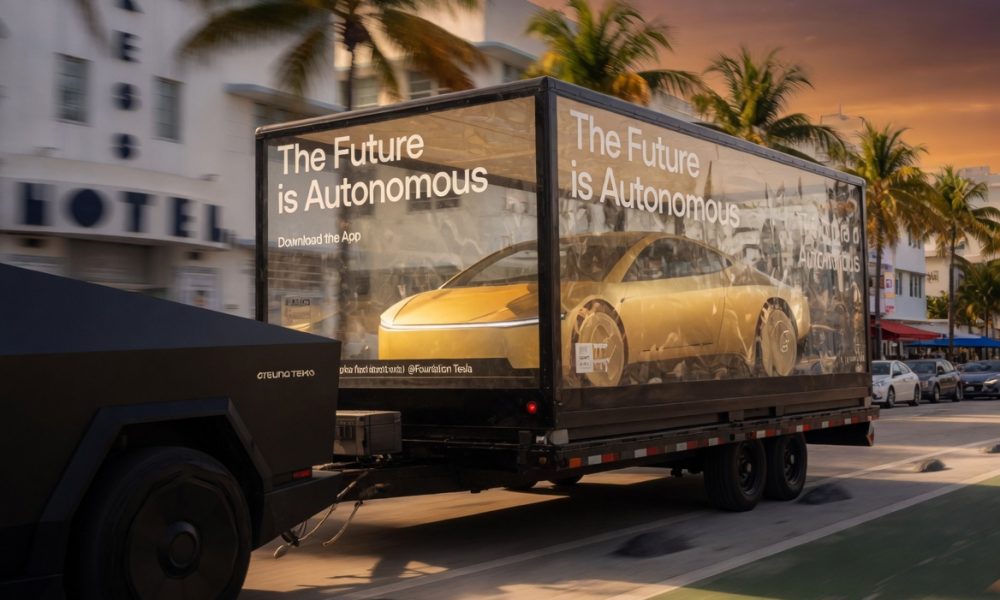


A Cybertruck towing a Cybercab inside a glass display case marked “Future is Autonomous” rolled through the beachfront crowds at Lummus Park in Miami Beach last week. The setup was part of Tesla’s “Autonomy Pop-Up,” embedded within the official F1 Miami Grand Prix Fan Fest from April 29 through May 3.
It was free spectacle, engineered for maximum eyeballs and zero advertising spend. Tesla has been perfecting this playbook all year.
Two weeks before Miami, Tesla stationed its Optimus humanoid robot at its Boston Boylston Street showroom, planted directly on the final stretch of the Boston Marathon course. Tens of thousands of runners and spectators encountered the robot without Tesla buying a single ad placement. In December 2025, the company ran a similar event at its Miami Design District showroom during Art Basel, featuring both the Cybercab prototype and Optimus interacting with attendees.
The pattern is unmistakable. Tesla is planting itself into marquee cultural events in cities where it plans to deploy robotaxis. Miami is one of seven cities confirmed for unsupervised robotaxi expansion in the first half of 2026, alongside Dallas, Houston, Phoenix, Orlando, Tampa, and Las Vegas, all building on the service already operating in Austin.
Showing up at an F1 race with a glass-encased vehicle isn’t promotional whimsy. It’s pre-deployment conditioning. Tesla wants Miami residents to have already seen, touched, and photographed the Cybercab before it starts picking up passengers on their streets.
The product pipeline behind this marketing push is moving fast. Cybercab pre-production units began rolling off the line at Gigafactory Texas in February 2026, with full production scaling through April. Elon Musk has told shareholders the manufacturing process could eventually hit a cycle time of one unit every ten seconds, with a theoretical ceiling of five million vehicles per year.
Those are staggering numbers, and they need to be treated as such. Musk has also promised a purchase price under $30,000 and an operating cost around $0.20 per mile. Whether any of those figures survive contact with reality is an open question Tesla has not yet been forced to answer.
The ambition is not modest. Musk expects robotaxi coverage across a quarter to half of the United States by end of 2026. Scaling to 10 million operational robotaxi units over the next decade is a key condition of his compensation package, sitting alongside a target of 20 million passenger vehicle sales.
Meanwhile, the broader Tesla vehicle story remains complicated. A recent NHTSA recall affecting Cybertruck units with 18-inch steel wheels inadvertently revealed that the short-lived Rear-Wheel-Drive trim sold abysmally, with only 173 units potentially affected, representing just a fraction of total RWD production. Tesla killed that trim last September after customers balked at paying $69,990 for a stripped-down truck that cost only $10,000 less than the fully loaded All-Wheel-Drive version.
The Cybertruck did earn one genuine bright spot: an IIHS Top Safety Pick+ rating, making it the only pickup truck in America to hold top safety honors from both IIHS and NHTSA. That distinction matters, even if it hasn’t solved the truck’s demand problems.
But the glass box rolling through Miami Beach tells you where Tesla’s real bet lies. The company is not banking its future on selling trucks to individuals. It is banking on owning the autonomous mobility layer in American cities, one carefully staged public appearance at a time.
The Cybercab in that glass case was not a museum piece. It was a declaration of intent, delivered to a crowd of 100,000 people who didn’t have to pay a dime to receive it.
Share this Story