
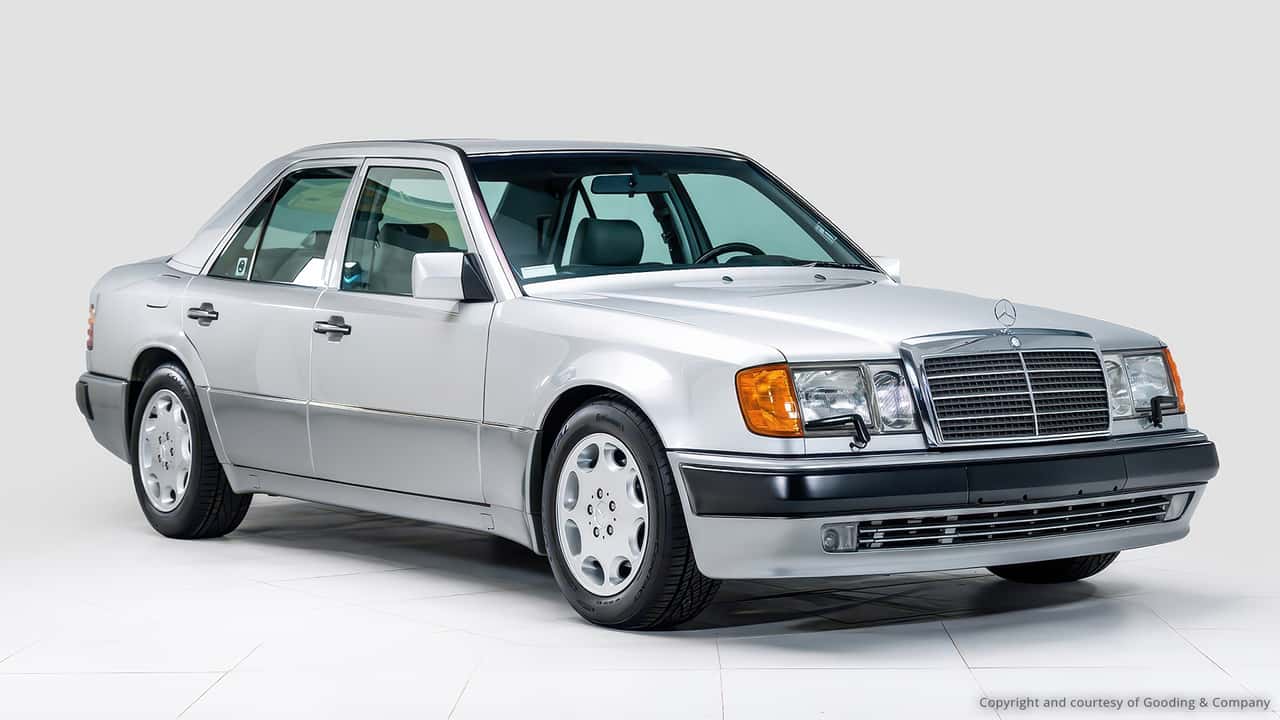


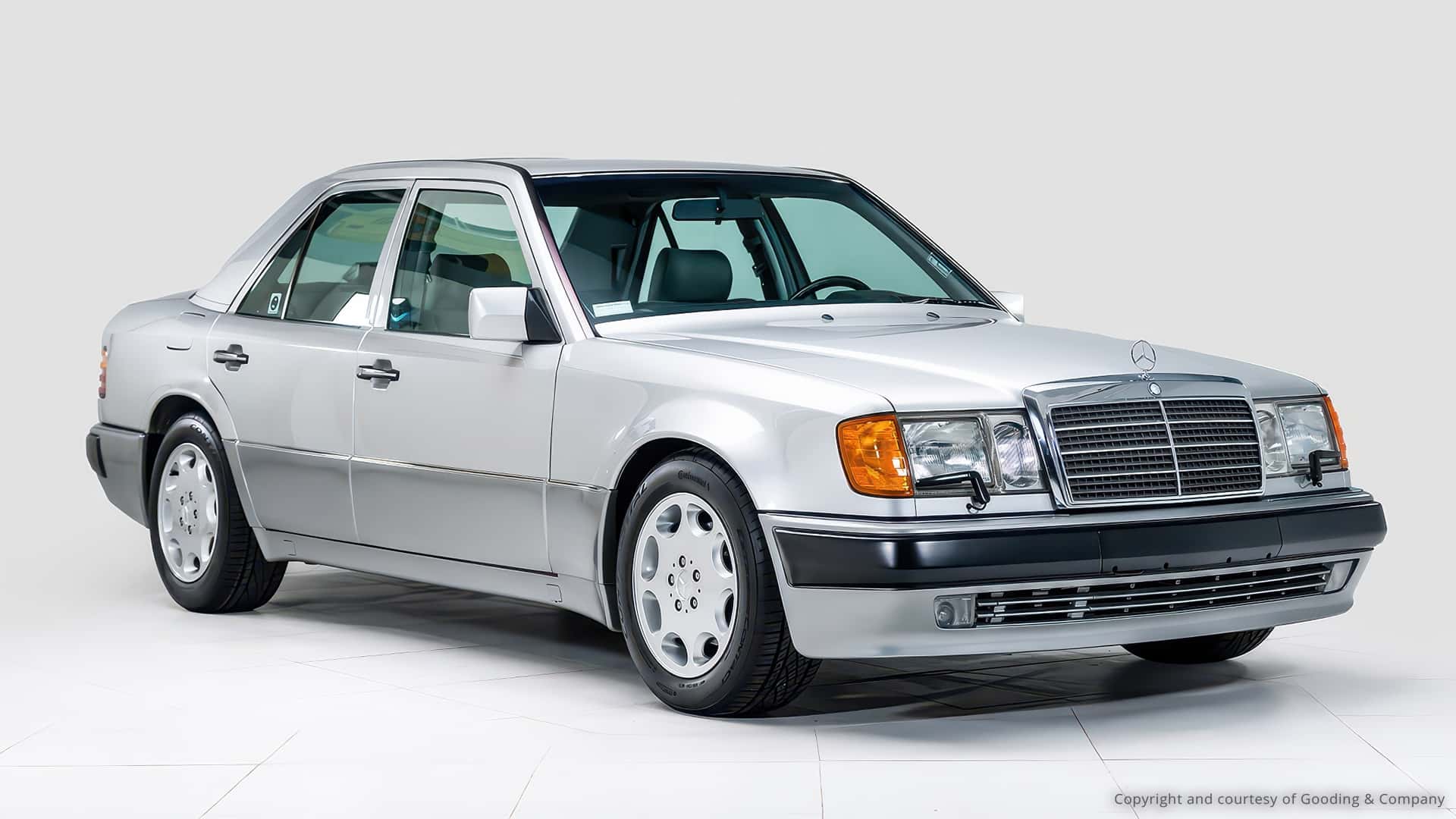
A 1992 Mercedes-Benz 500E with 2,335 miles on its odometer and Jerry Seinfeld’s name on its original bill of sale hammered for $357,000 at the Gooding & Christie’s auction during The Amelia weekend. That’s 48.75 percent above the high estimate, more than triple what Hagerty pegs a concours-condition 500E at, and a world record for the model.
The pre-sale estimate ranged from $180,000 to $240,000. Bidders blew past both numbers without hesitation.
Celebrity provenance explains part of it. Seinfeld bought the car new and kept it for 24 years before selling it in 2016. Under his watch and the subsequent owner’s, it accumulated fewer miles than most commuters log in a month.
Gooding described the condition as “near new,” with its Brilliant Silver Metallic paint and gray leather looking factory-fresh.
But there’s a deeper story baked into this car’s sheet metal. The 500E is one of the strangest collaborations in automotive history — a Mercedes sedan whose widened body couldn’t fit the Sindelfingen production line, so it was hand-assembled at Porsche’s Zuffenhausen facility, in the same building where the company now builds its most exotic sports cars. Under the conservative W124 skin sits a 5.0-liter M119 V8 making 326 horsepower, routed through a four-speed automatic.
Clean, honest 500Es still trade for around $50,000 on the open market. That a Seinfeld-owned example fetched seven times that figure says something about where the collector car market’s head is right now — and it wasn’t the only car at Amelia that rewrote the script.
The broader auction results from both Gooding & Christie’s and Broad Arrow told a story of two markets running in opposite directions. Modern-era exotics and low-mileage time capsules commanded wild premiums. A 2005 Porsche Carrera GT nearly doubled its high estimate at $3,112,500.
A 2017 Ferrari F12tdf hit $4,185,000, up 67 percent over projections. A 1972 Lamborghini Miura P400 SV — unusual color, low miles, highly original — landed at $6,605,000, obliterating its $4 million ceiling.
Meanwhile, the traditional blue-chip stuff? Buyers walked right past it. A 1951 Ferrari 342 America Coupe — the first of seven built, bodied by Ghia, originally owned by Aston Martin’s David Brown — sold for $533,000, roughly half the low estimate.
A 1957 Ford Thunderbird went for $50,400, the price of a loaded Camry. A Lehmann-Peterson Lincoln Continental limousine brought $39,200, barely enough to cover the shipping.
The pattern is unmistakable. Cars that are recent enough to drive hard, rare enough to feel special, and clean enough to need nothing are pulling the kind of money that would have been reserved for prewar brass-era machines a decade ago. Nostalgia’s center of gravity has shifted.
The buyers writing six- and seven-figure checks grew up with posters of Carrera GTs and F12s on their walls, not Duesenbergs and Delahayes.
A BMW 2002 electric conversion — the first all-electric 2002 restomod — couldn’t even clear half its low estimate, selling for $84,000 against $180,000 to $240,000 expectations. Electrifying a classic, it turns out, doesn’t electrify bidders.
Seinfeld’s 500E sits at the intersection of everything working in the current market: cultural cachet, mechanical purity, obsessive preservation, and a car that was already half-Porsche before anyone slapped a celebrity tax on it. Three hundred and fifty-seven thousand dollars for a four-door sedan with a four-speed automatic. The W124 has come a long way from the used-car lots.


Share this Story