
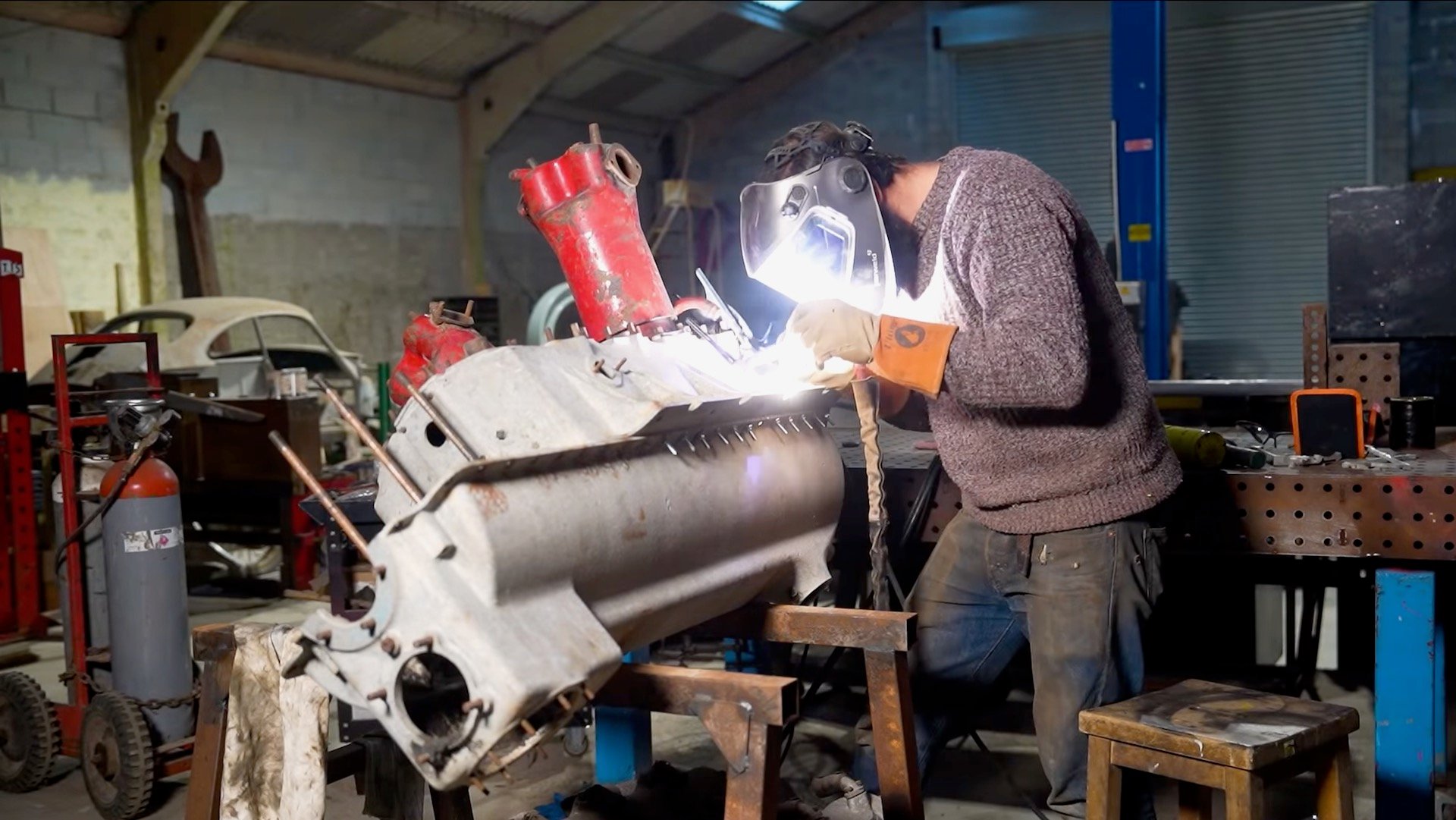


Dominic Chinea cut a 1917 Liberty V12 airplane engine in half. Putting it back together as a V8 has proven far harder than taking it apart.
Chinea, a former set designer and cast member of the BBC’s The Repair Shop, is building an aero-engined race car in the mold of the Edwardian-era British specials. The recipe is a 1912 Rochet-Schneider chassis and that Liberty, shortened to fit.
He’s aiming for the Goodwood Members’ Meeting. That means period-correct parts and period-correct techniques, which rules out the modern shortcuts most builders would grab first.
The engine choice has solid history behind it. Just after World War I, racers prized aircraft engines because they made far more power for their weight than anything built for the road.
They were also easy to find. The Liberty was mass-produced for the war effort, and there were plenty left over.
The problem is length. The V12 wouldn’t fit the chassis, so Chinea cut out four cylinders and set about welding the block back together.
The Liberty block comes in two big pieces. The upper half carries the cylinders, the lower half holds the crankcase and sump, and his latest video deals only with the top.
That top half is cast aluminum, made to 1910s standards. Aluminum is already fussier to weld than steel, and this stuff is full of impurities.
As Chinea laid down his beads, those impurities bubbled up. They contaminated the welds, and the welds cracked.
Around the 20-minute mark of the video, he finds a partial fix. Wet rags keep the casting cool while he welds very short sections at a time.
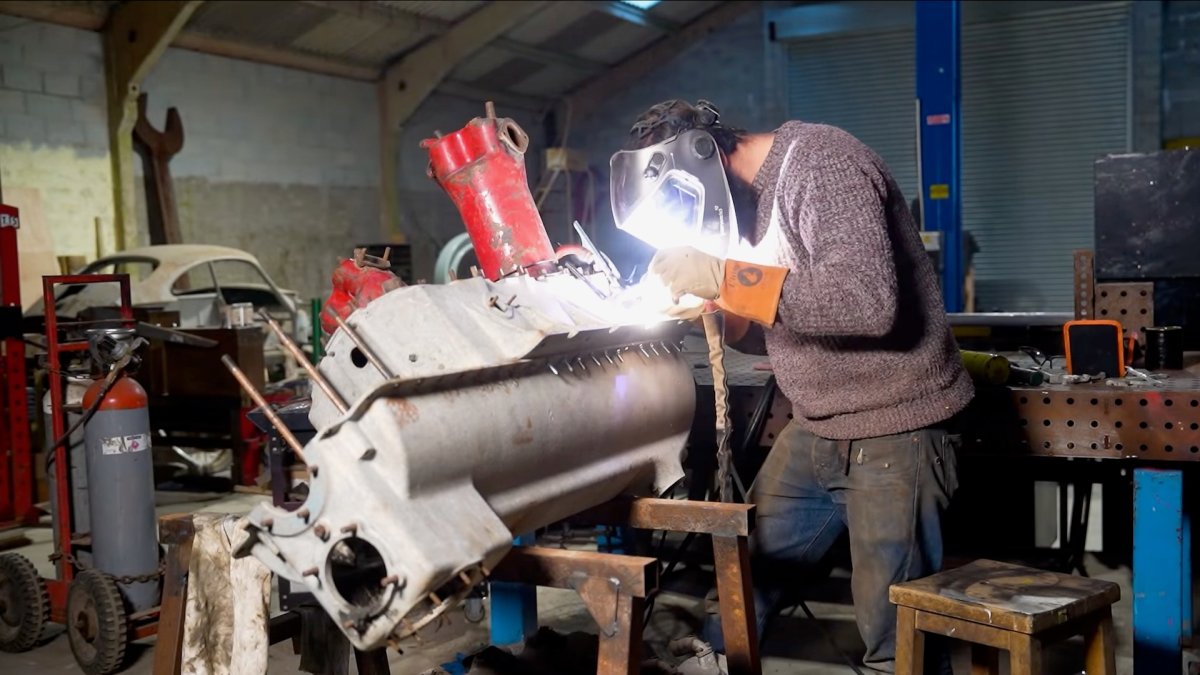
Then he had to do it all again on the inside of the block, with far less room to work. Once the inside was done, the outside cracked.
Out of ideas and out of welding gas, Chinea did what every YouTuber does. He asked the comments section for help.
Usually that gets you noise. This time it got him a seminar.
A Swiss welder who has worked on 1920s Bugattis and Bentleys diagnosed excess aluminum oxide and offered tips for dealing with it. You won’t find that in a textbook, because nobody ever wrote one.
An 80-year-old former locomotive engineer suggested drilling small holes to stop the cracks from spreading. A former fabricator for a hydraulic ram manufacturer agreed and added that building up material with small, tack-style welds might help.
None of these people stood in a 1918 workshop. But between them, they hold the closest thing left to a living memory of how mechanics once coaxed old, dirty castings into holding together.
There’s no service manual for turning a century-old aircraft engine into a race car motor. The people who did this work back then are gone, and much of what they knew went with them.
What’s left is scattered across a Swiss shop, a retired railwayman’s memory, and a factory floor that built hydraulic rams. It took a cracked engine block and a plea in a comment box to pull it into one place.
Chinea still has the bottom half of the block to tackle. The top half is waiting on fresh gas and another attempt, this time armed with advice from strangers who know old metal better than almost anyone alive.
Goodwood won’t wait forever. And the casting has already made clear it doesn’t care how badly anyone wants this to work.


Share this Story