
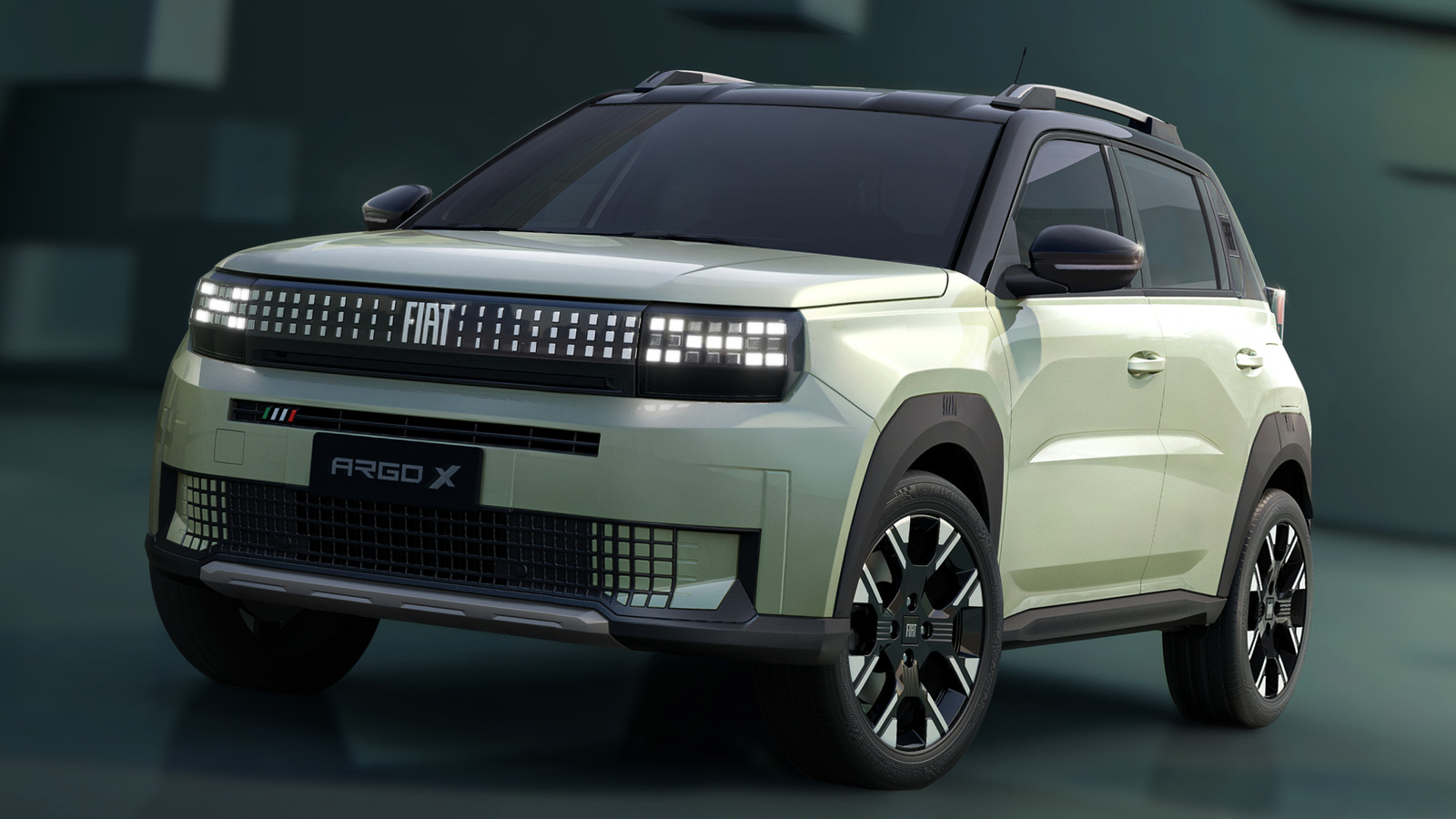


The word “Panda” is stamped into the doors of every Grande Panda sold in Europe. On the Brazilian version, Fiat has sanded it off.
That is the most visible change on the Argo X, a South American twin of the Grande Panda. Fiat revealed it in new official photos ahead of a Brazilian launch in the coming months. The car follows a run of spy shots of camouflaged prototypes and shadowy teasers.
Same body. Same boxy proportions. New name, smoother doors.
The Grande Panda has been on sale in Europe since 2024 as a budget hatchback dressed up as a crossover. It leaned hard on nostalgia, with an off-center Fiat badge and that embossed lettering calling back to the original Panda.
Brazil gets none of the wink. The Argo X moves the Fiat emblems on the grille and tailgate to a symmetrical layout and adds an Argo X badge at the rear.
The retro cues that sold the car in Europe are gone. Brazil never had the same history with the Panda name, so the nostalgia would have fallen flat.
The rest stays put. The raised stance carries over, as do the plastic cladding with its hidden Fiat Easter eggs and the pixel-style LED lights. Brazil adds its own diamond-cut alloy wheels and a two-tone paint job with a black roof and pillars.
Fiat has not shown the cabin. Expect it to be a little plainer than the Grande Panda’s.
Fiat has also kept the specs to itself, but local media have largely worked out what sits underneath. The Argo X rides on Stellantis’ Smart Car platform, the same one under the Citroën C3.
The engines are where the two cars part ways.
Europe’s Grande Panda uses turbocharged 1.2-liter three-cylinders. The Argo X is expected to run 1.0-liter three-cylinders that burn both gasoline and ethanol. That flex-fuel setup is what Brazilian buyers expect at the pump.
The base engine should be naturally aspirated, making up to 74 horsepower (55 kW / 75 PS) through a five-speed manual. Above it may sit a turbocharged 1.0-liter with a 12-volt mild-hybrid system, rated at 114 hp (85 kW / 116 PS) and paired with a CVT.
Neither figure is confirmed. Both match what Stellantis already builds for the region.
Production will happen at Stellantis’ plant in Betim, Brazil. Building it locally matters in a market that punishes imports with taxes and rewards homegrown cars.
The old Argo is not going anywhere. The aging hatchback stays on sale below the newcomer as the cheaper option. Fiat will sell two Argos at once, one old and one wearing a European face.
Stellantis is not retiring a nameplate it has already paid for. It is stacking a newer car on top and letting the price gap sort out the buyers.
Fiat calls the Argo X the first model to bring its new global design language to Brazil. It describes the car as “the beginning of a new era” for the brand in the country.
That points beyond one hatchback. The same design family includes the Fiat Grizzly and Grizzly Fastback, and Brazilian versions of both could follow over the next few years.
Fiat has not confirmed either one. For now, Brazil gets the Panda’s body without the Panda’s name, with interior photos and official numbers still to come.



Share this Story