
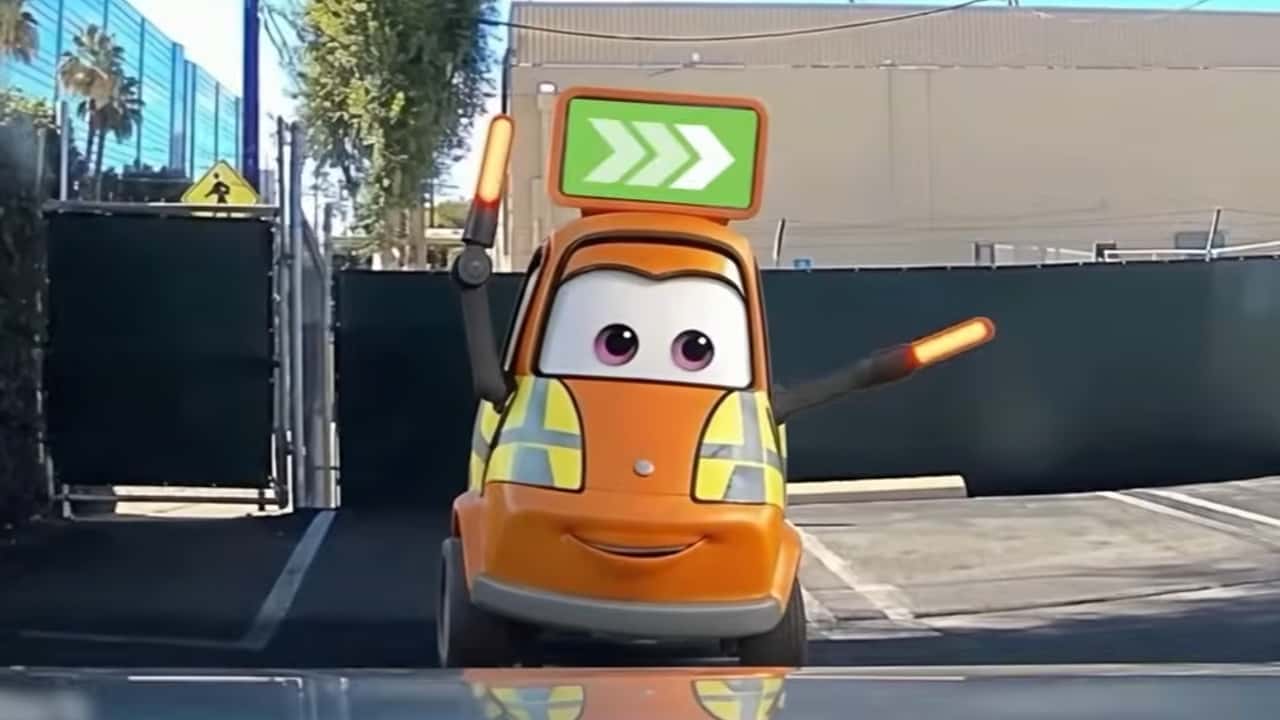


Disney rolled a four-wheeled robot with blinking cartoon eyes onto the stage at its Accelerator Demo Day 2026. Disneyland officials then told reporters there are no plans to put it to work.
The machine is a parking assistant. It is meant to roll around a lot, find open spaces, and wave drivers into them.
It comes from Field AI, an Irvine, California, robotics firm founded in 2023 by engineers from Google DeepMind, NASA, Nvidia, and Tesla. Walt Disney Imagineering partnered on the project.
That team’s background spans machine learning research, space exploration, chip design, and self-driving cars. Their first public project with Disney is a robot that points at empty parking spaces.
Disney calls it a proof of concept, built to test how the robots perform and how people react to them. There is no deployment timeline, and Disney has not committed to ever using the machines in its parking structures.
The design borrows heavily from Pixar. A large front screen stands in for a windshield and shows animated eyes with moving eyelids, the same trick used by the delivery robots already rolling down some American sidewalks.
A sign on the roof changes its message to point drivers toward open spots. Picture the static directional boards in every resort lot, given wheels and a face.
Two small arms tipped with red lights wave at approaching cars, much like a ground crew guiding an airliner to its gate. The Cars and WALL-E styling is the whole point, with no plain shell hiding the hardware.
So the robot talks to drivers three ways: a screen, a sign, and a pair of glowing arms. Each is aimed at someone who has never seen it before and has a few seconds to decide whether to trust it.
That problem goes well beyond theme parks. Automakers building driver assistance systems face it daily, trying to make a machine signal its intent to a human who has to react in real time.
A merging car and a robot waving you into a stall want the same thing. You have to understand them before you will trust them.
The difference is the stakes. A misread signal in a parking lot costs a few seconds, while a misread signal at highway speed can cost far more.
That gap helps explain why Tesla tests its autonomous cars on public roads in Texas while Disney tests its robot on a demo stage. One company is betting lives on the answer, and the other is betting on a smile.
Field AI was one of five companies presenting at the event. Disney uses the program to vet outside technology before deciding whether any of it belongs in its parks.
Most of what appears at showcases like this never leaves the stage. Disney has given no sign this robot will be any different.
For now, Disneyland’s most advanced parking attendant is a prototype with eyelids, a roof sign, and nowhere to report for duty. Neither Field AI nor Disney has said what comes next.
Share this Story