
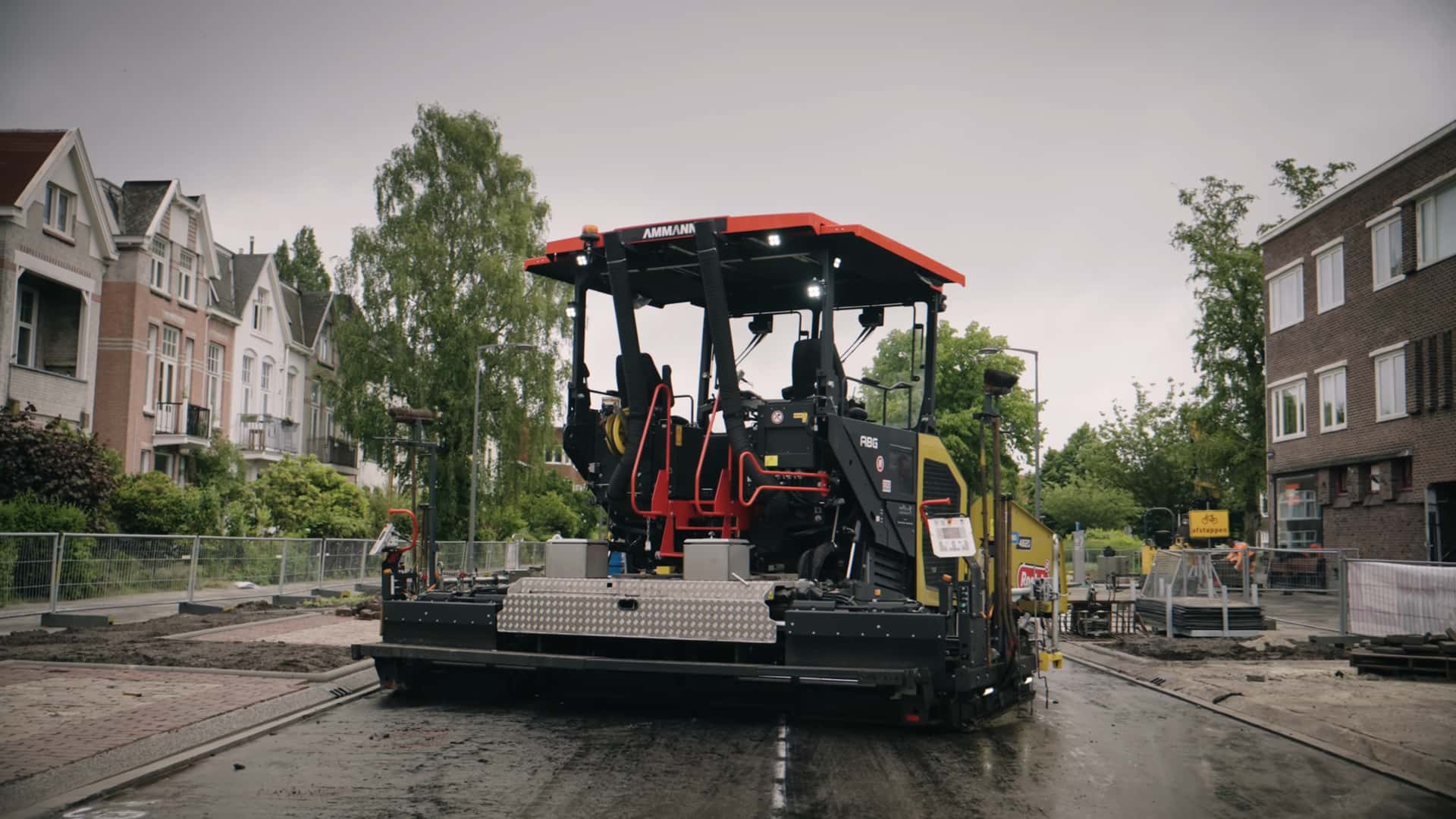


Ammann says its new eABG 4820 can lay 1,200 tonnes of asphalt in a single day. Read the fine print, though, and that number depends on a charging stop in the middle of the shift.
Without one, the Swiss machine puts down between 350 and 450 tonnes. That is still real work, but it is roughly a third of the headline figure.
The eABG 4820 is an electric conversion of one of Ammann’s mainstream diesel pavers, and it ranks among the largest battery pavers on the market. Peak output is 500 tonnes per hour, across paving widths up to 6.5 meters, or 21.3 feet.
The hardware comes from Volvo Penta, the Volvo Group’s engine and drivetrain arm. It supplies the batteries, motors, power electronics, and control technology. Ammann handled integration, drawing on decades of hydraulic machinery experience.
That split tells you where the construction business is heading. The equipment maker increasingly builds the body and the hydraulics, while someone else owns the electric heart.
The numbers are not small. A 99-kilowatt electric motor draws from a 270-kilowatt-hour nickel-cobalt-aluminum battery pack, divided into three separate units.
“It comes down to energy management and architecture,” said Philipp Bramer, who leads Ammann’s e-paver development team. “The electric driveline doesn’t just power the machine. It communicates with the hydraulics.”
Charging is where jobsite reality sets in. On a CCS2 connector at up to 150 kW, the pack refills in about an hour and a half, while 22 kW AC takes 12 hours.
That means overnight at the depot on AC, or a DC fast charger somewhere near the work. Road crews do not typically haul 150 kW of charging capacity to the shoulder of a highway.
Ammann says the battery covers a full work shift, but there is a catch. The company’s ABG e+ screed heating system, which keeps the asphalt workable as it is laid, runs off an external power supply.
So the paver is battery electric for driving and hydraulics, and plugged in for one of its hungriest jobs. Contractors will have to plan around that cable.
The payoff shows up where it counts. Anyone who has stood near a diesel paver knows the racket, and electric machines cut it dramatically.
Ammann also claims up to 70 percent less carbon dioxide than a diesel rig. An electric driveline has far fewer moving parts, which eliminates routine jobs like oil changes and the costs that come with them.
Those advantages matter most in dense cities, where night work draws complaints and emissions rules keep tightening. The machine is pitched squarely at noise- and emission-sensitive sites.
Pavers are simply the latest heavy machine to lose the diesel. Trucks went first, then excavators and cranes, and Volvo Penta’s components are spreading through that entire chain.
What Ammann has not published is the price premium over the diesel ABG. Nor has it said how long the NCA pack should last under the vibration and heat of daily paving.
Those are the figures fleet buyers will ask for first. The tonnage got the headline, but the invoice and the charger will decide how many of these actually show up on a street near you.


Share this Story