
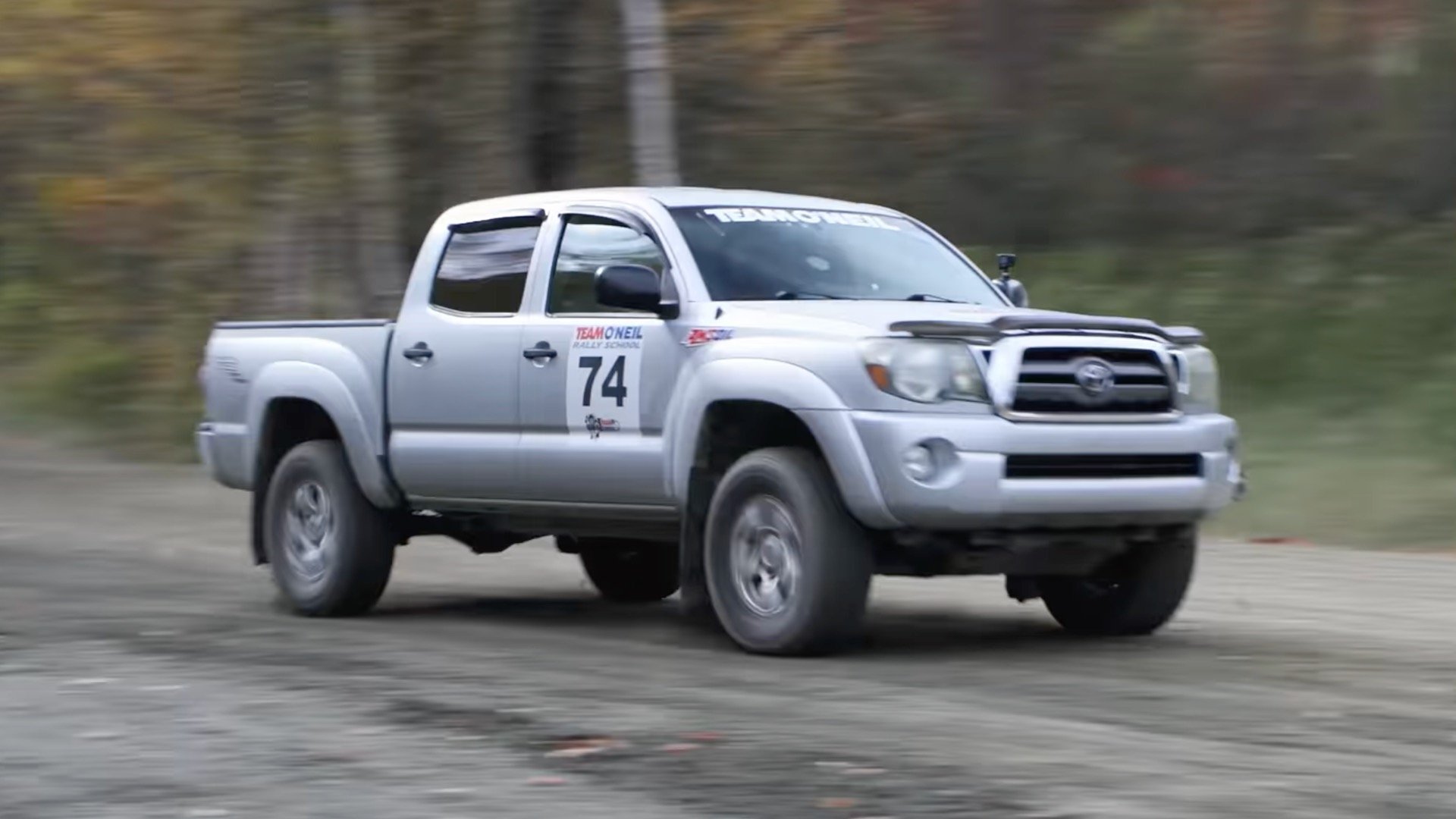


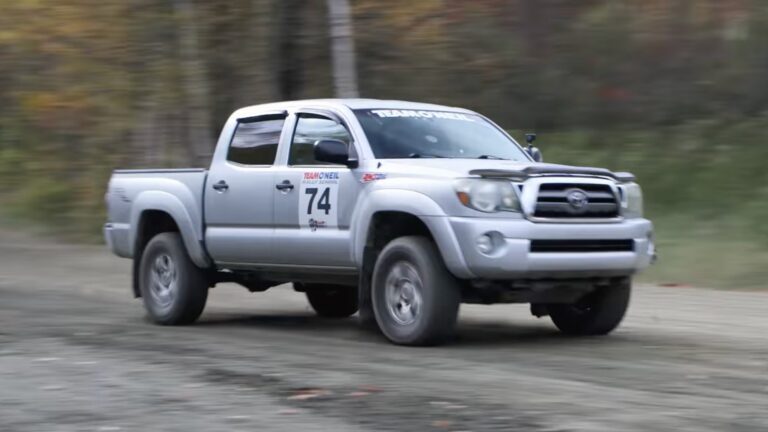
The lesson comes from an older Toyota Tacoma, not a Raptor. Team O’Neil, the New Hampshire rally school whose instructors will happily throw anything with wheels down a gravel road, picked a modest pickup to teach a problem the industry has been building for years.
The problem is height. Trucks like the Ford F-150 Raptor and Ram 1500 TRX are sold on their ability to cover rough ground at speed, and they deliver on that promise until a corner arrives.
A high center of gravity is the opposite of what anyone wants in a performance vehicle. The factories have handed buyers desert-running hardware, but they can’t engineer around where the mass sits.
The Drive’s Stephen Edelstein put it bluntly in his writeup of the new video. It’s all fun and games until you roll it.
Team O’Neil’s answer starts with lateral weight transfer. Load a tall truck with long-travel suspension too far to one side, too quickly, and you end up on your roof.
The fix is old-school and unglamorous. Brake in a straight line, scrub off the speed the corner demands, then start turning while easing smoothly off the pedal.
That’s trail braking, a technique rally drivers have leaned on for decades. It asks for patience on corner entry, which is the last thing a 700-horsepower truck seems to encourage.
The instructors admit the temptation to slide. Oversteer into a corner looks heroic, but straight-line braking gives the driver far more control over where the weight goes.
Rotation still has its place on the way out. On a corner exit that doesn’t feed a straightaway, a bit of oversteer lets the driver gradually unwind the wheel.
The throttle waits until the steering is straight. Same rule as the brakes, applied in reverse.
At lower entry speeds, lifting off the throttle before turning in can replace braking altogether. Small inputs, done in order, keep the load predictable.
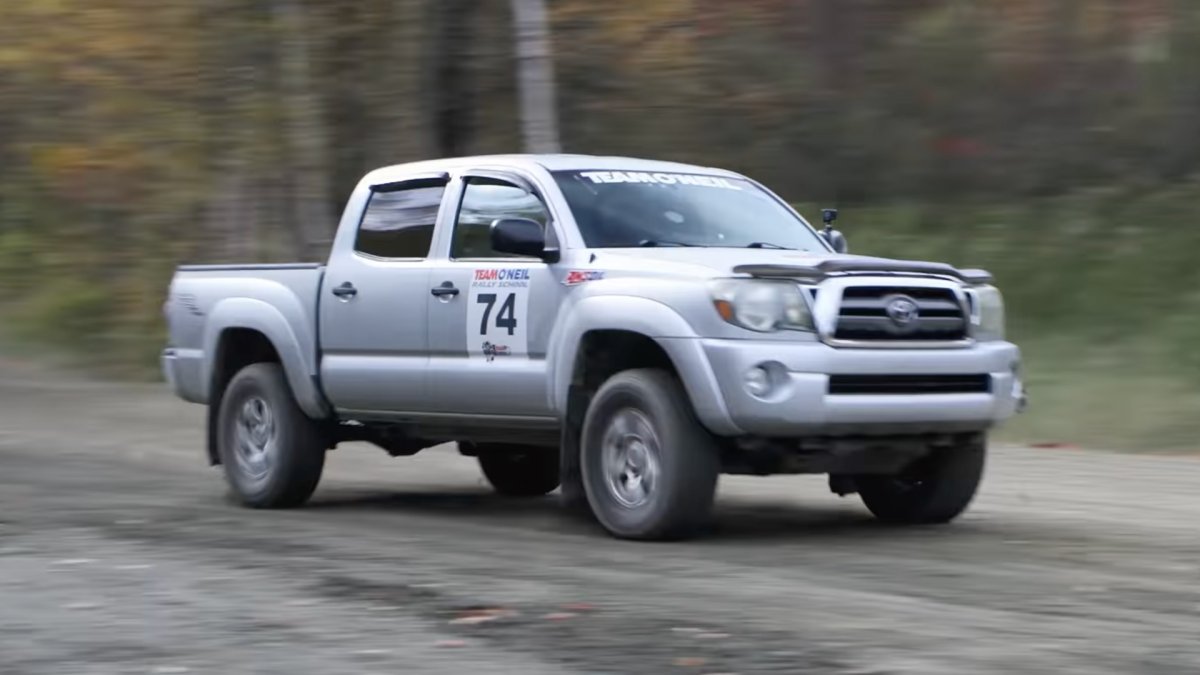
Then there’s the four-wheel-drive question, and here the school’s advice runs against how many owners actually play. Keep it in 4-Hi.
Low range limits speed, so it’s out. But 4-Hi gives more stable braking and better control through corners than leaving the truck in two-wheel drive.
Two-wheel drive lets the rear swing out, and that’s the appeal. It also lets lateral loads build faster, leaving an overeager driver chasing the steering wheel.
The tires add another trap. All-terrain rubber carries squarer sidewalls that can dig into loose surfaces, creating a lever effect capable of tipping the whole vehicle over.
That detail cuts against the image these trucks project. The aggressive tread that looks so right in the showroom is the same thing that can bite during a slide.
So the instructors’ verdict on excessive drifting in a tall truck is simple. Don’t.
None of this is news to rally people. What has changed is who’s holding the wheel, as factory off-road trucks with serious speed and serious ride height land in more driveways.
Even with flawless technique, Team O’Neil doesn’t pretend the risk disappears. Hustling a tall truck or SUV around a loose corner can still get sketchy, because physics doesn’t negotiate.
The school’s tools are a used Tacoma, a gravel road, and a camera. The automakers keep raising the horsepower.
The center of gravity stays exactly where it was.

Share this Story