
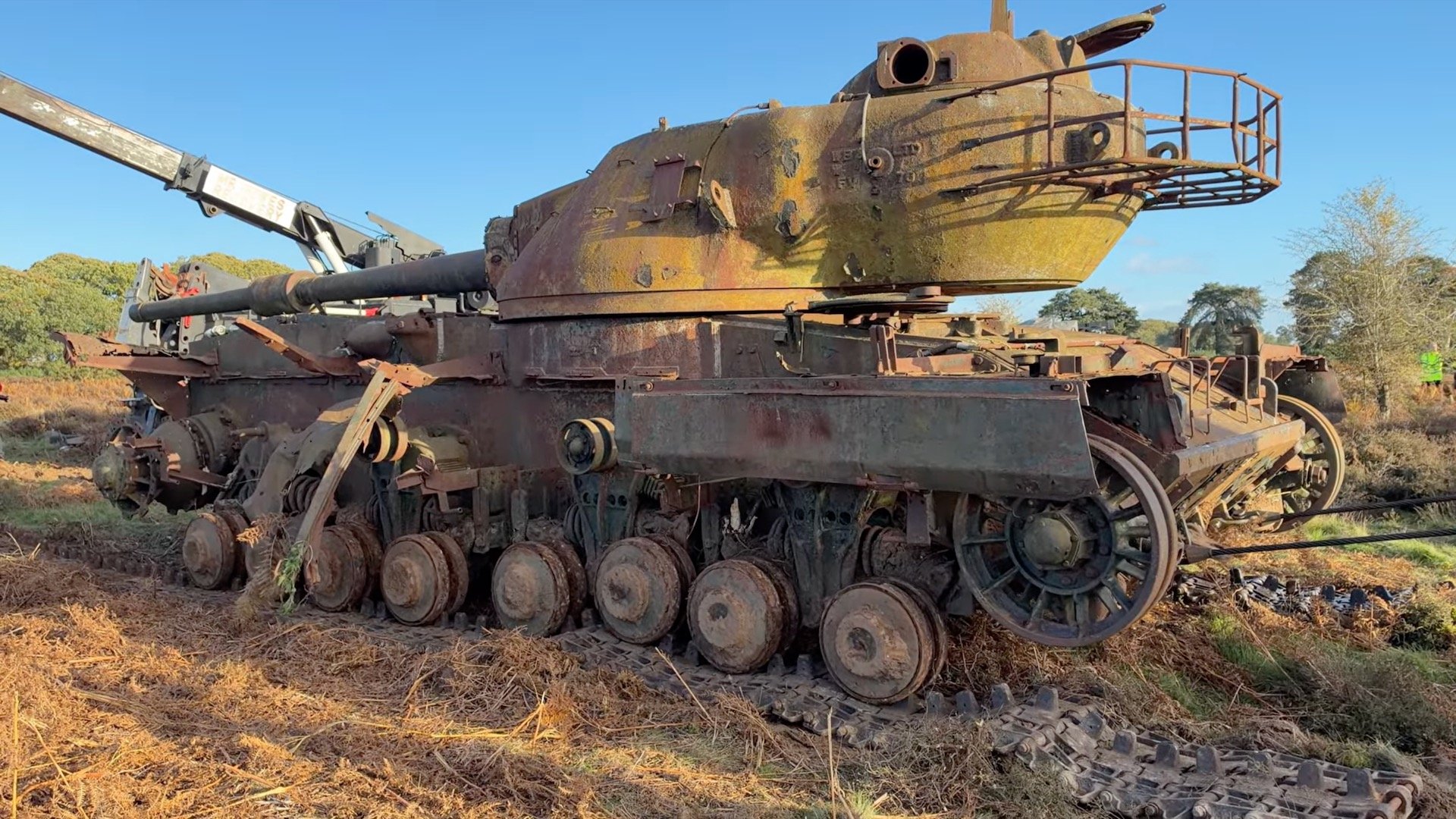


A British Conqueror tank spent decades on a Ministry of Defence gunnery range as a target. Now it’s a parts donor. Getting it out of the ground took two ex-Army recovery trucks, an American tank hauler, and a fresh set of tracks.
The job fell to Joe Hewes, who runs the Mr Hewes YouTube channel, and the staff of The Tank Museum. The museum holds one of the largest collections of military vehicles anywhere.
The museum is restoring its own Conqueror, which is missing its turret and main gun. Replacements existed. They just happened to be bolted to a derelict hulk on a live-fire range.
The donor had no engine and no transmission. That still left a lot of steel, since a Conqueror weighed about 65 tons when new.
The real problem was underneath. The tank had no tracks.
Tracks spread a tank’s weight across the ground. Without them, the Conqueror rested on its road wheels, and those wheels had sunk into swampy earth. Dragging it out would have meant plowing a 60-ton-plus furrow through artillery-range soil.
That soil could be hiding unexploded mines and shells just below the surface. The Ministry of Defence set the terms plainly. The tracks went back on, or the tank stayed put.
That’s easy to demand and hard to deliver. Only a handful of Conquerors were built, and fewer survive. Finding tracks for one is no small errand.
Once the tracks were sourced, the tank had to be raised where it sat. Hewes brought in two Foden heavy recovery trucks, the same rigs the British Army once used to retrieve its own broken vehicles.
They weren’t lifting the Conqueror off the ground so much as out of it. The road wheels were buried.
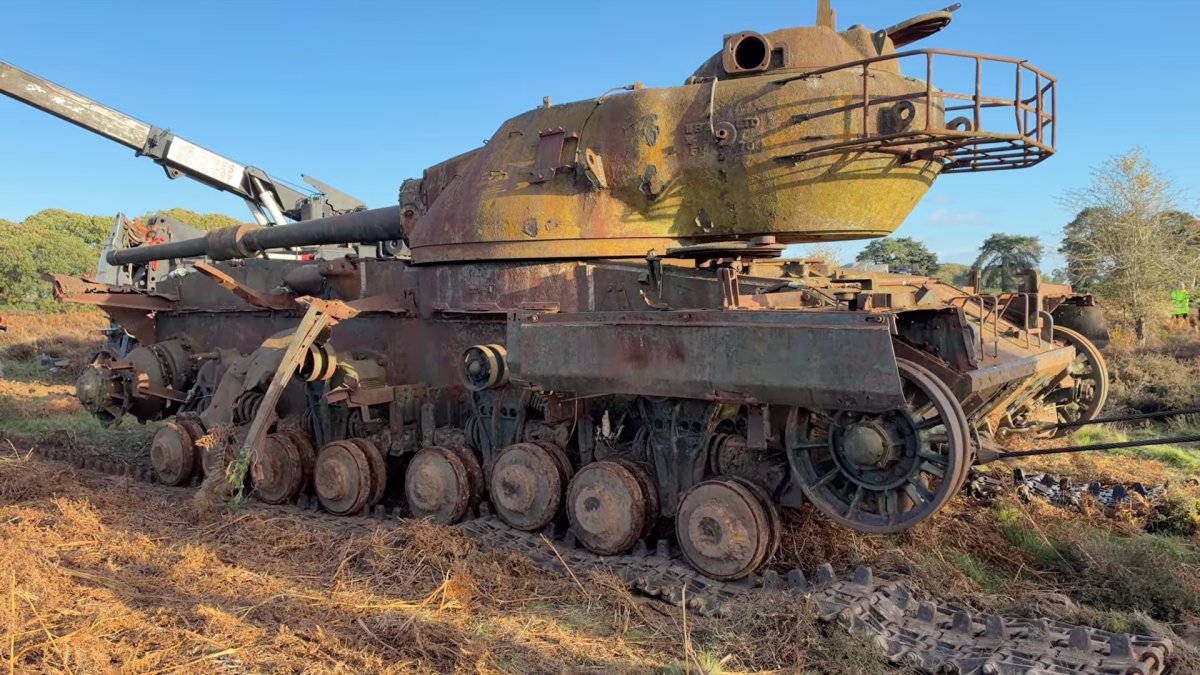
With the hull clear, an Oshkosh M1070 took over. The U.S. military uses the M1070 to move tanks, and here it winched the Conqueror onto its new tracks. Then it pulled the tank onto a trailer and hauled it off site.
Hewes titled the video “We Recovered a 65 Ton Tank Abandoned for 58 Years!” It runs about as long as a feature film. Nobody watching will think the work was easy.
The effort makes more sense once you know where the Conqueror sits in British tank history. It sits awkwardly, and that’s exactly why it matters.
After the Second World War, the Soviet IS-3 rattled NATO planners. The answer on both sides of the Atlantic was size.
The United States built the M103. Britain built the Conqueror, a heavier sibling to the Centurion.
Big, slow tanks carried too many compromises. Technology moved on, and Britain eventually landed on the Chieftain, a single design meant to do jobs previously split between separate machines.
The Conqueror lost that argument. It was a dead end, but it’s the dead end that sits between the Centurion and the Chieftain. A museum telling that story has a gap without it.
So a tank the Army abandoned long enough ago to turn into a target is being rebuilt by people who care enough to hunt down rare tracks. They jacked a swamped hull out of the mud and negotiated with the Ministry of Defence over unexploded ordnance to do it.
The donor has left the range. Its turret and gun are headed for the museum’s own Conqueror, and that restoration still has a long way to go.


Share this Story