


The most efficient Audi ever built doesn’t owe its title to Ingolstadt magic. It owes it to a Volkswagen Group drive unit, a 400-volt architecture, and a long list of small, unglamorous fixes.
Audi says the new A2 e-tron, in 140 kW form, uses 12.8 kWh per 100 km on the WLTP cycle. That figure comes with a condition: the optional efficiency package. Preliminary combined consumption for that version runs from 15.6 down to 12.8 kWh.
So the headline number is the best case, on the right spec, with the right box ticked.
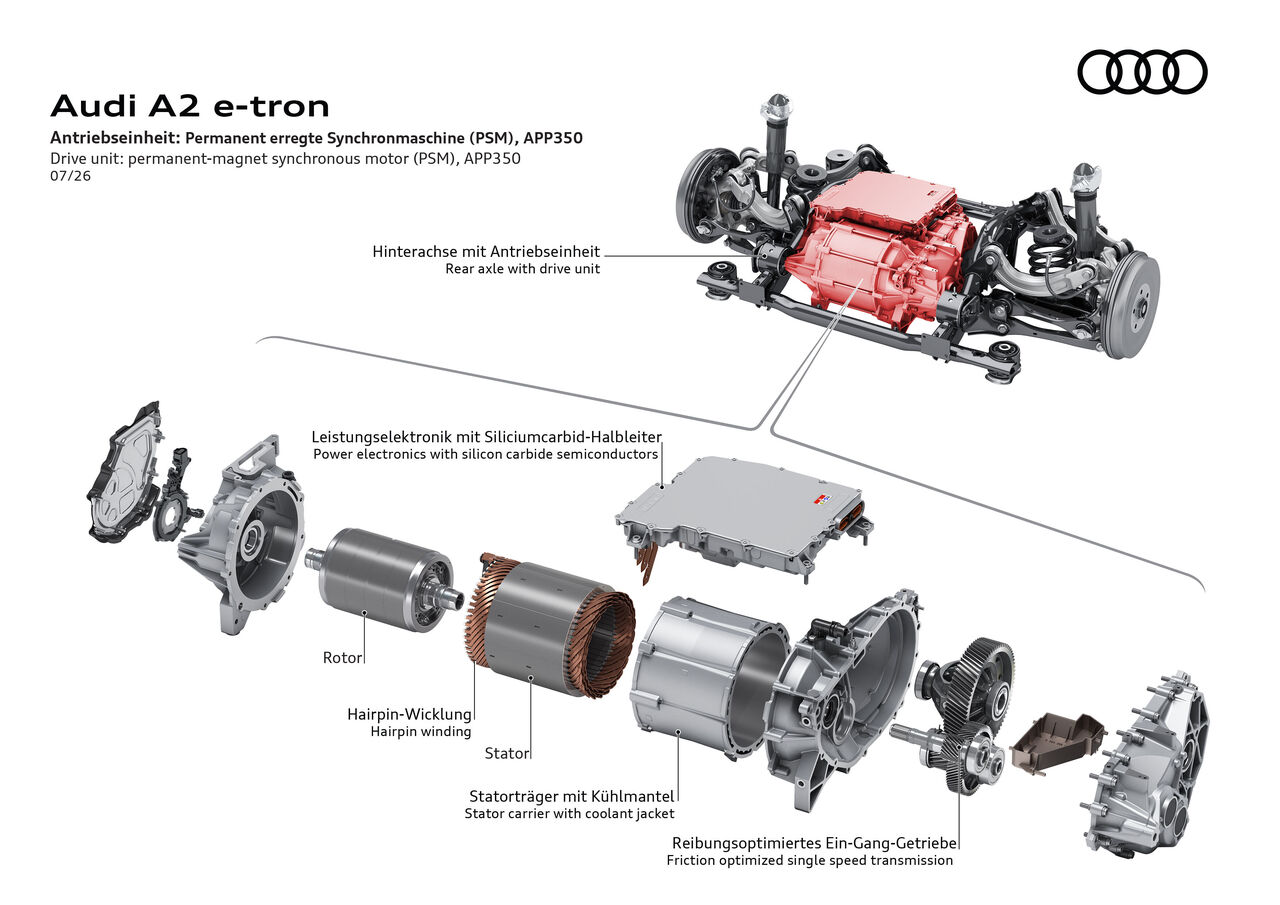
Behind it sits the APP350, a permanent-magnet synchronous motor mounted at the rear, parallel to the axle. It makes up to 350 Nm.
It is not an Audi exclusive. It is a Volkswagen Group unit, refined for the Modular Electric Drive Matrix. That’s the same MEB hardware family already found under a wide spread of the Group’s electric cars.
That is the real story here. Audi’s efficiency crown is a parts-bin achievement, polished hard.
The polishing starts in the power electronics. The pulse inverter, which turns the battery’s direct current into the alternating current the motor needs, ditches the silicon-based transistors Audi has used until now.
In their place go silicon carbide MOSFETs. Audi claims inverter efficiency above 97 percent.
Software does the rest of the inverter work. The switching frequency drops depending on the operating point, and fewer switches mean fewer losses. Audi is targeting the conditions most owners actually drive in: city traffic and country roads, medium speed, medium load.
There’s a practical payoff too. Audi says the electronics can now deliver full power even at a low state of charge, a weak spot plenty of EV drivers will recognise.
The motor itself got thinner where it counts. Compared with the older APP310, rotor lamination thickness drops by more than 30 percent. Thinner laminations cut iron losses, the energy burned as the material is remagnetised over and over.
The stator winding switches from a star to a delta configuration, with fewer parallel branches. Audi says this improves efficiency at partial load, which is commuting territory rather than flat-out autobahn running.
None of this is exotic. Silicon carbide has been spreading through the industry for years. What Audi has done is stack refinements until the sum looks like a leap.
The transmission gets the same treatment. The 125 kW and 140 kW versions use a long 10.21:1 ratio to keep motor speeds down, while the 170 kW model gets 11.53:1.
Gear teeth are fine-machined for smoother flanks. That allows a very low-viscosity oil and less churning in the gearset.
The work shows up in the cabin, not just on the spec sheet. The inverter injects high-frequency harmonics into the motor current to cancel unwanted noise. The rotor segments are now staggered instead of lined up, which Audi says all but kills the tonal whine when pulling away.
Three outputs will be offered: 125, 140 and 170 kW. Only one of them, properly optioned, holds the record.
The A2 badge carries history. The original was an aluminium-bodied efficiency obsessive that buyers largely ignored. This time Audi has tied the name to aerodynamics, battery chemistry and a drive unit its parent company built for everyone.
Final certified figures are still pending. So is the market’s verdict on whether a shared motor can justify a premium price.

Share this Story