
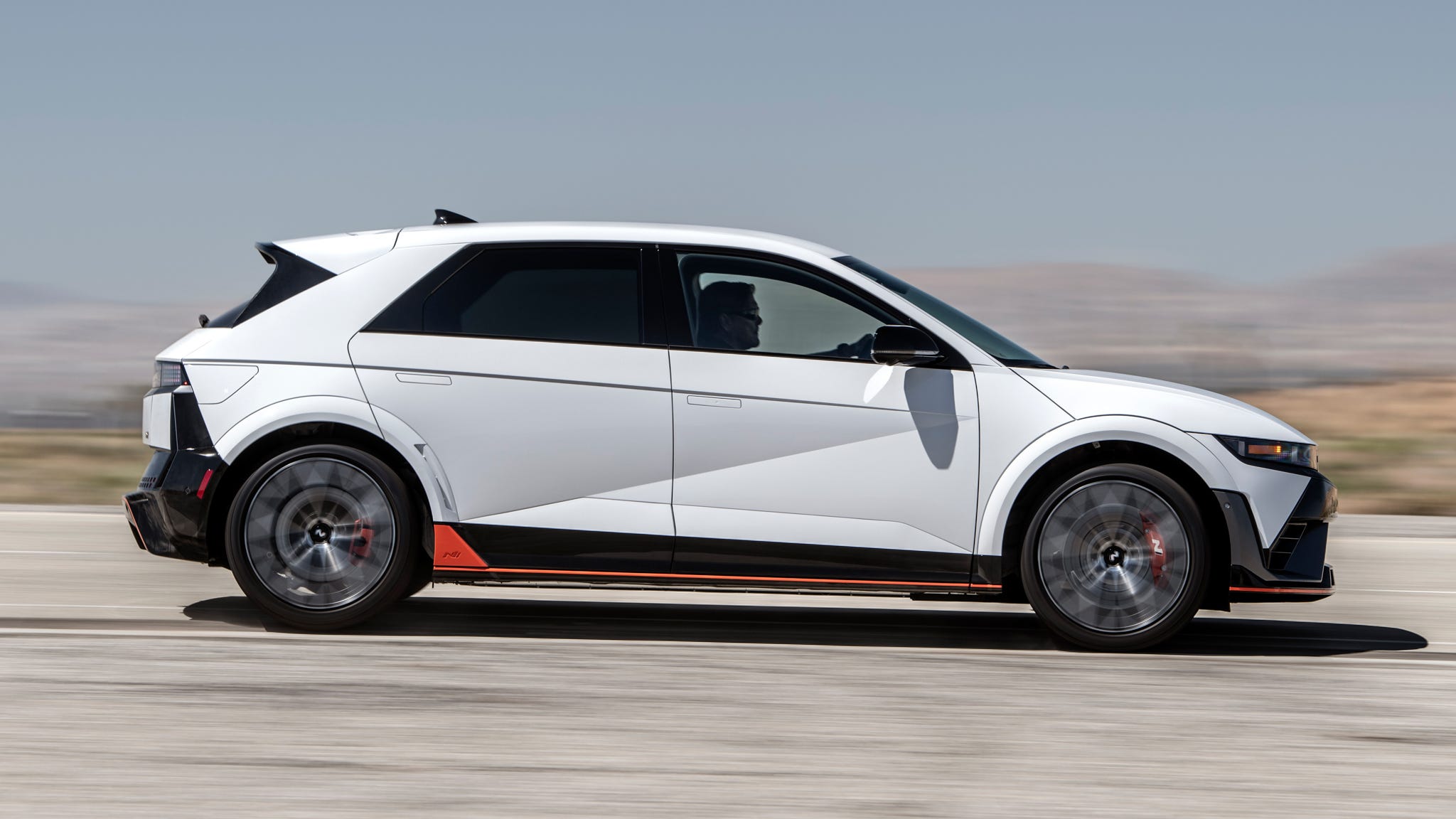


Ferrari engineers studied it. Mercedes-AMG tested one during development. The car both storied brands used as a reference point for their new electric flagships wasn’t a Porsche, a Rimac, or a Tesla. It was a Hyundai.
The Ioniq 5 N, Hyundai’s hot-rod electric crossover, has quietly become the car that rewrote the rules for how a performance EV should feel. And now the receipts are piling up.
Mercedes-AMG CEO Michael Schiebe and Ferrari development test driver Raffaele de Simone have both confirmed their teams evaluated Ioniq 5 Ns while developing the new AMG GT 4 Door Coupe EV and the Ferrari Luce. Not as a curiosity. As a benchmark.
The AMG’s approach to wrapping its electric powertrain in old-school V-8 sound, digitized from recordings of actual AMG engines, and replicating the feel and timing of its Speedshift nine-speed transmission through fake gearshifts, traces directly back to the template the 5 N established. Ferrari’s engineers say the Ioniq informed their work on paddle-controlled regenerative braking and torque-limitation systems in the Luce.
A decade ago, suggesting that Ferrari and AMG would look to a Korean crossover for inspiration would have gotten you laughed out of the room. But the 5 N solved a problem nobody else had cracked: making an EV that drivers actually wanted to interact with.
The car was the brainchild of Albert Biermann, the former BMW M boss who brought decades of chassis and dynamics expertise to Hyundai. Under his direction, Hyundai’s N division did something radical. Instead of chasing the biggest horsepower number or the quickest 0-60 time, they used the precision of electric motors and the flexibility of software to build a toolkit for enthusiast drivers.
Fake engine noise, simulated gearshifts, adjustable torque split, a drift mode. All of it synthetic, none of it necessary for raw speed. The Ioniq 5 N in its default state is a composed, fast crossover. But flipping into N mode hands the driver choices that go beyond steering, braking, and throttle application.
That philosophy ran counter to nearly everything the EV performance world had prioritized. Tesla’s approach to computing power in the Model S yielded fart noises and a rainbow road graphic. Rimac and Lotus and BYD’s Yangwang brand kept stacking horsepower into the thousands. The party trick was always the same: brutal, one-dimensional acceleration.
Hyundai asked a different question. What if the driver’s experience mattered more than the spec sheet?
The answer turned out to be contagious. The 5 N didn’t just sell well for a niche performance EV. It established a vocabulary that luxury and supercar brands are now adopting wholesale. Simulated powertrain character, driver-adjustable dynamics, sensory engagement layered on top of electric efficiency. This is the emerging template for what high-performance EVs should feel like.
Tesla’s Model S was the 1.0 blueprint for the modern EV, its skateboard platform and minimalist interior copied by everyone from GM to Porsche. The Ioniq 5 N is shaping up to be the 2.0 equivalent, at least in the performance space.
The irony is thick. Hyundai spent decades trying to be taken seriously alongside European performance brands. It finally got there not by copying them, but by building something they needed to copy.
Ferrari and AMG aren’t just aware of the Ioniq 5 N. They’re building on its ideas, adapting its playbook for six-figure machines that will carry their badges.
Whether Hyundai can sustain that influence as the next wave of performance EVs arrives is the open question. The Ioniq 6 N is coming. So is a new generation of electric AMGs, Ferraris, and Porsches that will push the software-defined driving experience further. The benchmark has been set by a car that starts under $70,000.

Share this Story