
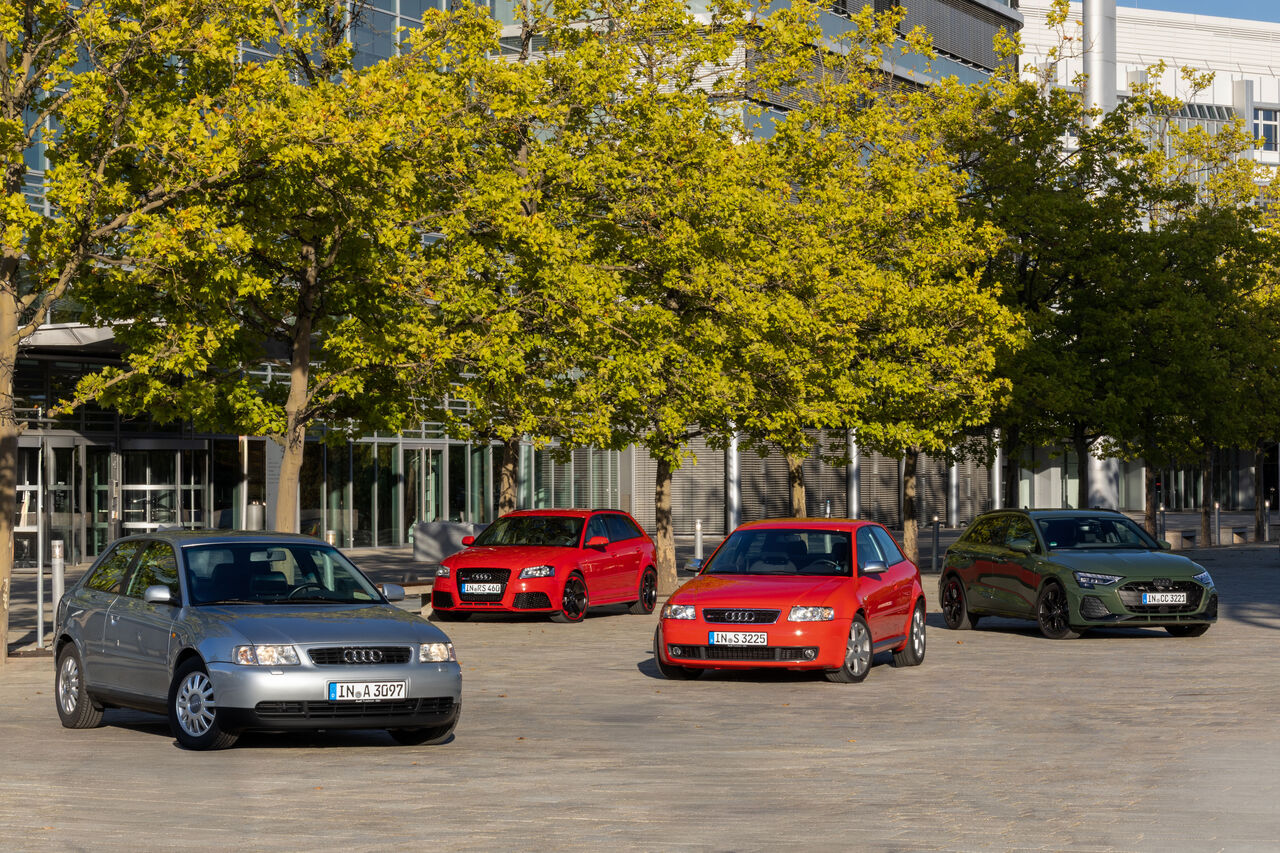


Six million units. More than 100 countries. Thirty years on the line in Ingolstadt. The Audi A3 turns 30 this year, and the numbers alone tell you this compact car punches well above its weight class.
When the A3 debuted at the 1996 Paris Motor Show, the idea of a “premium compact” barely existed. Small cars were appliances. Audi bet that buyers would pay for quality materials, sharp dynamics, and real engineering in a hatchback-sized package.
BMW and Mercedes took years to respond with the 1 Series and A-Class. By then, Audi had already defined the rules.
The first generation arrived as a three-door with a coupe-like stance, rising shoulder line, and heavy C-pillars. It looked like nothing else in the segment. By 1998, Audi had dropped quattro all-wheel drive into the compact class for the first time, using an electronically controlled multi-plate clutch designed for transverse engines.
A year later, the S3 showed up with 210 horsepower and Recaro seats. The template was set.
Each successive generation layered on technology that had previously been reserved for cars costing twice as much. The second-gen A3 brought a seven-speed dual-clutch transmission and a four-link independent rear suspension. The Sportback variant, launched in 2004, introduced the Singleframe grille that would become Audi’s visual signature across its entire lineup.
The third generation, built on the MQB platform starting in 2012, went hard on lightweight construction and digital integration. Aluminum body panels shaved weight. A retractable monitor and rotary controller brought the cockpit into the modern era.
Cylinder-on-demand technology shut down half the engine under light loads. The A3 Sportback e-tron of 2014 marked Audi’s first plug-in hybrid in the compact class, years before electrification became an industry-wide talking point.
Then came the RS 3. The 2011 original, with its 340-horsepower five-cylinder and widened carbon-fiber fenders, invented the modern hot hatch arms race. By 2016, the RS 3 Sedan was pushing 400 horsepower through a 2.5-liter TFSI.
The current version does 0 to 100 km/h in 3.8 seconds and tops out at 290 km/h. Those are numbers that would have embarrassed proper sports cars a decade ago.
The fourth-generation A3, on sale since 2020, currently offers 17 model and drivetrain variants. That range includes the allstreet crossover added in 2024, which lifts the Sportback by three centimeters and adds an SUV attitude without the SUV bulk.
The S3 got a torque splitter for its rear axle the same year, distributing power between the rear wheels individually. That is technology borrowed directly from the RS 3, filtering down through the lineup exactly the way Audi likes to operate.
Production has spread from Ingolstadt to Győr, Hungary, and for a time to São José dos Pinhais, Brazil. The Sportback remains the highest-volume body style, though the sedan has carved out strong demand outside Europe, particularly in markets where a proper trunk still matters.
Thirty years in, the A3 occupies a strange position. It created a segment that now includes fierce competition from the BMW 1 Series, Mercedes A-Class, and even Lexus. The compact premium space is crowded in a way it simply was not in 1996.
Audi’s answer has been to keep widening the A3 family rather than simplifying it, betting that variety and technology will hold the ground that novelty once claimed.
Whether the next chapter involves a full EV version remains unspoken. Audi has committed to an electric future across the brand, but for now, the A3’s current generation soldiers on with combustion engines, mild hybrids, and plug-in hybrids. The car that invented premium compact still runs on gasoline.


Share this Story