
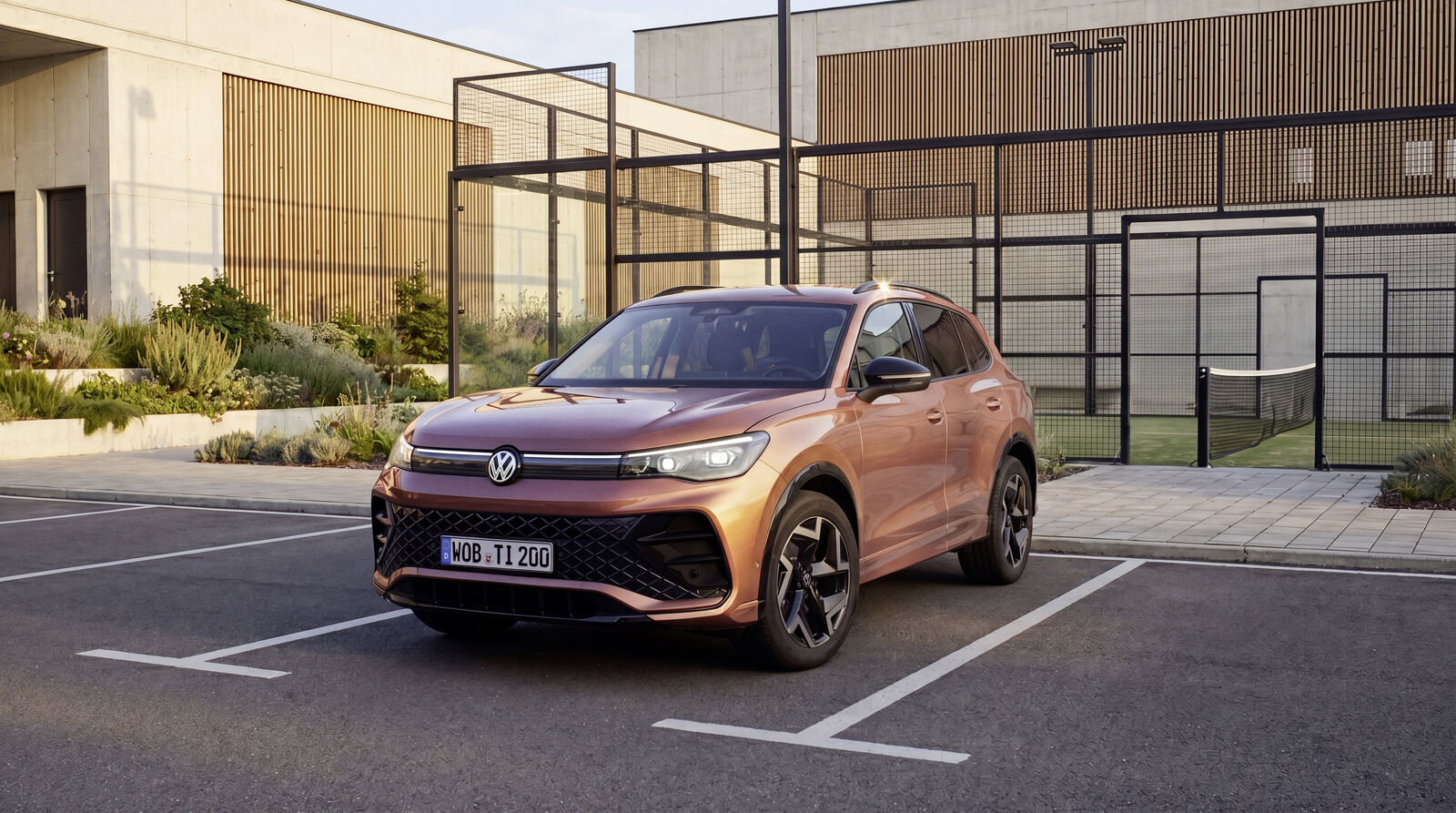


Nine million units. That’s how many Tiguans Volkswagen has pushed out the door since the compact SUV debuted in 2007, a number the automaker confirmed through the end of May 2026. To mark two decades of its most important nameplate, Volkswagen is rolling out the Tiguan EDITION 20, a special-edition model available to order now starting at 48,180 euros in Germany.
The anniversary trim is not exactly a radical departure. It’s a Life-spec Tiguan dressed up with the R-Line exterior package, 19-inch Coventry alloy wheels, darkened rear windows, red contrast stitching throughout the cabin, and illuminated door sills laser-etched with “EDITION 20.” There’s a new exclusive color called Maple Red metallic.
Logo projectors beam the anniversary badge onto the ground when you open the doors. It’s the kind of stuff that sells a few extra units without requiring any engineering investment.
But the real story here isn’t the special edition. It’s the quiet dominance of the Tiguan itself.
Since 2017, this nameplate has been the single best-selling model across the entire Volkswagen Group. Not just the VW brand — the whole group, which includes Audi, Porsche, SEAT, Škoda, and everything else. Eight consecutive years at the top of a portfolio that spans dozens of nameplates and nearly every segment.
That’s a remarkable run for a vehicle that started as a concept car at the 2006 Los Angeles Auto Show with a goofy portmanteau name voted on by readers of Auto Bild magazine.
Production tells the growth story in stark terms. Volkswagen built 120,000 Tiguans in its launch year. By 2019, annual output had climbed to nearly 911,000 units. Three factories across three continents — Wolfsburg, Puebla, and Anting — now feed demand in more than 60 countries.
The third-generation model, launched in 2024, brought a full redesign with a new cockpit, larger touchscreen, and a powertrain lineup stretching from conventional TSI and TDI engines through 48-volt mild hybrids to plug-in eHybrid variants claiming over 100 kilometers of electric range. Volkswagen also confirmed it is developing a new high-performance R variant, though it offered no timeline or specifications.
Martin Sander, VW’s sales and marketing chief, called the Tiguan “a key factor in the Volkswagen brand’s success for the past 20 years.” That’s corporate understatement. The Tiguan hasn’t just been a key factor — it has been the financial backbone of the brand during a period that included the diesel scandal, a costly pivot toward electrification, and a bruising confrontation with Chinese competitors eating Volkswagen’s lunch in the world’s largest car market.
While VW’s ID-series electric vehicles have struggled to meet sales expectations and the brand has engaged in painful cost-cutting negotiations with German labor unions, the Tiguan has simply kept selling. It’s the combustion-powered cash cow that funds the electric ambitions.
The EDITION 20 package is available across all engine options offered on the Tiguan Life trim, starting at 110 kW (150 PS). No word yet on whether the anniversary model will be offered outside Germany, though given the Tiguan’s global footprint, regional variants seem likely.
Twenty years ago, the compact SUV segment was still emerging. Toyota had the RAV4, Honda had the CR-V, and Volkswagen had nothing. The Tiguan filled that gap so completely that it redefined what a Volkswagen could be — not a people’s car, exactly, but an accessible SUV that millions of buyers worldwide decided was good enough, practical enough, and just premium enough to justify writing the check.
Nine million customers later, that formula hasn’t changed. Neither has Volkswagen’s dependence on it.
Share this Story