
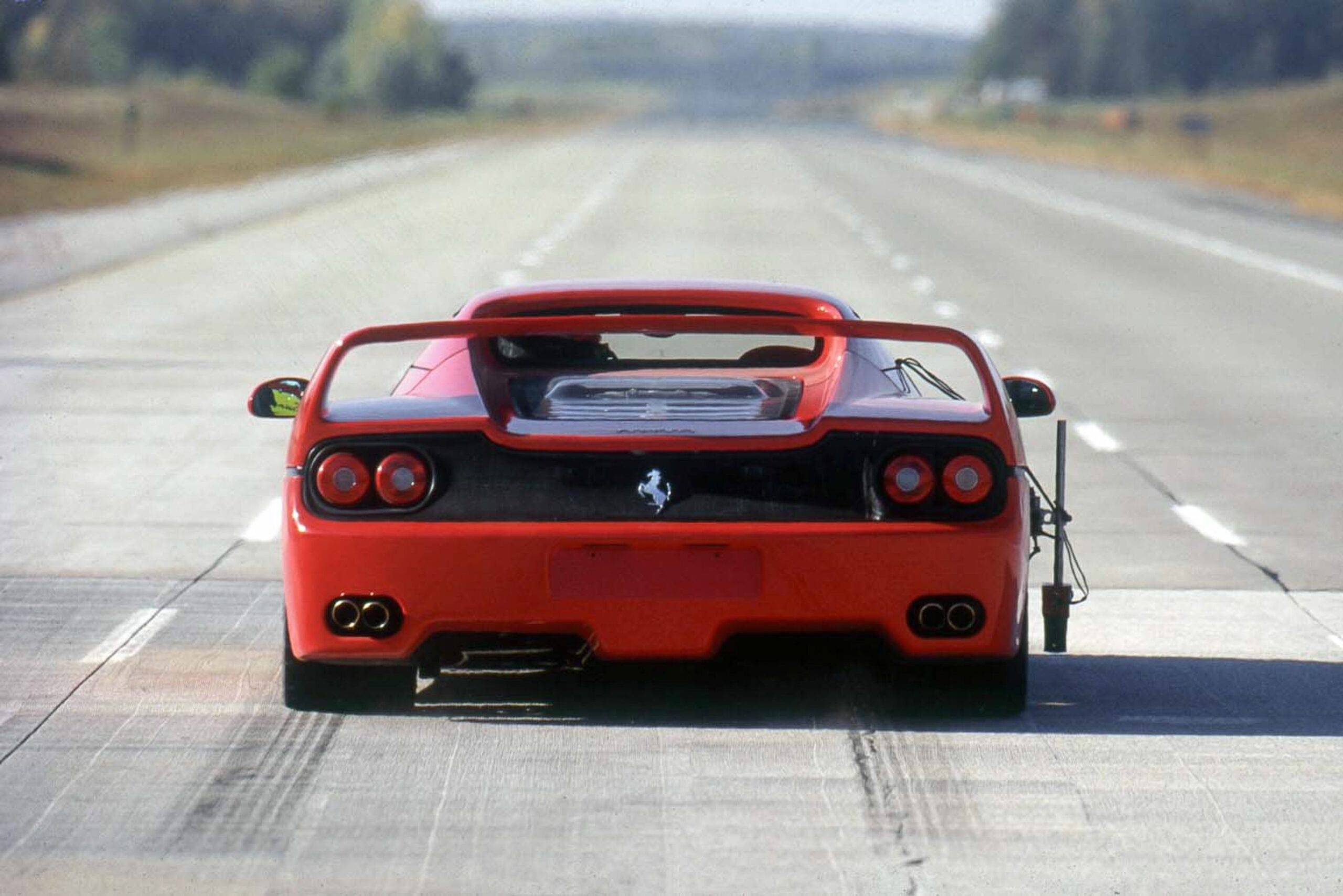


In January 1997, Car and Driver published one of the most remarkable test stories in automotive journalism history. It took 13 months, 11 reluctant owners, and one fearless racing millionaire to do what no publication in the world had done: strap timing equipment to a Ferrari F50. The results explain why Maranello fought so hard to keep it quiet.
The F50 wasn’t slower than embarrassing. It was slower than the car it replaced.
Ferrari’s mid-1990s halo car, the $560,640 V-12 successor to the legendary F40, couldn’t outrun its turbocharged predecessor. At the Transportation Research Center’s 7.5-mile oval in Ohio, the F50 topped out at 194 mph — three miles per hour shy of the F40 and eight below Ferrari’s own factory claim. In acceleration, the two cars were dead even to the quarter-mile.
Beyond that mark, the older, supposedly inferior F40 pulled away. By 170 mph, it held a half-second advantage — more than 100 feet of daylight — despite giving up four cylinders, 28 valves, and 35 horsepower. That’s a problem when your newer car costs roughly four times as much.
The lengths Ferrari went to in suppressing those numbers read like corporate espionage fiction. Car and Driver contacted all 55 U.S. F50 lessees it could find. Eleven engaged in conversation, and several eagerly agreed to lend their cars for testing.
Then, one by one, they went silent. Four stopped returning calls entirely as test dates approached. Others phoned back with sheepish confessions: Ferrari had suggested their future as preferred customers might be at risk.
One lessee laid it bare: “I buy every new Ferrari that comes out. It was suggested that if my F50 got tested, I might not be on the list of preferred customers.” Another admitted that factory tours in Maranello and private drives at Fiorano were perks he couldn’t afford to lose.
Ferrari North America spokesman Giampaolo Letta denied anyone was threatened but acknowledged the company “didn’t want a customer’s car to be tested.
The entire F50 distribution scheme was designed for control. You couldn’t buy one. You leased it — $240,000 down, 24 monthly payments of $5,600, then a $150,000 balloon — through a program administered exclusively by Ferrari North America. You filled out a questionnaire about your ownership history, your racing intentions, your loyalty.
Even then, Maranello made the final call. It was a velvet leash. And it worked, keeping owners compliant and magazines empty-handed.
Until Andy Evans.
Evans was a 45-year-old investment analyst, friend of Bill Gates, owner of Team Scandia, and the man whose IMSA Ferrari 333SP had won the constructors’ championship. When he visited the factory afterward, Ferrari asked what he wanted as a reward. He asked for the first F50 off the line.
He got chassis number 003 — a European-spec car, delivered outright, no lease. Ferrari’s loyalty apparatus had no grip on him.
When Car and Driver asked if they could test his car, Evans asked only two questions: “When?” and “Can I do the top-speed driving myself?”
On October 11, 1996, Evans arrived at the Ohio oval in a 40-foot Penske-grade transporter, wearing head-to-toe Ferrari gear and a prancing-horse cap he swapped for a helmet without a word. On his third lap, the F50 screamed through the timing lights at 194 mph, its gated exhaust bellowing 104 decibels inside the cockpit. Coolant was fizzing out by lap four.
The acceleration numbers were genuinely strong: 0-60 in 3.8 seconds, the quarter in 12.1 at 123 mph. Quicker than a Porsche 911 Turbo, quicker than a Dodge Viper GTS, five-tenths faster than a Lamborghini Diablo. But identical to the F40.
And after the quarter-mile, the older car simply walked away.
An anonymous dealer had predicted exactly this. “The F50 probably isn’t as fast as the F40,” he’d told the magazine. “I’m sure Ferrari would prefer this go unsaid.”
Ferrari preferred a lot of things go unsaid. Andy Evans apparently didn’t get the memo.
Share this Story