
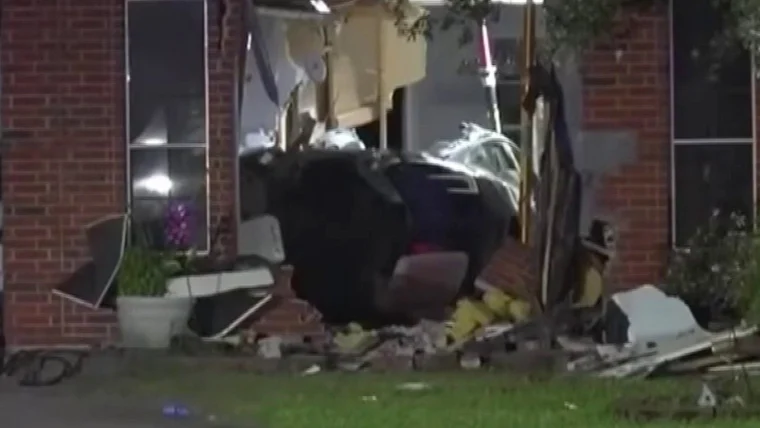


Michael Butler told investigators his Tesla was in self-driving mode when it plowed into a Houston-area home last month, killing a woman inside. Tesla’s own vehicle logs tell a different story, and now a Harris County grand jury agrees with the machine.
Butler, a DoorDash driver, was arrested Wednesday and charged with manslaughter after charging documents revealed he pressed the accelerator pedal to 100 percent while Full Self-Driving was engaged. He overrode the system’s speed control on approach to a left turn. He never touched the brake, never steered away from the curb, and the car went through it and into the home of the Avila family.
The victim’s relatives have filed a wrongful death lawsuit against both Butler and Tesla, seeking at least $1 million. But the criminal case now rests squarely on the driver, not the software.
What makes this case unusual isn’t just the vehicle data. It’s Butler’s phone. A forensic extraction revealed a trail of Google searches in the weeks before the crash that read like a slow-motion confession of frustration.
“Tesla fsd not aggressive enough 2026 model.” “FSD is not aggressive enough for city driving.” “Tesla fsd too timid.” He wanted the car to drive faster and harder, and when it wouldn’t, he apparently took matters into his own hands.
The charging documents paint a picture of a driver who had been running FSD without incident across multiple deliveries that evening. The system was working. Then, approaching a turn, Butler mashed the accelerator and held it down.
FSD’s speed control was overridden the moment he did that, by design. Tesla’s system yields to direct driver input, which is precisely the kind of human-machine handoff that keeps regulators up at night.
Tesla moved quickly after the crash to release its internal data, a PR strategy the company has deployed repeatedly in high-profile incidents. The data showed no mechanical failure, no software malfunction, and no ambiguity about who was commanding the vehicle in those final seconds. The charging documents from the Harris County prosecutor echo Tesla’s account almost verbatim.
This case arrives at a loaded moment. Tesla just expanded its Robotaxi service to Miami, its third state, and reported 480,126 deliveries in Q2, a 25 percent year-over-year jump that demolished Wall Street estimates. FSD adoption is accelerating across markets.
The company cannot afford a narrative where its software kills people, and Butler’s arrest hands Tesla something it rarely gets: a clean exoneration backed by a criminal indictment of the driver.
But the Avila family’s civil suit against Tesla will proceed on a separate track, where the legal standard is lower and the question shifts from “who pressed the pedal” to “should the system have prevented this outcome regardless.” That’s a harder argument for Tesla to win, and one the company has faced before.
Butler remained in custody through Friday without entering a plea. His next hearing is Monday.
The broader tension here isn’t really about one reckless DoorDash driver in Harris County. It’s about what happens when millions of people use semi-autonomous systems they don’t fully understand, or worse, understand just well enough to be dangerous. Butler didn’t override FSD because it confused him. He did it because he thought he knew better.
The car’s data said otherwise. So did the grand jury.
Share this Story