
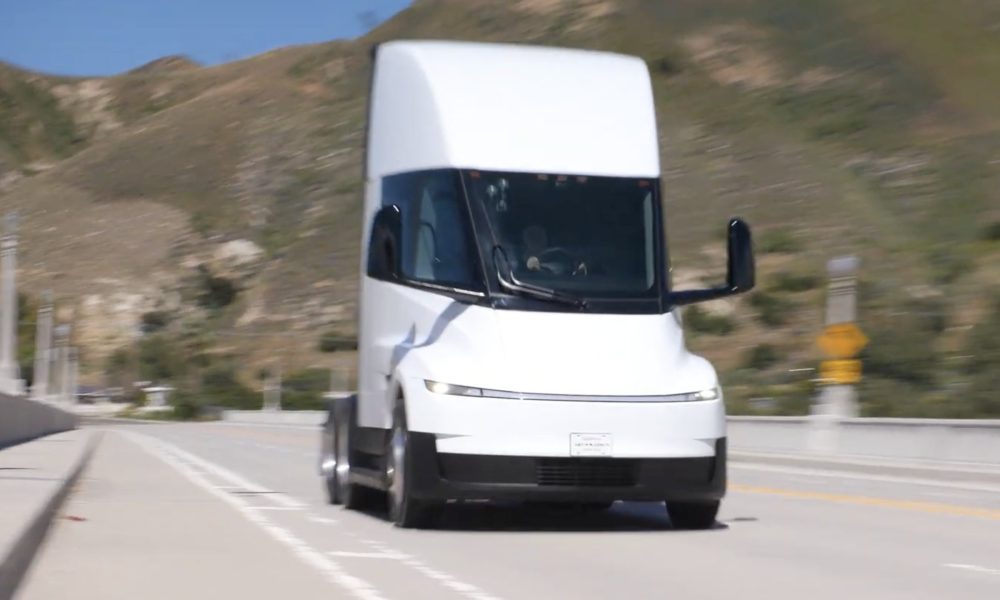


Jay Leno says driving the Tesla Semi is “like driving an office building.” That’s not an insult. It might be the most honest three-second review the truck has ever received.
In a MotorTrend interview published this week, the legendary car collector described piloting the production-spec Long Range Semi with a mix of bewilderment and genuine delight. “It’s as fast as a Tesla, but it’s like driving an office building,” he said. “You go 500 miles. You get 60% charge in 30 minutes. You’re saving on fuel costs. It seems quite good.”
The timing of Leno’s ride-along is no accident. It lands days after a California Air Resources Board filing confirmed what the industry had been guessing at for years: the exact battery capacities inside both Semi variants.
The Long Range model packs 822 kWh of usable energy. The Standard Range version carries 548 kWh. Both use NCMA lithium-ion chemistry and share a tri-motor powertrain rated at 800 kW peak and 525 kW continuous.
Cross-reference Tesla’s published efficiency of 1.7 kWh per mile under full load, and the math checks out. That’s roughly 480 miles for the big pack, around 320 for the smaller one.
Those numbers matter because they move the Semi from aspirational to auditable. CARB certification is not a press release. It is a regulatory document tied to real hardware that a state agency has independently verified before allowing the truck to operate on California roads.
Meanwhile, the factory behind all of this is no longer a construction site. Dan Priestley, Tesla’s Semi Programme Director, confirmed on April 29 that high-volume production is ramping at the dedicated 1.7-million-square-foot facility in Sparks, Nevada. The 4680 cells powering the truck are built in the same complex, which eliminates the supply chain delays that kept this program in limbo for years.
Tesla’s stated ambition is 50,000 trucks per year from that plant. That would represent roughly 20 percent of the entire North American Class 8 market. Bold, but no longer theoretical.
The economics are where diesel operators will feel the pressure. Tesla projects per-mile operating costs as low as 15 cents, compared to nearly a dollar per mile for conventional diesel rigs when fuel, maintenance, and downtime are factored in. Regenerative braking slashes brake wear, and the electric powertrain has far fewer moving parts to service.
A 370-unit, $100 million order reported just days ago suggests fleet buyers are already doing the arithmetic.
Obstacles haven’t vanished. A fully loaded tractor-trailer at 80,000 pounds will eat into that 500-mile range considerably. The Megacharger network remains thin.
The upfront sticker, estimated around $290,000 for the Long Range, is steep next to a $150,000 diesel tractor. Total cost of ownership may tilt electric over time, but that’s a hard check to write today.
Still, the convergence of events in the past two weeks tells a story that isolated headlines cannot. Confirmed battery specs from a regulatory body. A production line running at scale. A celebrity endorsement that, for once, actually communicates what the truck feels like to drive.
Leno has driven vintage Duesenbergs, McLaren F1s, and jet-powered motorcycles. He is not easily impressed, and he is certainly not easily confused. When a man with that garage says a semi-truck moves “like right now,” the diesel incumbents should pay attention.
The office building is moving. And it doesn’t need a drop of fuel to do it.



Share this Story