
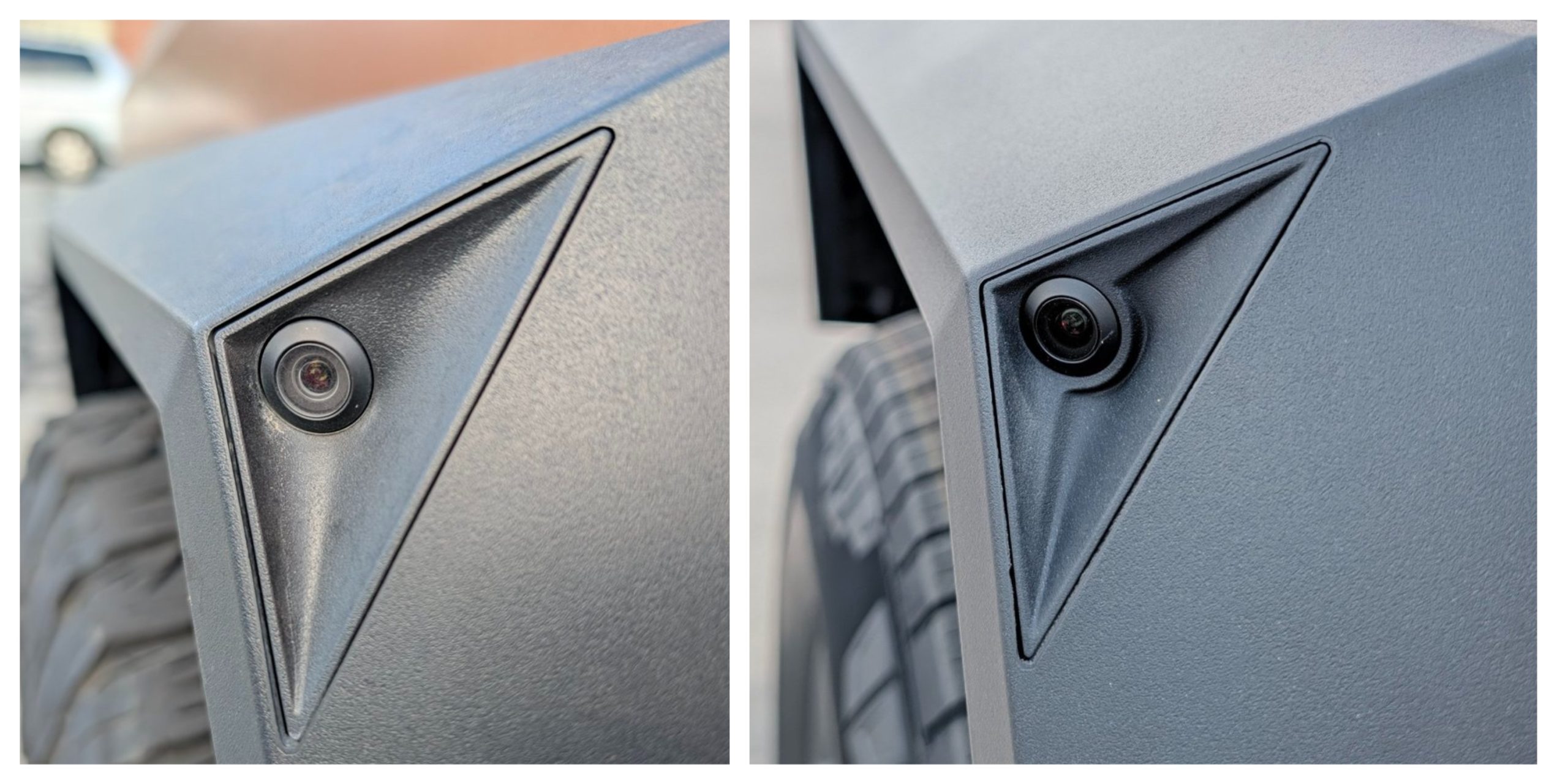


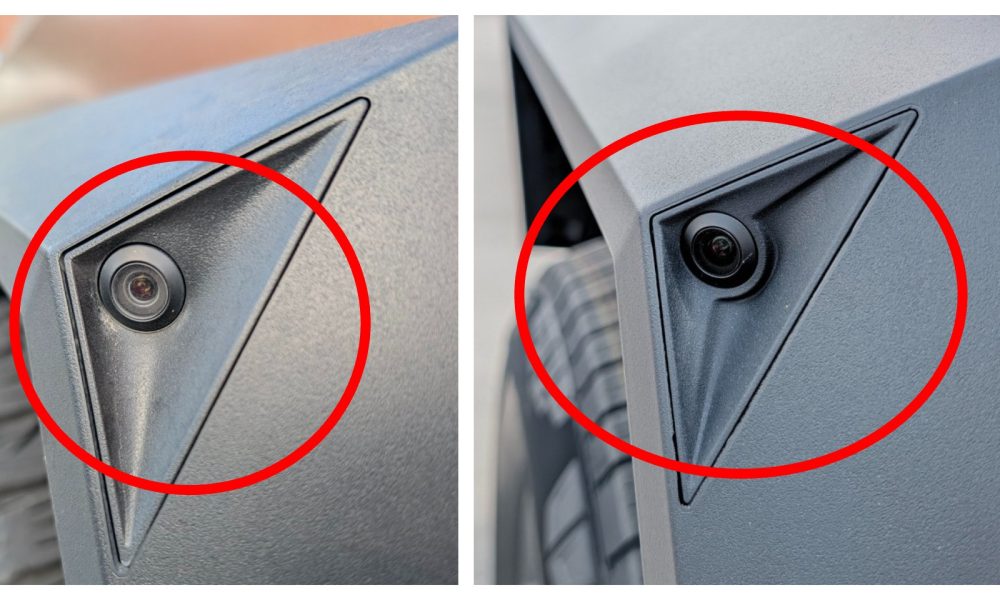
A few millimeters of reshaped plastic is doing what washers, wipers, and active spray systems do on other vehicles. Tesla’s Cybertruck lead engineer Wes Morrill posted side-by-side photos on September 8 showing a revised side repeater camera housing now in production at Gigafactory Texas. The change is already shipping on new trucks.
The triangular camera pod on each front fender looks nearly identical to the original. But a revised contour in the housing creates localized airflow disturbances that push water droplets away from the lens as the truck moves. No motors, no fluid lines, no nozzles. Morrill called it “pure vision improvement” at “no cost penalty.”
That last phrase matters. Once the production mold is swapped, every unit costs the same as the old one. Tesla added nothing to the bill of materials.
Early Cybertruck owners knew the problem well. Those exposed side cameras, mounted on flat stainless-steel panels with nowhere for water to drain naturally, collected rain and road spray like gutters. The degraded image would limit Autopilot and Full Self-Driving functions for lane changes and blind-spot monitoring. Some owners resorted to wiping lenses by hand at gas stations they no longer needed for fuel.
Tesla has used active camera washers on Cybercab prototypes and certain other models. But active systems bring hoses, pumps, fluid reservoirs, and freeze-protection headaches. Every component is a future warranty claim. The passive approach on Cybertruck sidesteps all of that by letting aerodynamics do the cleaning.
This camera fix arrived alongside another quiet change Morrill revealed the same week. The aluminum aero shield under the truck has been replaced with self-reinforcing polypropylene, a material that is lighter, cheaper, and more durable. The new shield also let Tesla refine underbody geometry for marginally better aerodynamic drag.
Neither change required a model-year rollover. Tesla does not operate on the traditional automotive calendar where improvements pile up for a fall launch. Parts get better when the tooling is ready, and the next truck off the line gets the upgrade.
Some owners who took delivery as recently as June 2026 have confirmed they already have the revised camera housing. Retrofit questions are already flooding forums. The cameras appear electrically compatible with older trucks, but Tesla has not announced a service bulletin or parts program.
These small moves tell a larger story about where Tesla is focusing engineering hours on the Cybertruck. Volume production started over two years ago. The truck’s stainless-steel body, steer-by-wire system, and 48-volt architecture grabbed all the early attention.
Now the work is granular. Cheaper underbody panels. Camera housings shaped to exploit airflow physics. A windshield protection subscription dropping from $35 to $25 a month. The base AWD model jumping to $74,990 after months at $59,990. Tesla is simultaneously trimming production costs and raising the sticker price.
What keeps the Cybertruck interesting from an engineering standpoint is this relentless incremental loop. No single change here rewrites the spec sheet. But a truck that sees better in the rain, costs less to build, and sheds a fraction more drag is a materially better product than the one that rolled off the same line six months ago.
The molds get updated, the line keeps running, and the next truck is already a little different from the last one. Morrill’s phrase sticks: a living thing, constantly evolving. Whether that evolution is fast enough to justify a $15,000 price hike is a question Tesla apparently feels comfortable letting customers answer with their wallets.

Share this Story