
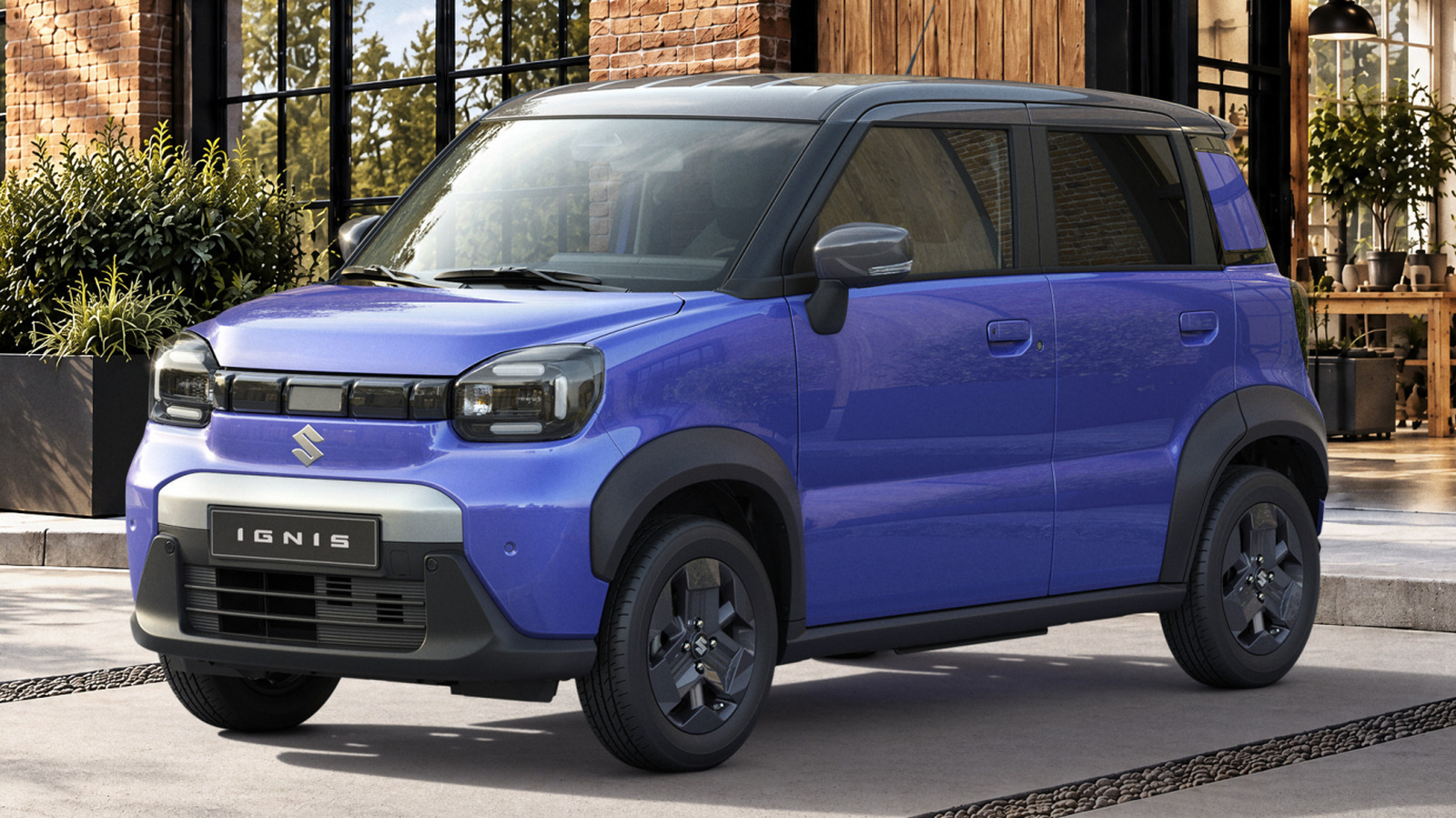


The new Suzuki Ignis is 140.6 inches long. That makes the third-generation car the smallest Ignis Suzuki has ever built, and for the first time, it will not burn a drop of fuel.
It is electric only. The platform comes almost unchanged from the e Sky, the kei car Suzuki revealed a few months ago in Japan.
Park the two side by side and you will struggle to tell them apart. The e Sky grew out of the Vision e-Sky concept, so the Ignis is a concept twice removed, stretched for export.
The stretch is modest. Freed from Japan’s kei rules, the Ignis runs 6.9 inches longer and 3.5 inches wider than the e Sky, at 61.6 inches across, and stands 0.4 inches taller.
The wheelbase stays put. Both cars ride on the same 96.9 inches, which tells you where the extra length went, and it wasn’t the cabin.
The interior confirms it. This is strictly a four-seater, and the back row looks like a cloth bench with very little around it.
The front is better furnished. Images show a driver monitoring system, a small digital instrument cluster, a prominent infotainment screen, heated front seats and two USB-C ports.
Suzuki also kept a separate climate control panel instead of burying temperature and fan speed in the touchscreen. Plenty of bigger, pricier cars have gone the other way, and their owners have been grumbling ever since.
A front-mounted motor makes 90 horsepower and 98 lb-ft of torque. The battery is a 26-kWh lithium iron phosphate pack, a chemistry picked for cost and durability rather than density.
This is where the announcement goes quiet. Suzuki has not said how far the Ignis will travel on a charge in Europe.
The Japanese e Sky is rated at 193 miles on the WLTC cycle, a decent number for so small a pack. That cycle is generous, though, and the Ignis is bigger and likely heavier, so expect a lower European figure.
Charging details are also missing. The e Sky takes DC fast charging at up to 50 kW, and the Ignis shares its bones, but Suzuki hasn’t confirmed the number.
Price is missing too. For a car this size, aimed at European city buyers, that number will decide almost everything.
The styling, at least, is settled. There’s a blacked-out grille, daytime running lights Suzuki calls “friendly,” black fenders, black skirts, a black rear bumper and clear taillights.
An antenna sits off-center on the roof. It’s a small joke, and it works.
The Ignis name has always been a survivor. The original launched in 2000, sold as the Swift in some markets including Japan, and came with 1.3-liter and 1.5-liter naturally aspirated four-cylinders in three-door and five-door forms.
Production ended in 2008. The badge sat unused until 2016, when the second generation arrived, built in Japan and India with gasoline, diesel and mild-hybrid options.
That car was discontinued earlier this year. The gap between the old Ignis dying and the new one going on sale will stretch past a year.
Suzuki says it tested the new car in Europe and elsewhere to suit buyers worldwide. A turning radius of 14.7 feet suggests it was tuned for tight old-town streets.
Sales start in summer 2027. Range, charging speed and price are still Suzuki’s to reveal, and until they are, the smallest Ignis ever remains a car with plenty left to prove.
Share this Story