
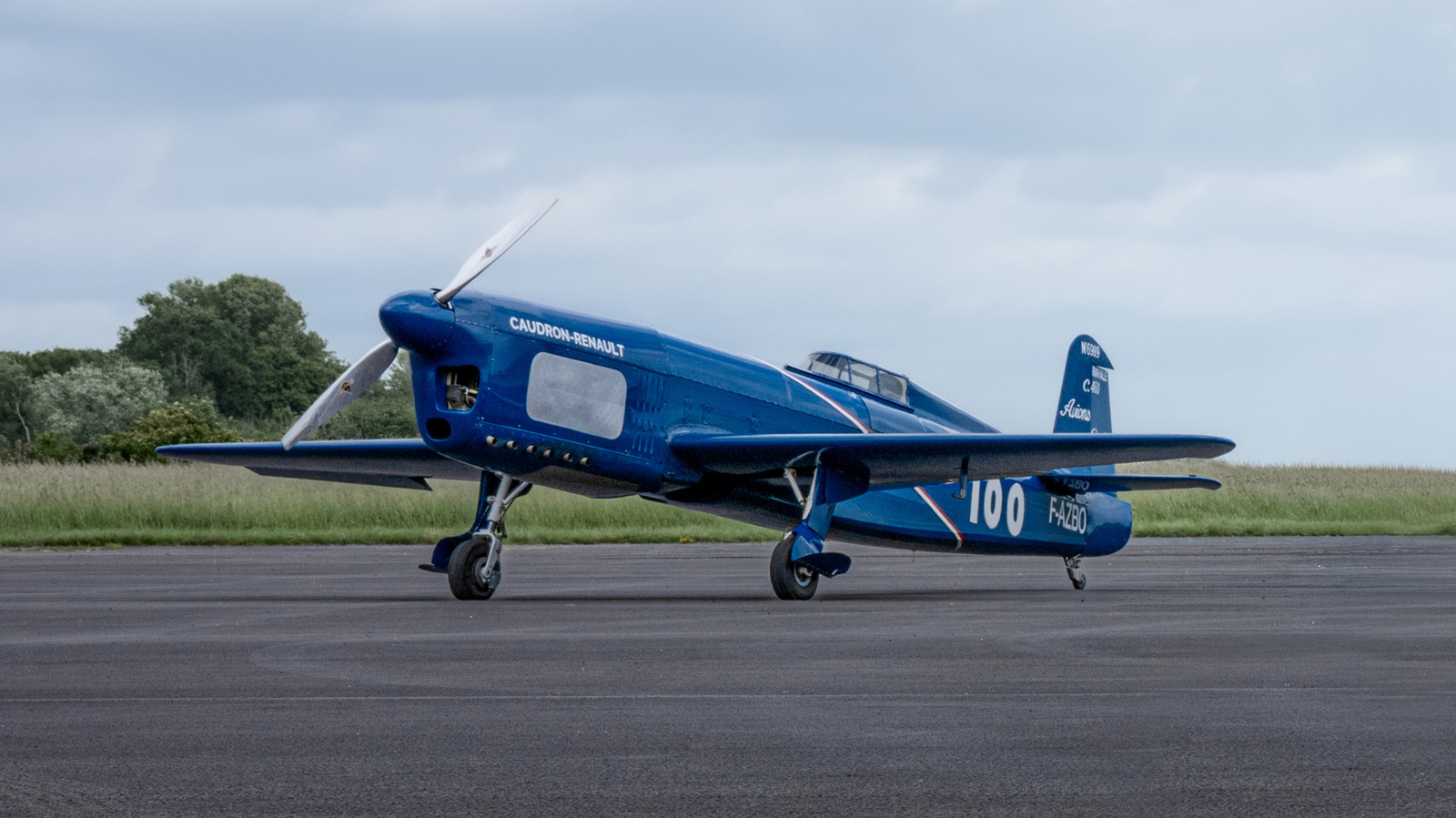


Three Caudron Rafale C.460s were ever built. One of them belonged to Renault. And nobody at Renault knew it.
The French automaker recently completed a painstaking restoration of its 1930s racing plane, a slender, plywood-and-fabric monoplane that once held the world airspeed record for light aircraft. The project was kicked off to support the launch of the Renault Rafale, a 349-horsepower hybrid crossover SUV. But when the heritage team went digging for the nameplate’s origins, they discovered something awkward: the company’s own executives had no idea Renault controlled the rights to the Rafale name through its long-defunct aviation subsidiary.
That subsidiary was Caudron, a French planemaker in which Renault acquired a controlling stake in 1933. The partnership produced some of the most aerodynamically advanced light aircraft of the era, and the C.460 was the crown jewel.
Powered by an inverted, supercharged Renault inline-six making 310 horsepower, the C.460 weighed just 1,146 pounds dry. On Christmas Day 1934, test pilot and World War I ace Raymond Delmotte averaged 314.32 mph over a regulation 1.86-mile course, shattering the light aircraft speed record. A year earlier, pioneering aviator Hélène Boucher had used a Rafale to set the overall women’s airspeed record at 284 mph.
The plane also won the prestigious Coupe Deutsch de la Meurthe and took top honors at the National Air Races in Los Angeles. Then, after 1936, it vanished from competition. Three built, none remembered.
The corporate archaeology explains why. Renault Caudron ceased aircraft production during World War II. After the war, the French government nationalized Renault.
Caudron was absorbed through a series of state consolidations that eventually fed into Aérospatiale, which itself was rebranded as Airbus in 2000. The aviation lineage got buried under decades of mergers, reorganizations, and institutional amnesia.
Renault’s heritage fleet tracked down and acquired a surviving C.460 in March 2023 and restored it to flying condition. When the Rafale crossover debuted at the Paris Air Show later that year, the 90-year-old racing plane sat on stage beside it. The juxtaposition was striking, if slightly absurd — a record-setting aircraft that once screamed past 300 mph parked next to a family hauler with a hybrid powertrain.
The marketing logic connecting a 1930s airspeed record to a mid-size crossover is thin enough to see through. Renault isn’t the first automaker to raid its own archives for borrowed glory, and it won’t be the last. But the restoration itself is genuine and admirable.
Bringing a plywood racer from the interwar golden age back to airworthy condition is not a trivial exercise.
What sticks is the corporate blindness. Renault owned the Rafale name for decades without knowing it. The plane that made the name famous — a machine that outran everything in its class, piloted by war aces and barrier-breaking women aviators — was so thoroughly forgotten that it took a marketing campaign for a crossover SUV to rediscover it.
Sometimes the most damning thing a company can reveal about itself is what it forgot it owned. The C.460 deserved better than to be a footnote in an SUV launch. At least now it flies again.
Share this Story